AI Won't Give You 20 Hours Back. It Gives You About 5.

You read the headline. Some vendor promised you twenty hours a week, your weekends restored, an assistant who never sleeps, all for $30 a month. Then you bought the tool, handed it to your team, and waited for the time to appear. It did not appear, and now the subscription is a line item nobody defends.
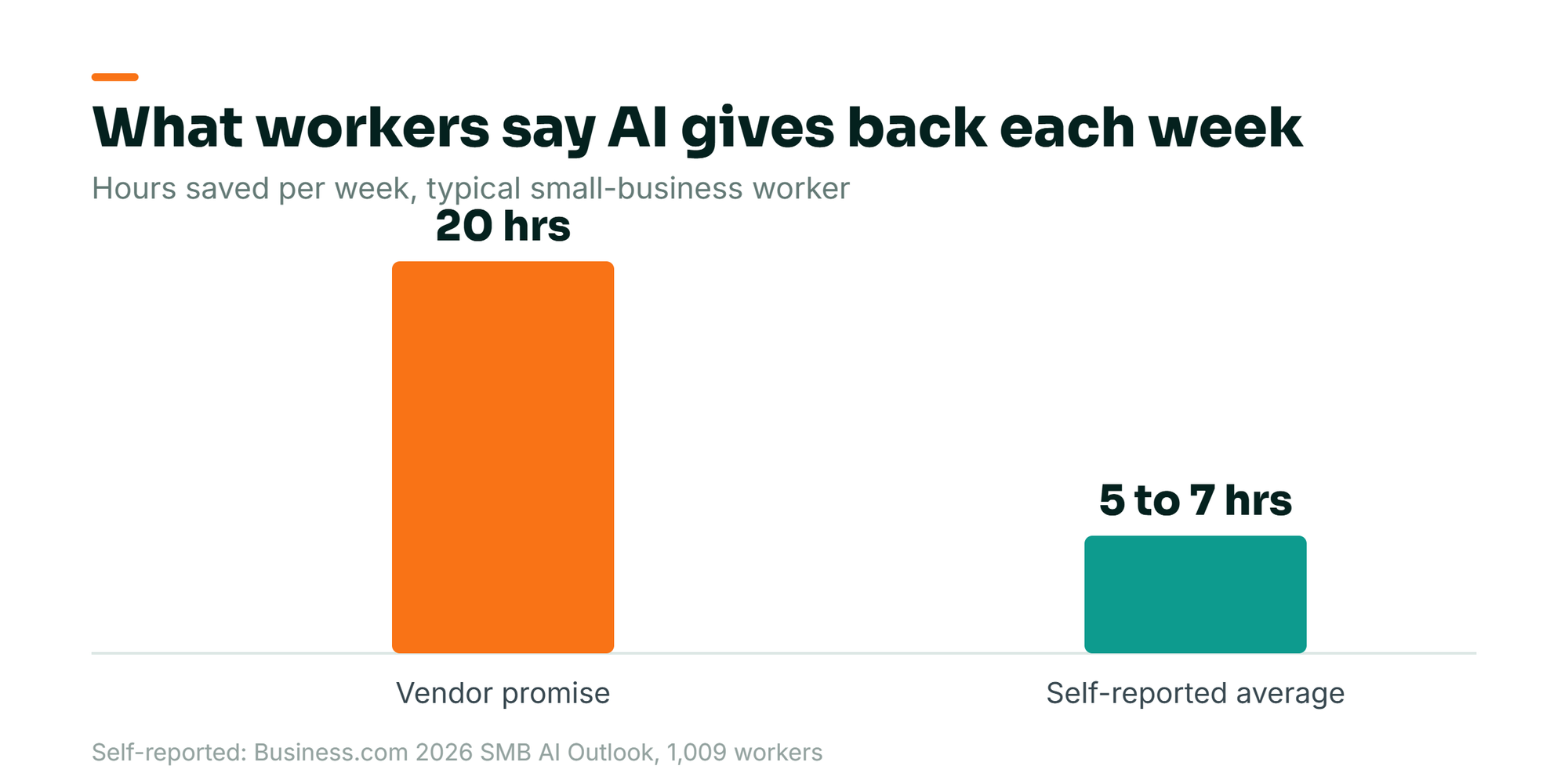
Business.com asked 1,009 small-business workers what AI saves them, and the answers came back at five to seven hours a week. Twenty is the vendor number. Five is what workers said, and a careful trial on experienced software developers found that people who felt faster were measurably slower. Your own number shows up only if you learn one tool yourself, rebuild one task around it and time that task. Buying software and hoping is not a plan.
A worker survey puts the number at five hours, and your job title decides how many you get
Start with the data. The Business.com 2026 Small Business AI Outlook Report was published in January 2026. It surveyed 1,009 workers at firms under 250 employees and found the average SMB worker reports saving 5.6 hours a week using AI. Call it most of a Friday afternoon, every week. It is also less than a third of what the louder promises imply. The survey asked workers what they saved. Nobody timed them.
The average hides the part you need. That same report found managers report saving 7.2 hours a week while individual contributors report only 3.4. The gap is not random. The people who decide what work matters, who shape the process and who know what "good" looks like report more than double the return of the people just executing tasks. The hours pool around whoever directs the work. If you do the directing, they pool around you.
Run the numbers on a four-person marketing agency. It buys five AI seats at roughly forty dollars a month each, hands them out and tells everyone to use AI more. The staff are individual contributors getting 3.4 hours each, and nobody redesigns a single process. The agency spends twenty-four hundred dollars a year to recover time people then spend polishing things that did not need polishing. The tool works. The plan does not exist.
Owners chase the twenty-hour fantasy because the five-hour reality requires them to do the work
Twenty hours is a better story than five. It justifies a bigger purchase, a company-wide rollout, even a new hire. The five-hour number asks something harder of you: it asks you to sit down and learn the tool yourself before you delegate anything. Most owners would rather write a check than spend a week being a beginner again.
The spending data shows the avoidance in motion. The Business.com 2026 report found 57% of US SMBs are investing in AI in 2025, up from 42% in 2024 and 36% in 2023. On the survey answers, the money is moving fast. But only 24% of firms with one to nine employees invest, against 45% of firms with ten to forty-nine and 75% of larger SMBs. The smallest businesses, the ones where the owner does everything, stay out. That is rational if your only model is "buy a tool and hope," because at that size there is no IT person to hand it to. It stops being rational the moment you realize the owner learning one tool is the whole play.
There is a quieter sign that owners know the answer is people, not products. The same survey found only 18% of SMBs say they are highly likely to hire someone specifically to use AI, while 64% plan to train existing staff instead. Read that as a near-consensus: the return comes from a human who already understands your business learning a new tool, not from a specialist parachuting in. The owners are right about that. Most of them just have not started the training, including their own.
Why AI feels faster even when the stopwatch says slower
The five-hour figure comes from asking people how much time they think they saved. A careful study of that exact gap points the other way. METR, a research group, ran a randomized controlled trial published in mid-2025 on experienced open-source developers using early-2025 AI tools. They took 19% longer to finish tasks with AI than without it. The confidence interval ran from 2% to 39% slower.
These were not beginners. They knew their codebases cold. They expected AI to speed them up, and after the tasks were done they still reported that it had. They felt faster while the stopwatch said slower. Put a price on that. Say a developer earning the equivalent of $100 an hour believes AI saved an hour on a task that actually cost twelve extra minutes. The business banked no $100 saving. It quietly added about $20 of cost and wrote it down as a win.
Part of the gap is memory. The nine-second draft that went over well sticks. The three rewrites, the invented fact you caught and the tone you had to fix all fade. Part of it is comfort. Once you have a shortcut, the old way starts to feel heavier even when the shortcut is slower.
The old fashioned way now felt "like trying to get across the city walking when all of a sudden I was more used to taking an Uber," one METR participant said. He said it in a trial where the measured result was a slowdown. He is describing how the manual way feels now. The clock is a separate question. Owners hear that kind of enthusiasm from their teams and log it as time saved.
Between 30% and 50% of the METR participants declined to do certain tasks at all without AI. A tool that measurably slowed experienced workers is a tool they would not give up. If your team fights to keep a tool the stopwatch says is slowing them down, the value is real. It lives somewhere other than the five hours: less mental strain, fewer blank-page starts, a Friday task that gets finished instead of pushed to Monday. Those can be worth paying for. Give them their own line in the budget.
METR is just as careful with the numbers that flatter AI. Its May 2026 survey of 349 technical workers found a median self-reported value gain of 1.4x to 2x, and METR cautioned that the magnitude is likely overstated. Its February 2026 follow-up on developer speed could not separate a slowdown from a speedup, because the range around both of its estimates crossed zero. METR calls its central estimate "likely a bad proxy" and announced a redesigned experiment. I went through those numbers, and the headlines that misread them, in the piece on the AI work you only do because it got cheap.
The 19% comes from one careful trial, and that trial was on coding. It does not map one to one onto answering phones, writing intake notes or drafting invoices. What carries over to your business is the gap between felt speed and measured speed. Your own log is where you check it.
The same belief gap shows up across the whole economy. The Federal Reserve's April 2026 FEDS Notes, "Monitoring AI Adoption in the U.S. Economy," put actual firm-level AI adoption near 18% at the end of 2025. Vendor surveys asking whether companies were "investing in or using" AI put the figure around 57%. Same economy, two numbers, a 39-point spread. Every survey figure in this article is an answer people gave, and that includes the Business.com numbers.
Spending without a measured return repeats one level up, in companies large enough to run formal pilots. The enterprise numbers are the clearest evidence yet that buying big does not buy results.
Ninety-five percent of corporate AI pilots show no measurable profit impact
The companies with budgets you will never have are failing at this in public. The MIT NANDA report "The GenAI Divide: State of AI in Business 2025" was reported by Fortune on August 18, 2025. It drew on 150 leader interviews, a 350-employee survey, and 300 public deployments, and found about 95% of enterprise generative-AI pilots deliver no measurable profit or loss impact. Only about 5% achieve rapid revenue gains. These are organizations with data teams and seven-figure budgets, and nineteen of twenty get no measurable return.
"The 95% failure rate for enterprise AI solutions represents the clearest manifestation of the GenAI Divide."
MIT NANDA report, quoted in Fortune, August 18, 2025.
If a bank can light a million dollars on fire chasing this, your forty-dollar subscription is not the problem. The plan is. And the same study points straight at the cheaper plan that works. MIT NANDA found that buying AI tools from specialized vendors succeeds about 67% of the time, while building your own internally succeeds roughly one-third as often. In plain terms: the off-the-shelf chatbot you can start using this afternoon beats the custom system a consultant wants to build you, by a factor of three. Spend zero on custom. That comes straight from the data.
The "build your own" temptation has a newer, more dangerous face: letting AI write the software for you. A Tenzai study conducted in December 2025, reported by CSO Online on January 14, 2026, tested five leading AI coding tools and found 69 total vulnerabilities across 15 sample apps, several rated critical. The researchers explained why.
"[Code generated by AI] agents seems to be very prone to business logic vulnerabilities. While human developers bring intuitive understanding that helps them grasp how workflows should operate, agents lack this 'common sense' and depend mainly on explicit instructions."
Tenzai researchers, quoted in CSO Online, January 14, 2026.
The engineer Addy Osmani framed the same limit a different way in his 2025 writing on AI's "70% problem." AI quickly produces about seventy percent of a solution, the scaffolding and the obvious patterns. The last thirty percent is the edge cases, the debugging, the security, the production integration. That part stays exactly as hard as it always was and still needs a human who understands the system. That last thirty percent is where the 69 vulnerabilities live. For a non-technical owner, the lesson is simple: use AI to do work you can read and check, not to build software you cannot. If you want the longer version of that argument, I made the case that AI coding is a force multiplier you still have to steer.
How to measure AI time savings on one task
Everything above points to one move. Time one task without AI for a baseline week, then give it one AI tool for a month. The researcher Ethan Mollick has argued the practical version of this for a while in his One Useful Thing writing. You do not need a data scientist or a computer science degree to benefit from AI. You need to pick one painful process, apply one tool, and measure one metric.
First, name the single task that eats the most of your week. Not the most annoying one, the most expensive one in hours. Writing proposals. Answering the same fifteen customer emails. Turning meeting notes into follow-ups. Drafting listings. Pick one that repeats, ideally a few times a day. The narrower and more frequent the task, the cleaner the answer.
Then spend one week doing it the old way, before any AI touches it. Log the minutes each time it happens and count how many times it happened. That before number is the only baseline you will get. Do not skip it.
Second, pick one off-the-shelf chatbot and only one. ChatGPT, Claude, or Gemini. The free or twenty-dollar tier is fine. Do not compare three tools, do not read reviews for a week, do not buy anything custom and do not let anyone sell you a "bespoke AI solution." You are testing whether the tool plus your judgment beats your current process on one task. That is the entire experiment.
Third, you learn it, not your team. For thirty days, you run that one task through that one chatbot yourself. The manager-versus-contributor gap from the Business.com data is the reason: the person who knows what good output looks like extracts double the hours. That person is you. When the draft is wrong, you will know why, and teaching the tool to fix it is the skill you are actually building. This is the part most people skip. It is also the part I keep coming back to, because the real AI advantage is management skill, the ability to direct the work, not the software license.
Fourth, log the month the same way you logged the baseline week. Write the minutes down as each occurrence happens. A guess made at 6 p.m. is just another self-report, and you now know how those read. Every minute spent editing, fact-checking or rewriting the AI output goes in the AI column. This is where the METR slowdown was hiding. The draft arrives fast. The cleanup is the cost.
Keep it to that one task. No company-wide rollout and no second use case. If you spread it across the team on day three, you will get the 3.4-hour contributor result and a pile of mediocre output. Then you will conclude AI does not work, when what failed was the rollout. One task, one tool, one person, thirty days.
Fifth, on day thirty, compare minutes per occurrence before and after, rework included. Convert the difference to money at a real hourly rate for the person doing the work. Say AI saves eight minutes per occurrence and the task runs twenty times a week at a $40-an-hour loaded cost. That is about 2.7 hours and roughly $107 a week. Over a year it comes to close to $5,500.
| What you log | Worked example |
|---|---|
| Minutes saved per occurrence, rework counted | 8 |
| Times the task runs each week | 20 |
| Hours back each week | About 2.7 |
| Loaded hourly cost of the person doing it | $40 |
| Value each week | About $107 |
| Value over a year | Close to $5,500 |
Judge the task against its own baseline week. If the minutes per occurrence fell and stayed down once rework was counted, the saving is yours and you can price it the way the table does. If the saving shrinks or disappears once rework is counted, this task is part of someone's hard thirty percent. You learned that for the price of a month of notes.
Keep the survey figure in proportion. The 5.6 hours is what the average worker reported across a whole week of AI use. Your one task is a single slice of that week, and the slice in the example above is worth close to $5,500 a year.
Measure recovered hours and what you did with them, not prompts typed or logins counted
The trap at the finish line is counting the wrong thing. Vendors love usage metrics: messages sent, prompts run, seats active, "engagement." None of those tell you whether you got time back. A team can run two hundred prompts a day and save zero hours if every prompt produces a draft someone rewrites from scratch. Count hours on the task, before and after. That is the metric. Everything else is decoration.
Speed-to-first-draft is the sneakiest of the usage numbers, because it is real and it feels like the finish line. A draft in nine seconds that takes eleven minutes to fix is slower than a careful draft in six. Time the finished thing.
There is a deeper trap behind the obvious one. Saved time is the input. The goal is what you do with it. Five hours back is worth very little if those five hours go to busywork, or to polishing things no customer notices, or simply to leaving early on the days you would have anyway. The only number that ends up on your books is what those hours produce: more proposals sent, faster quote turnaround, an extra service you finally have time to launch. I have argued this point hard, that getting faster is not the same as making money. After the thirty-day test, run one more week where you track where the recovered hours actually went. If they vanished, the experiment is not finished. You still have to redirect those hours.
Take a physio clinic front desk that uses AI to draft replies to patient intake questions. It feels faster, and the drafts look polished. Run the test anyway. Does the phone get answered sooner now, or does the receptionist spend the saved minutes proofreading AI text while a caller rings out to voicemail? Did more appointments get booked this month, or the same number with less typing? A booked appointment is revenue. A cleaner-looking draft is a draft.
This connects to the one statistic that explains why so few businesses ever see results. McKinsey's "The state of AI" report from March 2025 found only 21% of organizations using generative AI have redesigned any workflows. McKinsey's follow-up survey published in late 2025, covering 1,993 respondents across 105 nations, found high performers are about three times more likely to have fundamentally redesigned how the work flows. The tool alone changes little. Redesigning one process around it, which is exactly what your thirty-day test forces you to do on a small scale, is the thing that separates the 21% from everyone else. Measure the redesign, not the downloads.
One last vanity trap, because owners fall for it constantly: do not measure how impressed you are. AI output reads well. It is confident, fluent, and frequently wrong in ways that look right. "It wrote a great email" is not a metric. "It cut my email time from four hours to ninety minutes and the replies still convert" is. Hold the tool to the same standard you would hold a new hire after thirty days, and judge it on output and hours, not on how clever it sounds.
Frequently Asked Questions
How many hours a week can AI realistically save my small business?
Surveyed small-business workers report about 5 to 7 hours a week, not the 20-plus that ads promise. The Business.com 2026 SMB AI Outlook Report put the self-reported average at 5.6 hours, but the split matters: managers reported 7.2 hours while individual contributors reported only 3.4. The owner who learns and directs the tool gets the high end. Treat any promise above ten hours a week as a sales number until you measure your own.
How do I actually measure AI time savings without special software?
A timer and a notebook are enough. Pick one task that repeats often and log the minutes per occurrence for a week the old way, then for a month with one AI tool. Write the minutes down as they happen instead of guessing at day's end. Every minute of editing and fact-checking goes in the AI column, since that rework is where the cost hides. Multiply the difference by a real hourly rate to see the money.
Why does AI feel faster even when it might not be?
Memory keeps the good runs and drops the bad ones. The nine-second draft sticks while the three rewrites fade. The manual way also starts to feel heavier once you have a shortcut, which reads as speed even when the clock disagrees. A METR trial published in 2025 found experienced developers felt AI sped them up while it actually slowed them by 19%. The feeling is real. It measures comfort. Saved time needs a stopwatch.