Your Ranking Is Fine. Your Phone Disagrees.

Your rank-tracking report says position two in the map pack. Has been for six months. Yet you are looking at your call log and something feels off. The phone is quieter. Not dead, just quieter, in a way that does not match the report. This article is not going to tell you local SEO is dying. It is going to tell you that the metric you have been watching is no longer the metric that controls your revenue, and the data proves it.
The Google Business Profile you spent years building is still visible. What changed is how much of the screen is left for it, who else shows up in AI-generated results, and where the call button is sitting relative to four paid placements. Those three things together explain the quiet phone. Each one is documented. None of them require you to panic.
The Metric Every Owner Watches Is No Longer the Metric That Pays Bills
Fifteen years of SEO audits teach you to recognize a specific pattern: visibility holds while outcomes erode. You saw it when featured snippets started eating clicks. You saw it when the knowledge panel pushed everything down a screen. This round is faster and the data is sharper.
Jepto analyzed 179 Google Business Profiles across 34 US law firms over two years and found that mobile call-icon clicks were declining even in accounts where rankings held steady. The decline was mobile-specific. Desktop call behavior did not drop the same way. That distinction matters because the mobile screen is where Google has been most aggressively adding paid placements above organic results, and the Jepto data showing mobile call-icon clicks declining while desktop held steady suggests those placements are doing real work at the exact moment someone is ready to call.
This is not a gut feeling or an agency narrative. The attribution gap between what your SEO metrics report and what actually drives revenue is measurable, and in local search it is widening in a specific direction: toward paid placements and away from the organic pack you are tracking. If your agency's monthly report leads with "you're holding position two," ask them what happened to your GBP call clicks over the same period. That question tends to produce a different conversation.
Google Shrank the Organic Surface and Expanded the Paid One. At the Same Time.
Sterling Sky's May 2026 state of local SEO report, by Joy Hawkins, published the numbers that put this in concrete terms. Local pack ads grew from roughly 1% of mobile search reports in early 2025 to approximately 22% by December 2025. Local Services Ads went from 11% to 31% of tracked queries over the same period. That is not a gradual shift. That is Google tripling and doubling paid real estate in under a year.
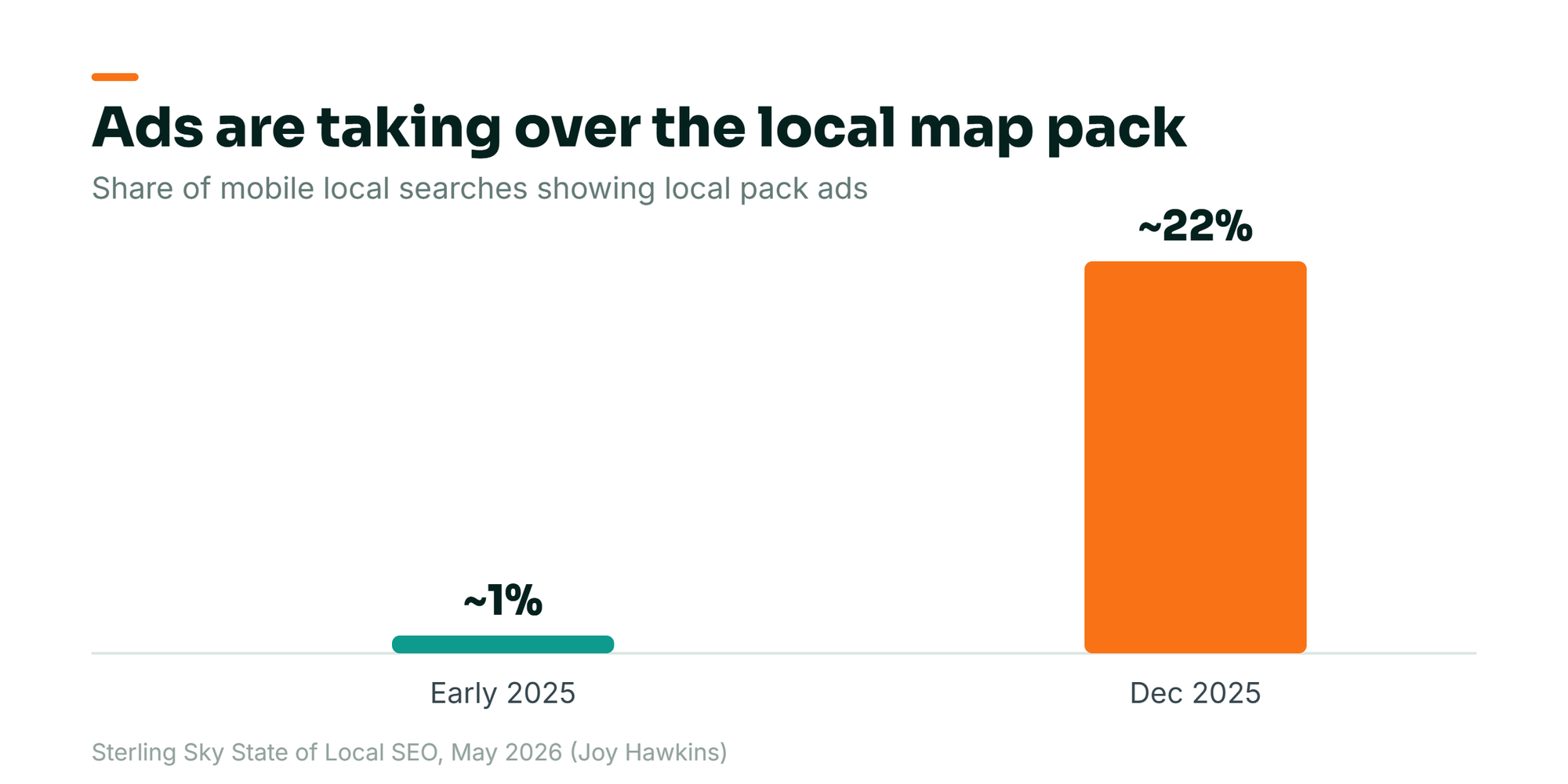
Run that math against a plumber in Phoenix. Twelve months ago, she opened a phone browser, searched "emergency plumber near me," and the first organic business she saw was maybe 200 pixels down the page. Today she might scroll past two Local Services Ad slots and two standard local pack ads before she sees any organic result. Your position-two ranking is still position two. It is just four units further from where her thumb lands.
This is worth naming clearly: Google is a publicly traded advertising company. The incentive to add paid placements is not going away. Every business owner who is still treating the map pack as free, reliable traffic needs to rebuild that assumption.
AI Local Packs Are a Different Problem Entirely, and They Show Fewer Businesses Than You Think
The paid-placement squeeze is the known problem. The AI local pack is the newer one and the data on it is more alarming for small businesses.
Joy Hawkins at Sterling Sky, using Places Scout data, found that AI local packs currently appear on roughly 7% of tracked keywords. That might sound small. It is not, if those keywords happen to be your highest-intent queries. And the composition of those packs is what should concern you.
"When Places Scout analyzed our recent ranking reports, it found that AI local packs featured 5,943 unique businesses whereas, regular 3-packs featured 18,330."Joy Hawkins, Sterling Sky, May 2026
That is 32% as many businesses getting any visibility at all in the AI format. Hawkins put a precise figure on the geographic spread too:
"AI local packs are only surfacing about 32% as many businesses as traditional 3-packs."Joy Hawkins, Sterling Sky, May 2026
"In the 322 markets we looked at, 88% had fewer unique businesses in the AI local packs than traditional local packs."Joy Hawkins, Sterling Sky, May 2026
Standard 3-pack: three slots. AI pack: one or two. And they are often different businesses than the ones in the regular pack. This is not a visibility upgrade for the businesses who make it in. It is an elimination event for the businesses who do not. If you currently rank in positions one, two, or three of the traditional map pack, you have no guarantee that maps to any presence in the AI pack. The businesses appearing in AI packs were pulled through a different signal set, and most practitioners do not yet have a clean picture of exactly what that set is.
For a deeper look at the five-stage filtering system your content moves through before it ever surfaces in AI search results, the breakdown of how AI search systems actually filter and rank content is worth your time before you adjust strategy.
One more number from Sterling Sky that is easy to misread: ChatGPT referral traffic for one large multi-location client went from 0.1% of Google traffic to 2% over the past year. That sounds like growth. It is still only 22% of Bing's referral volume for the same client. AI search is real and it is compounding. It is not yet a primary traffic source for most local businesses. Do not restructure your entire operation around it. Do reckon with it, specifically.
What to Do This Month, Without Calling a Developer
Joy Hawkins offered five recommendations in her May 2026 report. Three of them are doable without technical help. In practice those actions look like this.
Pull your GBP insights and find the call-click trend. Log into your Google Business Profile dashboard. Under "Performance," look at calls over the past 18 months as a trend line, not a snapshot. If calls are declining while your rank-tracking report says nothing changed, that gap is your real problem statement. This takes fifteen minutes and does not require an agency.
Write one piece of content your competitors have not written. Hawkins' first recommendation was to create content competitors have skipped. This is not generic blog advice. It means opening a competitor's site right now and finding the specific question they do not answer. A HVAC company in Austin that has not answered "how long does an AC replacement actually take, hour by hour" is leaving a clear lane open. One thorough answer, properly posted to your GBP and your website, is more durable than ten thin posts.
Get serious about Google's verification badge. Local Services Ads now show on 31% of tracked queries. If your category qualifies for LSA, the Google Screened or Google Guaranteed badge appears above standard ads. Apply for it. The process involves a background check and license verification. It takes two to four weeks. The cost is pay-per-lead, not pay-per-click, which means you pay when someone contacts you, not when they see the ad. For high-intent verticals like legal, home services, or healthcare, this is now table stakes.
Add your business explicitly to platforms AI systems pull from. Hawkins recommends building expertise and presence on YouTube and Reddit. The reasoning is not that these are great traffic sources on their own. It is that AI systems, including Google's, use these platforms as evidence of expertise and authority when assembling AI pack results. A roofing contractor with five genuine YouTube walkthroughs of past jobs has a signal set that a competitor with only a GBP listing does not. This takes time, not money.
Start tracking AI traffic separately in your analytics. Hawkins' fifth recommendation is to monitor AI-driven traffic. In Google Analytics 4, you can set up a custom channel grouping that isolates referrals from ChatGPT, Perplexity, and similar sources. This number will be small today. Establish the baseline now. A year from now, when it matters more, you will have trend data instead of a single confusing number.
The Vanity Metric Trap, and What to Watch Instead
Rank-tracking reports are not fraudulent. They measure what they measure accurately. The problem is that map pack position is no longer a reliable proxy for phone calls, direction requests, or booked jobs. It was a reasonable proxy five years ago. It is not now.
Track these instead, and note why each number connects to actual revenue. GBP call clicks, week over week, is the direct line: fewer clicks means fewer calls means less revenue, full stop. Direction requests tell you whether people are driving to your location, useful for any business that depends on walk-in or on-site visits. Website clicks from GBP show whether your profile is still generating top-of-funnel interest even when calls drop. If website clicks are holding but calls are down, the problem may be inside your website or your call-to-action, not your GBP.
The Google May 2026 core update is still settling as of early June, with reported local volatility across multiple categories per Search Engine Roundtable and Search Engine Land coverage. This is not the time to make dramatic changes to your site. It is the time to watch the data and not mistake update-period fluctuations for permanent trend shifts. Give it another three to four weeks before drawing conclusions from anything that changed in mid-May.
The honest question to hold right now is not "will AI kill my local SEO?" Most businesses are not going to feel a catastrophic drop. The question is whether you would survive being one of the two businesses an AI pack surfaces, or neither. The zero-click panic is a publisher problem, not a local service business problem, and the two should not be treated as the same situation. Your customer is still searching. They still need someone to show up. The shift is in which signals determine who that someone is.
Stop paying for the report that confirms your ranking is fine. Start pulling the report that tells you whether that ranking is producing any behavior at all.
Frequently Asked Questions
Why are my Google calls down if my map pack ranking hasn't changed?
Ranking position and call volume are no longer reliably connected. A Jepto analysis of 179 Google Business Profiles across 34 US law firms, tracked over two years, found that mobile call-icon clicks declined even when rankings held steady. The most likely culprits: local pack ads now occupy more screen space than they did a year ago, AI local packs are showing different businesses and fewer of them, and Google's interface has changed how prominently the call button appears on mobile. Your rank stayed put. The screen real estate around it did not.
What is an AI local pack and how is it different from the regular 3-pack?
An AI local pack is a results unit Google generates using its AI overview technology rather than pulling directly from the standard map pack algorithm. Instead of three businesses, it typically shows one or two, and they are often different businesses than the ones ranking in the regular 3-pack. According to a May 2026 Sterling Sky analysis using Places Scout data, AI local packs appear on roughly 7% of tracked local keywords and surface only 32% as many unique businesses as traditional 3-packs do. If you are not in those two slots, you are invisible in that result entirely.
Should I start running Google Ads for my local business?
It depends on your margin and your current organic footprint. Local pack ads grew from roughly 1% of mobile search reports in early 2025 to around 22% by December 2025, and Local Services Ads went from 11% to 31% of tracked queries over the same period, according to Sterling Sky's May 2026 state-of-local-SEO report. That means paid results now dominate above-the-fold real estate in many categories. If you are in a high-intent vertical like plumbing, legal, or roofing and organic visibility is sliding, ads are no longer optional. Start with Local Services Ads if you qualify; they show above standard search ads and carry Google's verification badge.
Every business owner I have talked to in the last six months has been watching their rank. Almost none of them have been watching their call click trend. Those are two different stories, and right now they are diverging fast enough that the gap has a dollar value. The question is when you want to find out what that dollar value is.