AEO vs SEO: What Changed in 2026 and How to Handle Both

If you own a website, someone has probably told you in the last six months that SEO is dead and you need AEO now. Or GEO. Or LLMO, depending on which newsletter got to you first. Most of that advice is repackaged panic. Acting on it without understanding what actually changed will cost you money in two directions: paying for "AI optimization" you don't need, and abandoning search fundamentals that still drive most of your revenue.
I've been doing SEO for 15 years, and I'll tell you exactly where the line sits. Some things genuinely changed. Most things didn't. Here's how to tell the difference and what to do about both.
Search Behavior Shifted and Clicks Fell
Let's start with what's actually happening, because the numbers are real even if the panic around them is overcooked.
Google now resolves roughly two thirds of searches without a click to the open web. That's from the State of Search research by Datos and SparkToro, the company run by Rand Fishkin, who has been tracking zero-click behavior longer than almost anyone. And much of the traffic that does still flow out of Google goes to branded and navigational searches, meaning people who already knew where they wanted to go.
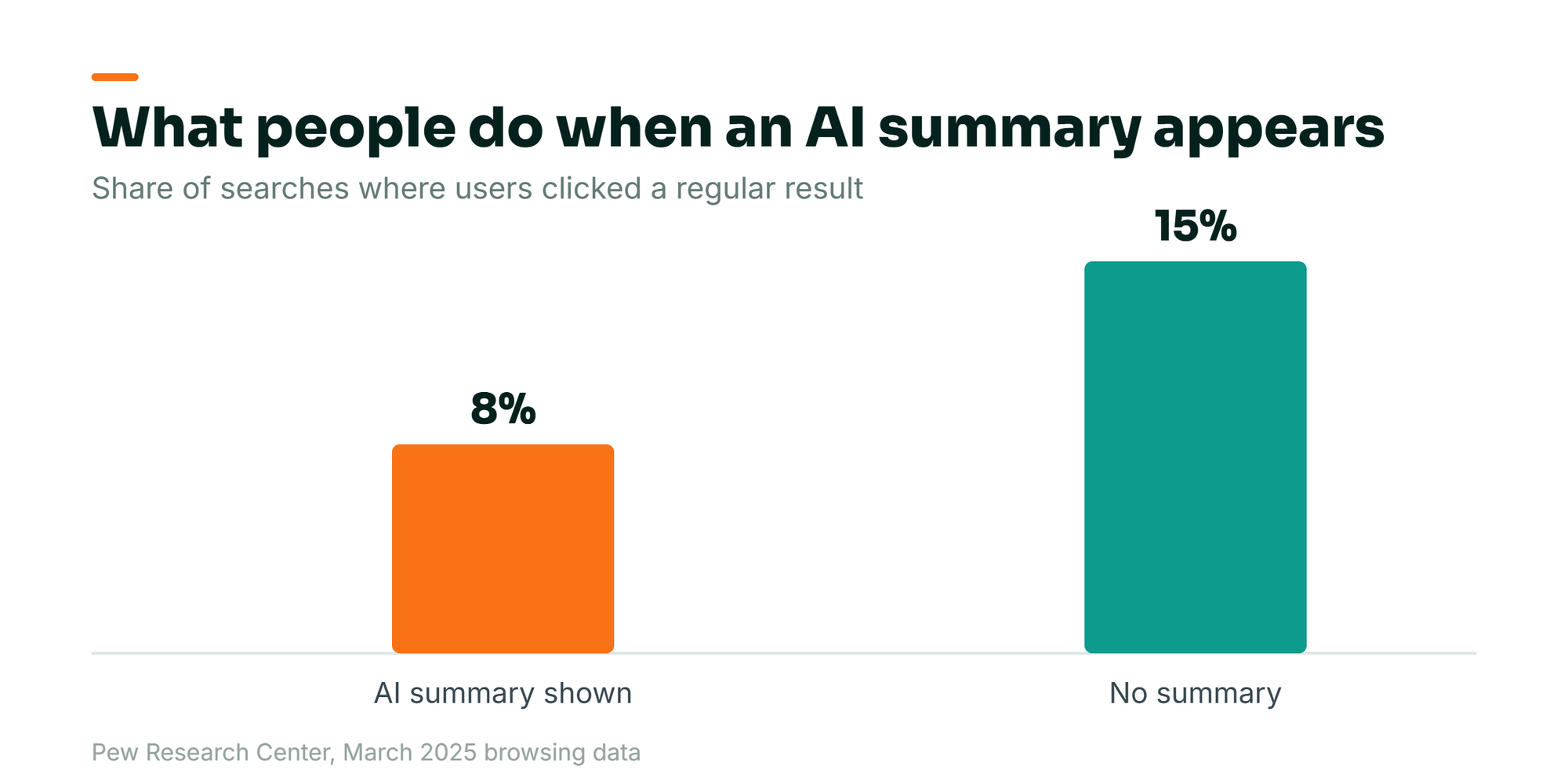
Then there's the AI Overviews effect. Pew Research Center studied real browsing behavior from 900 U.S. adults in March 2025. It found that when an AI summary appeared on a results page, users clicked a traditional result in only 8 percent of searches, compared with 15 percent when no summary appeared. Clicks on the sources cited inside the AI summary itself? About 1 percent of visits. Ahrefs tracked the same trend from the website side. In April 2025 they measured that AI Overviews cut click-through rates for the number one organic position by around 34.5 percent. By their December 2025 update that figure had worsened to 58 percent for queries where an AI Overview appears.
What this means for your business is simple and uncomfortable. Ranking number one no longer guarantees the traffic it used to, because the answer to many questions now gets assembled and displayed before anyone reaches your link. Informational content that used to feed your funnel quietly, the "what is" and "how does" articles, is getting answered on Google's page or inside ChatGPT instead of on yours.
The doom merchants leave out the next part. Similarweb data reported by TechCrunch showed AI platforms generated about 1.13 billion referral visits to top websites in June 2025. Impressive growth, up 357 percent year over year. Google search generated 191 billion referrals in the same period. That is not a typo. AI assistants currently send most websites somewhere around 1 percent or less of their total traffic. The shift is real and accelerating, but the bulk of your discoverable demand still moves through ordinary search. Anyone telling you to reallocate your entire budget to AEO is selling you a solution sized for a problem that doesn't exist yet.
Why Most Businesses Get This Wrong
The mechanism behind the confusion is worth understanding, because it inoculates you against the next acronym too.
Every time search shifts, an industry of rebranding appears around it. AEO, answer engine optimization, and GEO, generative engine optimization, are mostly new labels on a mix of old and new practices. Agencies have a commercial incentive to frame this as a brand new discipline requiring a brand new retainer. Business owners get pitched "AI optimization packages" that often consist of things like adding an llms.txt file, stuffing pages with question-and-answer blocks, or buying a dashboard. The site's actual foundations go untouched.
The deeper error is the either/or framing. Owners hear "SEO is dead" and conclude they must choose: keep doing SEO or pivot to AI. That's a false choice, and the data shows why. When Ahrefs studied where Google's AI Overviews pull their citations from in mid-2025, 76 percent of cited pages also ranked in the top 10 organic results for the same query. By early 2026 that overlap had dropped to 38 percent as Google's systems started pulling from a wider pool through query fan-out, where one question gets broken into many sub-queries behind the scenes. Read those two numbers together and you get the honest picture: strong organic performance was the main path into AI answers, and it's still a major one, but it's no longer the only one. The systems are diverging, not divorcing.
There's also a measurement blind spot that keeps businesses misjudging the whole situation. AI referral traffic is notoriously messy in analytics. Visits from ChatGPT or Perplexity often arrive looking like direct traffic or get lumped into generic referrals. Owners simultaneously underestimate how much AI exposure they're getting and overestimate how dead their search channel is. They're flying blind in both directions, which makes them easy targets for whichever pitch arrives next.
What the Data Actually Shows
First, AI traffic is small but disproportionately valuable. Semrush studied conversion behavior and found the average visitor arriving from an AI search source was worth about 4.4 times as much as the average traditional organic visitor, measured by conversion rate. The logic holds up when you think about it: by the time someone clicks through from a ChatGPT answer, the AI has already done their comparison shopping for them. They arrive pre-sold. The wrong mental model is "AI traffic is tiny, ignore it." The right one is "AI traffic is tiny, concentrated, and high intent."
Second, the inputs that drive AI visibility overlap heavily with classic authority signals, with one big twist. Ahrefs analyzed 75,000 brands to find what correlates with showing up in ChatGPT, Google's AI Mode, and AI Overviews. Branded web mentions, meaning your company name appearing across the web, correlated strongly with AI visibility, around 0.66 for AI Overviews. Backlinks, the currency of old-school SEO, correlated far more weakly at around 0.22. The single strongest correlating factor in that study was mentions on YouTube, in titles, descriptions, and transcripts, at roughly 0.74. Correlation isn't causation, and Ahrefs is careful to say so. The direction is still consistent across platforms: AI systems lean on how widely and credibly your brand is talked about, not just who links to you.
Third, different AI platforms are genuinely different ecosystems. Profound analyzed citation patterns across major platforms and found ChatGPT leans heavily on Wikipedia, Perplexity leans heavily on Reddit, and Google's AI Overviews cite YouTube more than any other single domain. A separate audit found only about 11 percent domain overlap between what ChatGPT and Perplexity cite. Being visible in one engine tells you very little about your visibility in another.
Some things haven't changed. AI crawlers still need to fetch and read your pages. Research from Vercel and others found that none of the major AI crawlers execute JavaScript, and content that only appears after scripts run is invisible to them. Crawlability, clean HTML, fast pages and clear site structure matter more under AI search. Search intent still governs what content earns attention. And authority, in the sense of being a name that credible sources mention, was always the long game in SEO. Mike King of iPullRank was named Search Engine Land's Search Marketer of the Year in 2025. He frames the discipline's evolution as relevance engineering, where the channels changed and the job was always making machines understand why you're the relevant answer. That job existed in 2010. It exists in 2026.
Cyrus Shepard scored what actually gets a page cited by AI. He founded Zyppy SEO, spent years at Moz and worked as a Google Quality Rater. His AI Citation Ranking Factors analysis, published May 7, 2026 on his Zyppy Signal newsletter, pulled 54 experiments, patents and case studies into 23 factors. He scored each one on how repeatable it was and how strong its evidence was.
The top of his list is SEO. URL Accessibility scored highest at 9.5: the AI has to be able to reach the page at all. Search Rank came second at 9.4. The middle tier is where the writing does its work, with the answer near the top, factually specific claims and passages that stand on their own. Getting cited by AI is SEO done more precisely.
| Factor | Score |
|---|---|
| Top tier: 9.5 to 9.2. | |
| URL Accessibility | 9.5 |
| Search Rank | 9.4 |
| Fan-out Rank | 9.3 |
| Preview Control | 9.2 |
| Query-Answer Match | 9.2 |
| Middle tier, where the writing does its work: 9.0 to 8.0. | |
| Intent-Format Match | 9.0 |
| Topic Cluster Ranking | 8.9 |
| Answer Near the Top | 8.8 |
| AI-ready Structure | 8.6 |
| Factually Specific | 8.3 |
| Explicit Phrasing | 8.1 |
| Citing Sources | 8.0 |
| Self-Contained Passages | 8.0 |
| Lower-impact signals: 7.6 to 5.0. | |
| Last of 23. | |
| LLMs.txt | 2.0 |
The llms.txt file from those AI optimization packages came last. It scored 2.0, alone at the bottom of all 23. My own llms.txt file has redirected to my homepage for months with no visible effect either way. Shepard wrote that "we're unable to find any credible evidence or experiments showing LLMs.txt files influence AI citations in any way."
Like Ahrefs, Shepard warns that "Correlation is not causation." His list scores which pages an AI cites as a source. The Ahrefs study above measured which brands it names, and that is where mentions pull ahead of links.
How to Handle Both in Practice
You don't need a new department. You need a both/and plan that a non-technical owner can run or delegate. Here it is in five moves.
First, verify machines can actually read your site. Ask your developer or agency one specific question: "If you disable JavaScript, is our core content, our pricing, our service descriptions, still visible in the raw HTML?" If the answer is no, fixing that comes before anything else, because it affects Google and every AI crawler at once. While they're at it, have them confirm your robots.txt isn't blocking GPTBot, ClaudeBot, or PerplexityBot, unless you've deliberately decided to opt out.
Second, restructure your key pages so answers are extractable. AI systems lift self-contained passages. Put a direct, factual answer in the first sentence or two under each heading, then elaborate. Make headings actual questions where it's natural. This is what featured-snippet optimization looked like in 2019. It now pays in two places instead of one.
Write those answers without hedging. Explicit Phrasing scored 8.1 in Shepard's review. Definitive phrasing gets cited. Hedged, both-sides prose tends not to. Take this example line: "Magnesium glycinate is supported by 137 scientific studies for heart health." A machine can lift that sentence whole. Bury the same claim under "may help" and "some experts suggest" and the firm claim is gone. The page-level version, heading by heading, is in how to format content for AI citations.
Third, shift content strategy away from commodity information. The queries getting absorbed by AI Overviews are the generic, easily answered ones. Double down on what an AI can't synthesize from elsewhere: your own data, real case studies, documented experience, named opinions, pricing transparency. This content earns citations instead of getting paraphrased into oblivion. It also converts the high-intent visitors AI does send.
Fourth, invest in being mentioned, not just linked. Given the Ahrefs correlation data, digital PR, podcast appearances, industry directories, and YouTube presence are now visibility plays for AI engines, not just branding exercises. If YouTube mentions are the strongest correlating signal across platforms and your business has zero video footprint, that's a concrete, delegable gap.
Fifth, keep doing the unglamorous SEO that still drives most revenue. Technical health, intent-matched commercial pages, internal linking, local listings if you serve a geography. Remember the ratio: 191 billion Google referrals against 1.13 billion from AI. You're adding a layer, not swapping foundations.
What to Measure and When to Expect Results
Measure the numbers below and be honest about what each one is.
Track organic conversions and revenue, not just sessions. Rand Fishkin's blunt position, published on the SparkToro blog, is that in a zero-click world traffic is a terrible goal, and he's right. Your traffic may decline while leads hold steady, because AI is filtering out the low-intent visits you never monetized anyway. If you only watch the traffic line, you'll panic at exactly the wrong moment.
Track AI referrals separately. Have whoever runs your analytics build a segment for visits from chatgpt.com, perplexity.ai, copilot.microsoft.com, gemini.google.com and similar referrers. The volume will look embarrassing for a while. Watch its conversion rate instead, and recall the 4.4x Semrush finding.
Track your share of voice in AI answers. Once a month, run 15 to 20 of the questions your real customers ask through ChatGPT, Gemini, and Perplexity. Note whether you're mentioned, cited, or absent, and who shows up instead. Tools exist for this at scale, but a spreadsheet and an hour gets a small business 80 percent of the insight.
Track branded search demand. People who see you recommended in an AI answer often don't click anything. They search your name later. Rising branded impressions in Google Search Console is one of the few free, reliable proxies for AI-era brand exposure.
On timelines: technical and extractability fixes can show effects in AI citations within four to eight weeks, since AI retrieval refreshes faster than you'd expect. Mention-building and authority work is a six-to-twelve-month compounding investment, the same as it always was. The vanity-metric traps to refuse: raw traffic as a health score, "AI visibility scores" from tools that don't disclose their prompt methodology, and impressions without any conversion column next to them.
This piece zooms in on AEO versus SEO. For how the whole thing fits together, I put it all in one place in my complete guide to AI search visibility.
Frequently Asked Questions
Is AEO really different from SEO, or is it just a rebrand?
It's about 70 percent rebrand and 30 percent genuinely new. The new parts are real: optimizing for answer extraction, tracking citations across several AI platforms, and building brand mentions as a machine-readable authority signal. The foundations underneath are what competent SEO has always required: crawlable sites, intent-matched content and earned credibility. Cyrus Shepard's May 2026 review of 54 experiments, patents and case studies found that ranking in regular search was the second-strongest of 23 AI citation factors, at 9.4. Treat AEO as an extension of your search program, and be skeptical of anyone selling it as a separate discipline with a separate invoice.
Should I stop investing in SEO now that AI answers are taking clicks?
No, and the math says why. Similarweb data showed Google sent roughly 191 billion referral visits in June 2025 against about 1.13 billion from all AI platforms combined. Traditional search still carries the overwhelming majority of web discovery. What you should change is the mix: fewer generic informational posts that AI Overviews absorb, more original data, experience-based content, and commercial pages. The businesses that get hurt are the ones whose entire model was commodity information traffic, not the ones solving real problems for a defined audience.
How do I show up in ChatGPT and Google AI Overviews?
Based on current evidence, the biggest levers are crawlability, answer-first structure and brand mentions. Make sure your content is server-rendered and crawlable, because major AI crawlers don't execute JavaScript. Structure pages so a direct answer opens each section, ready to be quoted. Then build brand mentions across the web, including YouTube, Reddit, Wikipedia where legitimate, and industry publications. Ahrefs' study of 75,000 brands found web mentions correlate with AI visibility roughly three times more strongly than backlinks do. Each platform has different source preferences. Check where your specific industry's answers are being drawn from and show up there.
Search in 2026 rewards the same business it always rewarded: one that's technically sound, genuinely authoritative, and talked about by name. It punishes the shortcut of publishing generic content and waiting for clicks. Don't let anyone scare you out of SEO, and don't let nostalgia keep you from adapting to answer engines. Run both, measure what actually pays, and ignore the acronyms. If you want help figuring out where your own gaps are, that's a conversation worth having before you sign anyone's AEO retainer.