The AI-Adoption Overreaction: 4 in 5 Buyers Still Aren't Using AI

Right now a vendor is telling you that buyers have abandoned search for AI, and that if you do not rebuild your entire web presence for it this year you will be invisible by Christmas. That pitch is engineered to make you panic, and panic is expensive. The numbers say something very different: more than 4 in 5 working-age adults are not regular generative AI users, and in the decisions that move the most money, people are actively walking away from AI back to traditional search. This article will show you the real adoption data, the documented consumer backlash, and how to size your 2026 bet so you do not torch your budget chasing a future that has not arrived for most of your buyers.
The Real Problem: You Are Being Sold A Crisis That Does Not Match Your Customers
The mistake is not ignoring AI. The mistake is letting a sales narrative set your budget instead of letting your customers set it. Vendors have a strong incentive to convince you that the ground has shifted completely, because "everything changed and you are behind" sells retainers far better than "adapt gradually and keep what works." So the message lands in your inbox framed as an emergency, and you start wondering whether the content, the search rankings, and the channels you spent years building are now worthless.
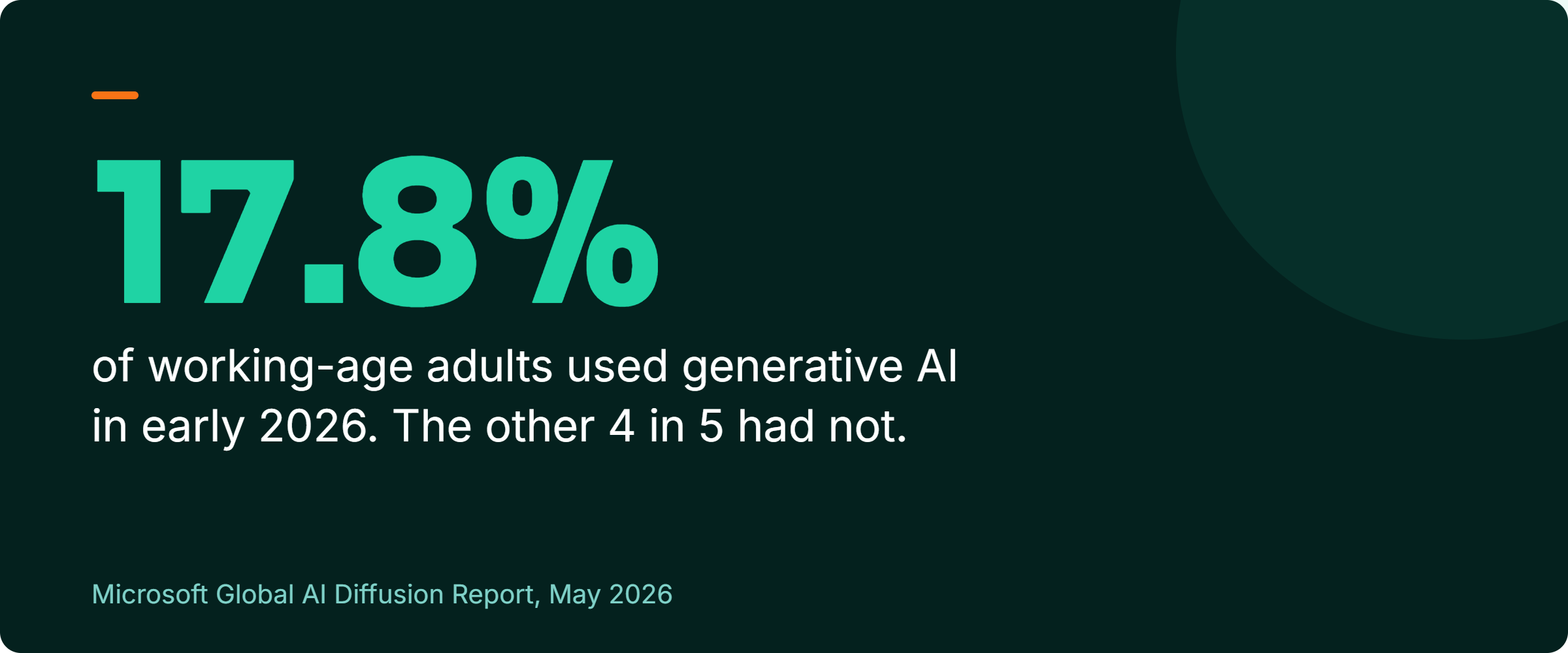
The verifiable numbers say something quieter. Microsoft's Global AI Diffusion Report, published May 7, 2026, found that 17.8 percent of the world's working-age population aged 15 to 64 used generative AI in the first quarter of 2026. That was up from 16.3 percent in the fourth quarter of 2025. Read that the other way around, which is the way that matters for your business: more than four out of every five working-age adults are not regular generative AI users. The people with jobs, income, and buying power, the exact people you are trying to reach, are in the majority still finding businesses the way they did last year.
Translate that to cost. If you take a vendor's panic at face value and shift the bulk of your 2026 budget into rebuilding everything for AI search, you are pulling money and attention away from the channels where roughly 80 percent of your reachable audience still lives. That is not future-proofing. That is defunding your present to over-fund a slice of the market that, for most businesses, is still a minority of buyers.
Why Most Businesses Get This Wrong
The conventional wisdom getting repeated in every webinar right now is that AI adoption is universal and accelerating so fast that traditional search is effectively dead. Both halves of that claim are wrong, and the mechanism behind why they are wrong is worth understanding because it tells you where your customers actually are.
First, adoption is fragmented, not universal. Microsoft's own figures show a wide gap between developed and developing markets, with generative AI adoption around 27.5 percent in developed economies versus 15.4 percent in developing ones. Even in the strongest markets, the majority still are not regular users. Treat "everyone is on AI now" as the marketing slogan it is, not a fact about your customer base.
Second, and more important, adoption is not just slow. There is documented resistance. Dan Taylor, writing in Search Engine Journal on June 4, 2026, points to a body of academic research explaining why a meaningful share of people actively avoid AI search. Two barriers stand out. One is opacity, which in plain English means AI is a black box: it gives you an answer but hides where the answer came from, so you cannot judge whether to trust it. The other is threat to agency, which simply means people do not like losing control of their own decision-making to a system that decides for them what they see. Taylor sources these to peer-reviewed work including De Freitas and colleagues in Nature Human Behaviour in 2023, Sapru in Technology in Society in 2026, and Yin in Frontiers in Education in 2025. This is not vibes. It is studied behavior.
The practical consequence is a pattern you have probably noticed in your own life. People happily use AI for low-stakes tasks, getting dinner ideas or a quick shortlist of plumbers, and then revert to traditional search the moment the decision actually matters. Health, money, legal. The higher the stakes, the more your customer wants to see the sources, compare options, and stay in control. Businesses that get this wrong assume their customers behave like the early adopters in the demo video. Your customers behave like people protecting a real decision.
What The Data Actually Shows
Let me put the verified numbers in one place, because the gap between the panic and the evidence is the whole point.
On adoption, Microsoft's May 7, 2026 report gives us the headline figure: 17.8 percent of working-age adults used generative AI in Q1 2026, up from 16.3 percent the prior quarter. That is real growth, and you should respect it. It is also a long way from the "search is over" narrative, since it leaves more than 80 percent of working-age adults outside regular use.
On the practitioner read of that data, here is Taylor describing what he is actually seeing across his client base:
"a lot of our clients who are worried about audiences (with buying power) moving away from traditional search to AI alternatives, are in the majority not adopting AI on a regular basis."
Dan Taylor, Search Engine Journal, June 4, 2026
That single sentence should reset your blood pressure. The very audience you are being told has fled, the one with money to spend, is in the majority not using AI regularly. Taylor is not telling you to ignore the shift either. His framing is the one I want you to adopt:
"We need to be adaptive and forward-thinking with our approaches, but we're not quite in panic mode yet."
Dan Taylor, Search Engine Journal, June 4, 2026
On the high-stakes split, Taylor cites survey data from Yext indicating that 57 percent of users prefer traditional search engines for information affecting their well-being, meaning health, money, and legal matters. Treat that specific figure as directional rather than gospel since it comes through his reporting of a vendor survey, but it lines up cleanly with the academic research and with how normal people behave. When the decision is serious, the majority want traditional search.
Then there is the part of the story the panic narrative leaves out entirely: backlash. When Google announced its Intelligent Search rollout on May 19, 2026, users did not all lean in. Many pushed back. As reported by multiple outlets including TechCrunch on May 26, 2026 and confirmed by DuckDuckGo's own posts, DuckDuckGo's "No AI" search traffic more than tripled after the announcement, averaging roughly 84 percent above its baseline in the weeks since May 19. US app installs for DuckDuckGo rose 18.1 percent week over week from May 20 to 25. DuckDuckGo even ships browser extensions that set AI-free search as the default. TechCrunch framed it as users rejecting being "force-fed" Google's AI search. When you force AI on people, a measurable share of them go looking for the exit.
Put it together and the picture is not "AI won." It is a fragmented market, growing unevenly, with a real and organized group of people actively opting out. That is a market you adapt to deliberately, not one you abandon your fundamentals for.
How To Fix It: Step-By-Step
You do not need to be technical to get this right. You need to make four or five decisions on purpose instead of by panic. What to do, what to delegate, and what to ask your agency.
Step one: find out what share of your customers actually discover you through AI. Before you spend a dollar based on a trend, get your own number. Ask whoever runs your analytics, in-house or agency, to pull the slice of your website traffic and leads that arrives from AI tools, things like ChatGPT, Perplexity, Gemini, and Copilot referrals, and compare it to traditional search, direct, and referral traffic over the last six months. The instruction to give them is simple: "Show me what percentage of our visitors and leads came from AI assistants versus everything else, and the trend line." That percentage, your number, beats every industry statistic in this article for the purpose of setting your budget.
Step two: allocate budget in proportion to that number, plus a small test margin. If AI sends you 5 percent of qualified traffic, you do not put 50 percent of your budget into AI search optimization. You fund it roughly in proportion to the value it delivers, and you add a modest test line, think single-digit percent of budget, to stay ahead of the curve. The rule of thumb: invest where your buyers are now, reserve a controlled experiment for where some of them are heading. Do not let a vendor talk you past that ratio without showing you your own data.
Step three: keep traditional search strong, especially in high-stakes verticals. If you operate in health, finance, legal, insurance, or anything that affects someone's well-being or wallet, the research and the behavior both tell you your buyers will revert to traditional search when they get serious. These are often called YMYL categories, which stands for "your money or your life," the topics where trust and verifiable sources matter most. In those verticals, your traditional search presence, your authoritative content, your reviews, and your visible sourcing are not legacy assets. They are where the high-intent decision actually happens. Protect that budget first.
Step four: make a low-stakes versus high-stakes map of your own offerings. Sit down for thirty minutes and split what you sell into two columns. Low-stakes, quick, low-risk purchases where customers might happily take an AI's recommendation, and high-stakes, considered, expensive, or risky decisions where they will want to verify. Fund AI visibility more aggressively on the low-stakes side and defend traditional search hard on the high-stakes side. This one exercise turns a vague industry debate into a concrete plan for your specific business.
Step five: pressure-test every vendor pitch against your number. When someone tells you the sky is falling, ask them one question: "What percentage of my buyers does your data show are actually making purchase decisions through AI today?" If they answer with global hype instead of your reality, you have learned everything you need to know about whose interests that pitch serves.
What To Measure And When To Expect Results
Right-sizing the bet only works if you measure the right things, because the wrong metrics will scare you back into panic.
Measure your AI referral share monthly. The single most important KPI is the percentage of your qualified traffic and leads coming from AI assistants, tracked as a trend. If it is climbing meaningfully quarter over quarter, you scale your AI investment to match. If it is flat or tiny, you hold. Pair it with the metric that actually pays your bills: leads and revenue by channel. A channel that sends visitors who never buy is not a channel worth chasing, no matter how modern it sounds.
On timelines, be realistic. Adoption moved from 16.3 to 17.8 percent in a quarter. That is the real pace of change you are responding to, not an overnight cliff. Expect to spend one to two quarters simply establishing your baseline numbers and watching the trend before you make any major reallocation. Anyone promising transformation in thirty days is selling urgency, not results.
Do not measure raw AI mentions or "is my brand visible in ChatGPT" as a standalone trophy. Appearing in an AI answer that no buyer with intent ever acts on is a vanity metric, which means a number that looks impressive but does not connect to leads or revenue. Do not measure your competitor's announcements either. A press release about going all-in on AI is marketing, not evidence that it worked. And do not measure total AI usage in the world. The only adoption number that should move your budget is adoption among your customers, which is why step one of the fix is pulling your own data first.
Frequently Asked Questions
Should I move my marketing budget to AI search optimization in 2026?
Only in proportion to how many of your actual customers find you through AI tools, which for most businesses is still a minority. Pull that number from your own analytics referral data before you move a single dollar. Fund AI visibility as a test line, not a full migration, and keep traditional search and your existing content fully funded. The audience with buying power is still mostly on the traditional web, so do not defund your present to over-fund a slice of the future.
My competitor says they went all-in on AI search. Am I falling behind?
Going all-in is not the same as winning, and a vendor pitch or a press release is not a results report. Most working-age adults are not regular generative AI users, and in health, money, and legal categories people deliberately revert to traditional search. If your competitor stripped budget from the channels that still drive most of their revenue, that is closer to a gift to you than a threat to you. Match your spend to where your buyers actually are, then revisit it every quarter.
What if AI adoption suddenly jumps next year?
Adoption is growing, but slowly and unevenly, moving from 16.3 percent to 17.8 percent of working-age adults in a single quarter. That pace gives you room to adapt deliberately instead of reacting in fear. Keep a small AI visibility test running so you are already in motion if the curve steepens, and watch your own AI referral share every month. The goal is to be adaptive and forward-thinking, not first in line to rebuild everything on a guess.
The story you are being sold is that the market moved and you missed it. The data says the market is fragmented, growing at a measured pace, and pushing back hard enough that "No AI" search traffic tripled the moment AI got forced on people. Your job is not to bet the whole budget on a future that has arrived for fewer than one in five adults. Your job is to find out where your specific buyers are, fund that, and run a small smart experiment toward where some of them are going. Before you sign anything a panic pitch put in front of you, go pull one number, the share of your own customers actually finding you through AI, and let that, not a vendor's fear, decide how much you spend.