Stop Grading Your Content by Google Traffic Alone

You are probably making this mistake right now. You open Google Analytics, see organic traffic dropping, and conclude your content is failing. It is the wrong read. Judging your content by Google traffic in 2026 is like judging a store's health by the foot traffic out front while ignoring the cash register inside.
That traffic number is falling for everyone, it now under-counts your best customers, and if you keep optimizing for it you will cut the content that is actually bringing you business. This article shows you what is really happening to the number, why owners keep misreading it, what the data says, and the exact things to start measuring on Monday. Change what you measure before you change what you publish.
The traffic number is shrinking and lying at the same time
Two things broke at once, which is why this feels confusing. The first is that fewer searches send anyone to your site at all. Rand Fishkin of SparkToro, using Similarweb clickstream data, reported on June 8, 2026 that 68.01% of US Google searches between January and April 2026 ended with no click to any website. Two out of every three times someone searches for what you sell, nobody lands anywhere, which means the lost clicks are not going to a competitor, they are going to the answer box at the top of the page.
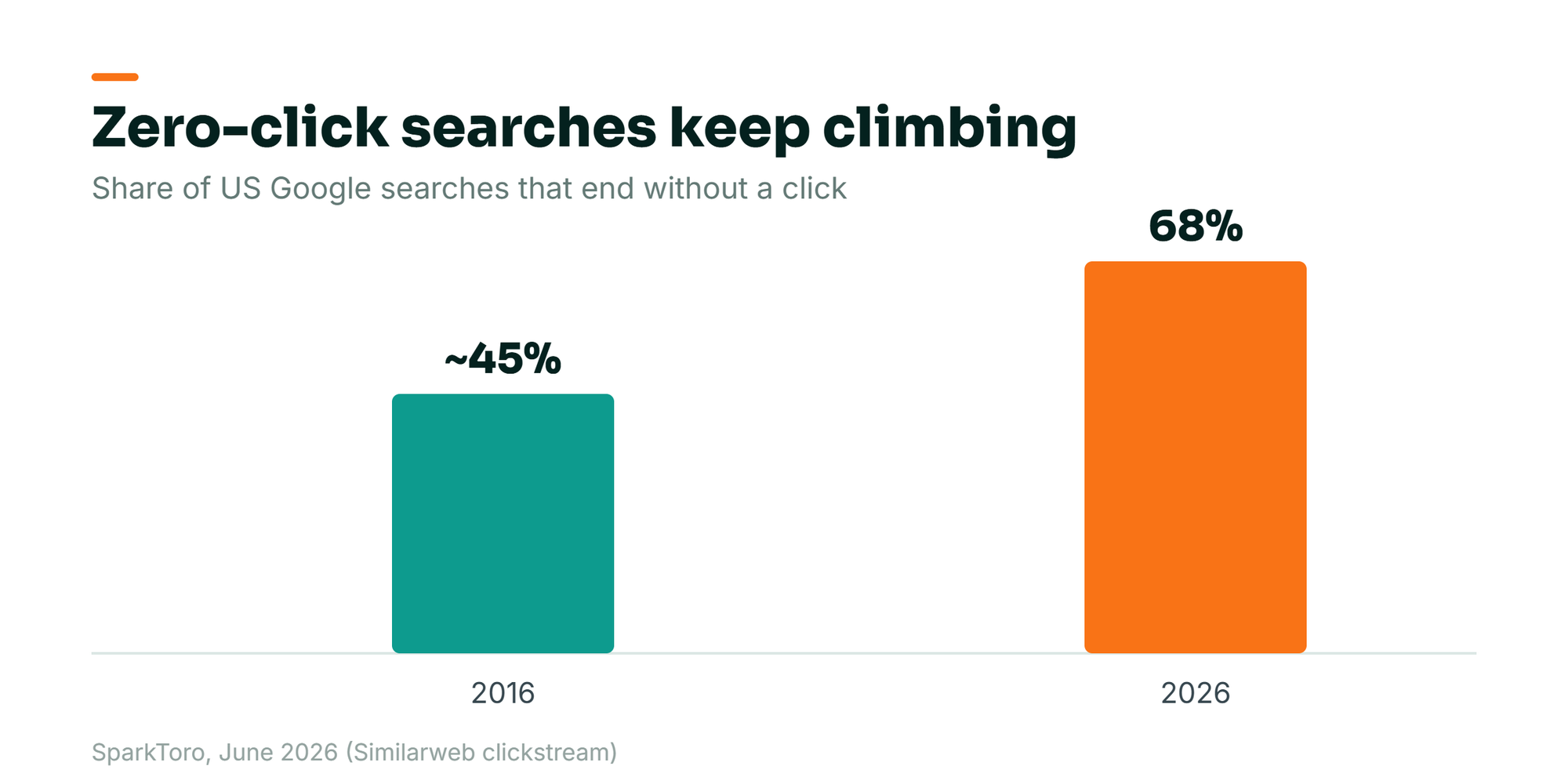
This is not a blip. SparkToro's June 2026 figures show zero-click searches climbing from roughly 45% in 2016 to 68% in 2026, so the share of searches that turn into a visit has been falling for a decade and just crossed a line where most searches resolve before anyone leaves Google. If you run a plumbing company and someone searches "how to stop a running toilet," Google now answers it on the spot, and the person who would have read your blog post and saved your number never sees your site.
The second break is Google sending a smaller slice of the clicks that do happen. SparkToro, citing the Ahrefs "ChatGPT vs Google" tracker in June 2026, found that Google's referral share to a panel of more than 75,000 tracked domains fell about 8 percentage points from June 2025 to May 2026, roughly a 22% drop. A fifth of the Google traffic those sites counted on a year ago is simply gone, and no amount of better blog posts brings it back, because the cause sits inside Google's results page, not inside your content.
So the number is shrinking. The harder problem is that the part still standing has started to lie. The visitors who used to arrive with a clean "Google" label are increasingly arriving through AI tools that strip the label off, and your dashboard files them under something vague. That is the gap I wrote about in detail on the attribution gap in SEO metrics in the AI era, and it is the reason a falling traffic line can sit on top of a healthy business and you would never know.
Why smart owners keep reading the wrong gauge
You trust traffic because for fifteen years it was trustworthy. More visits meant more leads meant more revenue, in that order, reliably enough that you could skip the middle steps and just watch the top number. That chain held when search worked one way: type a query, see ten blue links, click one, land on a site. The chain is broken now, and the habit of trusting the top number outlived the reason it was trustworthy.
The deeper trap is that traffic is easy to see and revenue from content is hard to see. Google Analytics hands you the visit count for free, in a chart, refreshed hourly. The lead that came in last week because a contractor asked ChatGPT for a recommendation, read three of your articles through it, then typed your company name into Google a day later, shows up as a "Direct" visit or a branded search with no story attached. You measure the easy thing and assume it stands in for the hard thing, the way a store owner counts cars in the lot because counting actual sales takes more work.
There is a buying-behavior shift underneath all of this that makes the gauge worse every quarter. People now research, compare, and largely make up their minds inside an AI chat or a search summary, then show up at your door already decided. I covered that pattern in how buyers now decide before they ever visit your site. When the deciding happens off your site, the visit that proves it happened may never register as content-driven, and your traffic report quietly takes credit away from the content that did the persuading.
One more reason owners get this wrong: the old playbook told you to win by ranking a page for one keyword and counting the clicks. That playbook is also expiring, for reasons I laid out in why ranking for one keyword no longer wins you Google. If your whole measurement system is built to reward keyword rankings and raw clicks, it will keep telling you to abandon exactly the content that AI tools are quoting to your future customers. That playbook is the one I retire in why just making great content is no longer a strategy.
What the data says when you follow the money instead of the clicks
The clearest evidence that low traffic can hide high value comes from a company measuring its own front door. Patrick Stox of Ahrefs reported on June 16, 2025 that, for Ahrefs' own site, visitors arriving from AI search were just 0.5% of traffic but drove 12.1% of signups, roughly 23 times the conversion rate of traditional organic visitors. Read that as a decision, not a headline: if you had cut the content those few AI-referred visitors read because the traffic looked tiny, you would have cut an eighth of your signups. That 23x is what Ahrefs found for their own site, not an industry law, so treat it as proof the pattern exists, not as a multiplier to paste into your own forecast.
Those high-value visitors are mostly invisible in your reports, and there is a plain technical reason. Here is how Stox explained where they land:
"We report whatever referrer we're told to report. If they don't send us one, then it would go in the 'Direct' bucket."
Patrick Stox, Ahrefs, February 6, 2025
An Ahrefs study of 3,000 sites by Louise Linehan and Xibeijia Guan, published February 6, 2025, found that 63% of websites already receive some AI traffic, and much of it gets logged as "Direct" because the referrer is missing. So when your "Direct" line creeps up, that is not all bookmark-and-type-it loyalists, a chunk of it is people an AI tool sent you, and your analytics is under-counting your newest acquisition channel by mislabeling it. The same study found that 98% of AI traffic comes from three chatbots, ChatGPT at about 50%, Perplexity at about 30.7%, and Gemini at about 17.6%, which means you do not need to monitor a hundred tools, you need to watch three.
The pattern shows up at the cash register too, not just in pageviews. Fairing's LLM Product Discovery Benchmarks for Q2 2025, drawn from "How did you hear about us?" survey answers, found that customers naming an AI tool rose more than 10x from January to mid-July 2025, and about 1 in 7 brands had seen at least one such mention by July 2025. The same benchmark reported that 69.4% of transactions had no identifiable last-click source, meaning for roughly seven in ten sales your analytics cannot tell you what earned the order, so the only reliable way to learn is to ask the buyer directly.
The man who has tracked these numbers longest is blunt about what to do with the traffic metric. Rand Fishkin's instruction in June 2026 was direct:
"Replace traffic as a KPI for your digital marketing efforts. Build a correlation dashboard instead."
Rand Fishkin, SparkToro, June 2026
Before you assume the AI channel will keep handing out easy clicks to replace your lost Google ones, hear the caution from inside Ahrefs. Ryan Law put it this way:
"These CTRs are probably the highest they'll ever be as the novelty of this format wears off."
Ryan Law, Ahrefs
Read together, those three quotes give you the whole strategy. Stop scoring yourself on a click count, start watching what correlates with sales, and do not bet the business on AI referral clicks staying generous, because the people closest to the data expect them to thin out.
How to start measuring revenue, not just visits, this week
You do not need new software or a data analyst to fix this. You need to add one question and start one log, and the rest is reading numbers you already have through a different lens.
Step one, ask every new customer how they found you. Add a single question to your contact form, quote request, or checkout: "How did you hear about us?" with a dropdown offering ChatGPT, Google, Reddit, YouTube, a friend, and other. This is the one move that beats every analytics tool, because Fairing's data showed 69.4% of transactions had no identifiable last-click source, so the buyer's own answer is often the only true signal you will get. If you take bookings by phone, have whoever answers ask the same question and tick a box. A roofer can do this with a clipboard.
Step two, start a monthly log of three numbers alongside your traffic, not instead of it. Once a month, write down your branded searches, your "Direct" traffic, and your lead count, next to your organic traffic number. You can pull branded searches from Google Search Console by filtering queries that contain your company name, and "Direct" from Google Analytics. Keep traffic in the log, because it still matters, you are just refusing to let it be the only witness.
Step three, watch your "Direct" and branded-search lines as AI signals. Since Ahrefs found much AI traffic lands in "Direct" because the referrer is stripped, a rising "Direct" line paired with rising branded searches is a fingerprint of people discovering you through AI and then coming to find you by name. When both climb in a month your organic traffic fell, that is not decline, that is your channel moving, and your log just caught what your traffic chart hid.
Step four, focus your attention on three tools, not the whole field. Because 98% of AI traffic comes from ChatGPT, Perplexity, and Gemini, you can sanity-check your own visibility by typing the questions your customers ask into those three and seeing whether you come up. If you sell commercial HVAC service in Phoenix, ask each one "who does commercial HVAC repair in Phoenix" and note whether your name appears. That is a fifteen-minute task you can do yourself or hand to an assistant with a written script.
Step five, connect the form answers back to revenue once a quarter. Every three months, tally which "how did you hear about us" answers came attached to your biggest jobs, not just your most numerous leads. Ahrefs found, for their own site, that a 0.5% slice of traffic drove 12.1% of signups, so the channel with the fewest visits can carry the most money, and you will only see that by matching the source answer to deal size. If you cannot or will not do this yourself, this is the one task worth delegating to a bookkeeper or marketing lead with a clear instruction: sort closed deals by source, then by value.
What to track every month and the numbers that will fool you
Set a monthly rhythm and a quarterly one. Monthly, you log four things: organic traffic, branded searches, "Direct" traffic, and total leads. Quarterly, you do the harder read: which sources your "how did you hear about us" answers name, and which of those sources show up on your highest-value deals. The monthly log catches movement, the quarterly read catches money, and you need both because a channel can grow in importance for months before it shows up in your lead count.
The traps are the metrics that feel like progress and prove nothing. Raw organic traffic is the first, and you already know why: SparkToro's June 2026 data shows it falling for everyone as zero-click searches passed 68%, so a drop tells you the search page changed, not that your content got worse. Treating that drop as your scorecard is how you talk yourself into cutting a page that AI tools are quoting to buyers.
Keyword rankings are the second trap. A page can rank first and get almost no clicks now, because the answer sits above it in Google's summary, so a rankings report that looks healthy can sit on top of a page nobody visits. The third trap is total pageviews unweighted by value, which treats the visitor who read one article and bought a 40,000-dollar job the same as the visitor who bounced in four seconds. Volume metrics flatten the difference between a tire-kicker and a buyer, and the whole point of the new measurement is to stop flattening it.
One caution on the channel everyone is excited about. Do not swing from worshipping Google traffic to worshipping AI referral clicks, because Ryan Law of Ahrefs warned those click-through rates are probably the highest they will ever be as the format's novelty fades. Measure the AI channel by the leads and revenue it brings through your form answers, not by a click count that may shrink the same way Google's did. The lesson of the last decade is that any single traffic number eventually stops telling the truth, so build a dashboard that watches several signals and trust the one tied to your bank deposits.
How you measure is one layer of the job, and I cover the whole thing in my guide to AI search visibility.
Frequently Asked Questions
Is my content failing if my Google organic traffic is dropping in 2026?
Not necessarily, and probably not for the reason you fear. SparkToro reported in June 2026 that 68.01% of US Google searches between January and April 2026 ended with no click to any site, and that Google's referral share to 75,000-plus tracked domains fell about 22% from June 2025 to May 2026. Your traffic is falling because the search page changed, not because your content got worse. Check your leads and your "Direct" traffic before you judge the content.
Why is my "Direct" traffic going up while my Google traffic falls?
A large share of AI-tool visitors arrive with no referrer attached, so your analytics files them under "Direct." Ahrefs studied 3,000 sites in February 2025 and found 63% already get some AI traffic, much of it logged this way. Patrick Stox of Ahrefs put it plainly: "We report whatever referrer we're told to report. If they don't send us one, then it would go in the 'Direct' bucket." A rising "Direct" line is often people who found you through AI and came back by name.
What is the single easiest way to measure content that AI tools influence?
Add one question to your contact form, quote request, or checkout: "How did you hear about us?" with a dropdown for ChatGPT, Google, Reddit, YouTube, a friend, and other. Fairing's Q2 2025 data found 69.4% of transactions had no identifiable last-click source, so the buyer's own answer is often your only reliable signal. The same data showed customers naming an AI tool rose more than 10x from January to mid-July 2025. Ask the question, then log the answers against your biggest deals.
The store owner who counts cars in the lot eventually closes, not because the lot emptied, but because he never noticed which customers were buying. Your traffic chart is the parking lot. Your form answers and your branded searches are the register, and right now the register is telling a different story than the lot. The uncomfortable part is not that Google is sending less traffic. It is that the content you were about to delete may be the content closing your best deals.