AI Citation Is Just SEO, Sharper. The File You're Buying Does Nothing.

Someone sold you a text file. It's called LLMs.txt, it costs anywhere from a setup fee to a monthly retainer, and the pitch is that it tells AI search engines how to read your site so you finally get cited in those answer boxes. The data says it does nothing. Getting cited by AI is not a new discipline with new tricks. It's SEO done more precisely, and the single most-sold fix for it is the one thing the evidence ranks dead last.
I've watched three "SEO is dead" cycles in 17 years of content work, 15 of them in search. Each one came with a product to buy. This cycle's product is the AI file, and I want to walk you through what actually earns a citation, what it's worth in real clicks, and the one line to say to your agency on Monday so you stop paying for noise.
Not getting cited costs you a third of your clicks, and a study just proved it
For years the click math was theoretical. Now it isn't. In the first randomized field experiment on this question, researchers Agarwal and Sen ran 1,065 US users through real searches between January and February 2026, hiding the AI Overview for some and showing it to others. When the AI Overview was hidden, outbound clicks rose from 0.38 per search to 0.61. Search Engine Journal's Matt G. Southern summarized the headline on April 27, 2026: a 38% drop in organic clicks on the queries where an AI Overview fires.
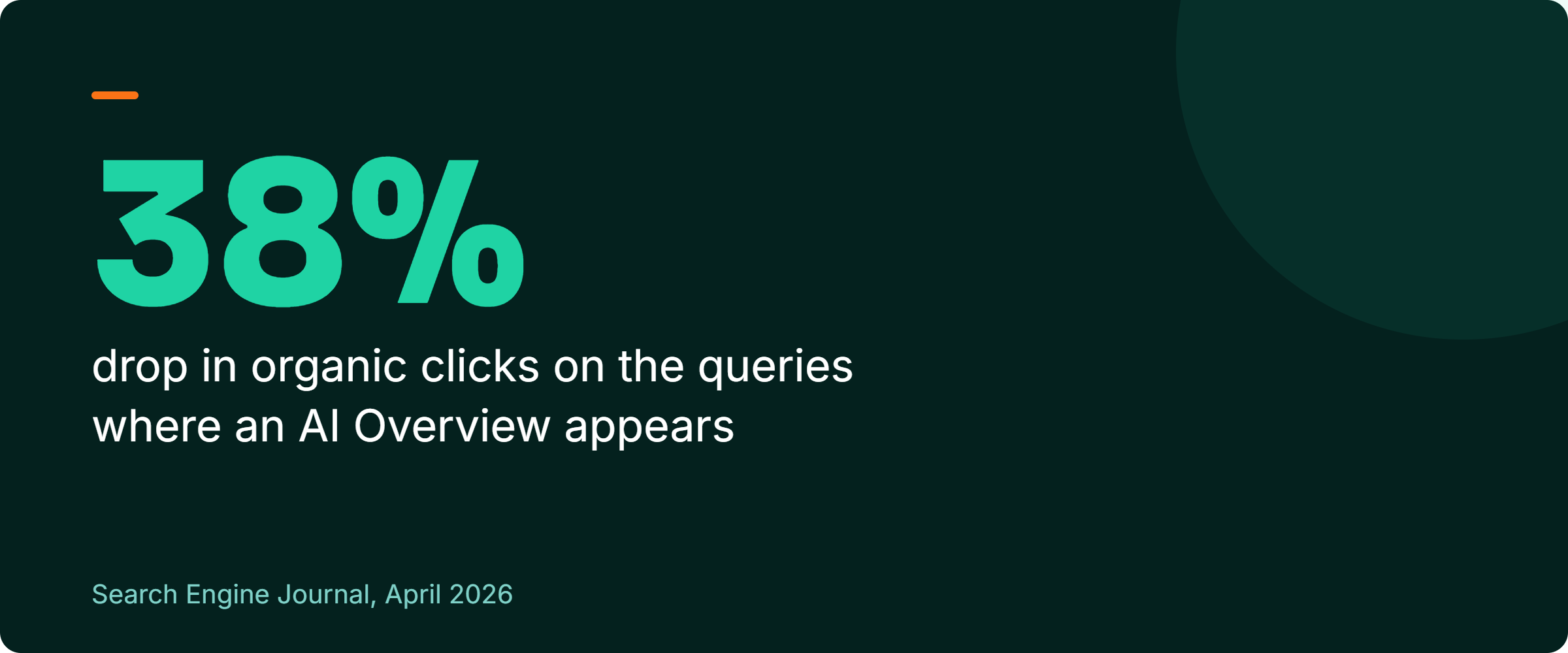
Translate that. The gap between hiding the box and showing it is 0.23 outbound clicks per search. For a plumbing company in Sacramento fielding 10,000 of those AI-triggered searches a month, that works out to roughly 2,300 lost clicks, my arithmetic on the study's rate, not a number the researchers measured directly. Those clicks were free. Now they go nowhere, or they go to whoever got named inside the box. The study authors put it plainly.
"AI Overviews divert traffic away from publishers without delivering measurable improvements in user experience."
Agarwal and Sen, randomized field experiment, January to February 2026 (reported by Search Engine Journal, April 27, 2026)
That last part matters more than it reads. Over 95% of users in the study did not even notice when the AI Overview was hidden, and there was no measurable difference in how satisfied they were either way. So the box isn't there because people love it. It's there, and it's eating a third of the traffic on every query it touches. The defensive move and the offensive move are the same move: be the source it cites. Get named inside the box and you're not losing the click, you're the one collecting it.
There's an upside number too, and it's large. Seer Interactive's figures, cited in Cyrus Shepard's analysis, show that being cited in a Google AI Overview correlates with 120% more organic clicks per impression and 41% more paid clicks compared with not being cited. Double the organic clicks for the same visibility. That is the whole game, and it explains why the vendors are circling.
You're being sold a file because a file is easy to sell
The reason business owners pay for an AI file is not stupidity. It's that the honest answer to getting cited is boring and the dishonest answer is a product. Tell a roofer in Tampa that the path to AI citations is "rank well, answer the question clearly, put the answer near the top," and you've described work, ongoing, unglamorous, hard to invoice as a one-time fix. Tell him there's a special AI file that makes ChatGPT and Google read his site properly, and now you've got a deliverable, a setup fee, and a recurring line item.
That's the trap. The new-magic-trick story sells better than the do-the-work story, every cycle, without fail. I saw it with meta keywords in the 2000s. I saw it with link directories. I'm seeing it now with LLMs.txt, a file vendors and plugins actively push to owners as the thing standing between them and AI visibility.
The deeper mistake underneath the file is treating AI citation as one problem with one switch. It isn't one problem. The reasons you're not cited stack on top of each other, and I've argued before that you don't have an AI visibility problem, you have five of them. A single text file cannot fix five layered issues. Nothing sold as a single fix can. Once you see citation as a stack of signals rather than a lock with one key, the file stops looking like a solution and starts looking like what it is.
The evidence ranks 23 signals, and the one you're buying scores 2.0
Cyrus Shepard built the cleanest map of this we have. He founded Zyppy SEO, spent years at Moz, and worked as a Google Quality Rater, so he's read the patents and graded the search results from the inside. For his AI Citation Ranking Factors analysis, published May 7, 2026 on his Zyppy Signal newsletter and updated June 5, he synthesized 54 experiments, patents, and case studies, then scored each factor on how repeatable it was and how strong the evidence behind it stood. A 50-million-query study outweighed a 10-query case study. The scores run from 9.5 at the top down to 2.0 at the bottom. PPC Land covered the same 23 factors in trade press on May 8, 2026.
Before the numbers, the caveat Shepard insists on, and the one I'll hold to as well.
"These aren't 'Ranking Factors' in the traditional sense. Instead, they are features correlated with AI citations across multiple studies. Correlation is not causation."
Cyrus Shepard, AI Citation Ranking Factors Analysis, Zyppy Signal, May 7, 2026
Hold that thought, because it's the only hedge I'm going to make. These are patterns that show up alongside citations, not proven levers. Now, the patterns themselves cluster into a shape that anyone who's done SEO will recognize. Shepard groups the whole thing into four buckets.
"Relevance, Trust, Topical Authority, & Extractability, all signals that should align with current SEO thinking."
Cyrus Shepard, AI Citation Ranking Factors Analysis, Zyppy Signal, May 7, 2026
Look at what sits at the top. URL Accessibility scores highest at 9.5, meaning the AI has to be able to reach the page at all. Search Rank follows at 9.4, then Fan-out Rank at 9.3, then Preview Control and Query-Answer Match tied at 9.2. Read that top tier again. The number one correlate of getting cited by AI is your page being reachable, and the number two is ranking well in regular search. The thing destroying your clicks is fed by the thing you were already supposed to be doing. This is why the smartest framing treats AI search as a five-stage pipeline where most strategies only cover one stage, because a page has to survive retrieval before any of the writing tricks matter.
The middle tier is where the writing does its work. Intent-Format Match scores 9.0, Topic Cluster Ranking 8.9, Answer Near the Top 8.8, AI-ready Structure 8.6, Factually Specific 8.3, Explicit Phrasing 8.1, Citing Sources and Self-Contained Passages both 8.0. Plain version: say the answer clearly, say it high on the page, make each passage stand on its own so a machine can lift it without needing the paragraph before it. The piece you wrote to sound thoughtful and balanced may be exactly the piece AI skips.
Then the lower-impact signals: Content Visibility 7.6, Freshness 7.0, Brand or Entity Trust 6.8, Length 6.7, Language 6.3, Entity Consistency 5.8, Structured Data 5.6, Known Source 5.4, Domain Authority 5.0. Real, but secondary. And at the very bottom, alone, scoring 2.0: LLMs.txt. The file you may be paying for is the lowest-scoring factor on the entire list. Shepard's words on it are not soft.
"we're unable to find any credible evidence or experiments showing LLMs.txt files influence AI citations in any way."
Cyrus Shepard, AI Citation Ranking Factors Analysis, Zyppy Signal, May 7, 2026
One counterintuitive finding deserves its own beat, because it's the cheapest win on the list. Definitive phrasing gets cited. Hedged, both-sides prose does not. A sentence like "Magnesium glycinate is supported by 137 scientific studies for heart health" outcompetes cautious, qualified writing that buries the claim in conditions. The machine wants a clean, liftable statement. If your writers were trained to soften every claim into "may help" and "some experts suggest," that habit is now costing you citations directly.
Do these four things Monday, and cancel one invoice
Start with the cancellation, because it's free and it's today. Pull up your invoices and find any line item for LLMs.txt, an "AI file," or an "AI readiness" plugin sold on the promise of AI visibility. Cancel it. The factor it addresses scores 2.0 with no credible evidence behind it, and the money is better spent on anything in the top tier. If a vendor resists, you'll hear what they actually believe.
Second, do this one yourself this week. Open your five most important pages and ask one question of each: is the direct answer in the first screen, before any scrolling, in a sentence that stands on its own? Most pages bury the answer under a warm-up paragraph. Move the answer up. Make it specific and unhedged. "We replace residential roofs in Tampa in two to three days, starting at $9,500" beats "We pride ourselves on quality roofing solutions tailored to your needs." One of those gets lifted into an answer box. The other gets skipped.
Third, delegate the ranking work, because that's where the real budget belongs. Search Rank scored 9.4, second only to being reachable, so the SEO you may have written off as old-fashioned is the single biggest lever you have. Tell whoever handles your search work that ranking and AI citation are the same project now, not two budgets. If you're unsure which weakness to attack first, the honest sequencing question is which layer is actually holding you back, and I've laid out how to figure out why the visibility work isn't moving the needle and which layer to fix first.
Fourth, ask your agency this exact question, word for word. "Show me which of Shepard's top-ten citation factors my key pages currently win, and which we're losing." A real partner will know the list, pull up your pages, and walk you through accessibility, rank, answer placement, and phrasing. A vendor selling files will change the subject to a product. The question itself sorts the room. You don't need to know the technical detail behind each factor to judge the answer. You only need to watch whether they engage the list or dodge it.
Watch citations and click share, ignore the dashboard that flatters you
The metric that matters is not a score in a tool. It's whether your pages show up as named sources inside AI answers for the questions your customers actually ask, and whether your click share holds as those answer boxes spread. Pick ten real questions a customer would type. Check monthly whether you're cited. That's the scoreboard.
Give it a quarter before you judge any of this. Citation patterns shift as pages get re-crawled and re-ranked, and a month is noise. Ninety days of moving answers up, sharpening claims, and pushing rank gives you something real to read. Tie it to money the way the data does: more citations should track with the click recovery the Seer figures point to, that 120% organic lift on cited impressions, against the 38% drain Agarwal and Sen measured on uncited ones.
The vanity metric here is a vendor dashboard showing your "AI readiness score" climbing after they installed a file. That number measures their product, not your citations. A rising readiness score with flat actual citations means you paid for a gauge, not a result. Watch for one signal above all others: are you getting named in the answers your customers see? And being named is not the same as being believed, which is why brand and entity trust still earns its place lower on the list. Count citations and click share. Everything else is decoration.
Citation is one moving part of a much bigger machine, which I map end to end in my AI search visibility guide.
Frequently Asked Questions
Do I need an LLMs.txt file to get cited by AI search?
No. In Cyrus Shepard's May 2026 analysis synthesizing 54 experiments and studies, LLMs.txt scored 2.0, dead last out of 23 factors. Shepard states plainly that there is no credible evidence or experiments showing these files influence AI citations in any way. If a vendor is charging you for one, that money is better spent on ranking and on improving the pages themselves. Cancel the line item.
How much traffic do I actually lose if AI search doesn't cite me?
The first randomized field experiment, run by Agarwal and Sen on 1,065 US users in early 2026, found that AI Overviews cut organic clicks by 38% on the queries where they appear, dropping outbound clicks from 0.61 to 0.38 per search. On the other side, Seer Interactive figures cited by Shepard show being cited correlates with 120% more organic clicks per impression. So the gap between cited and uncited is large in both directions.
What is the single most important thing for getting cited by AI?
Being reachable and ranking well. URL Accessibility scored highest at 9.5 and Search Rank second at 9.4 in Shepard's analysis, meaning the page must be crawlable and rank in regular search before any citation is possible. After that, put a clear, specific, self-contained answer near the top of the page. These are the same fundamentals as good SEO, applied more precisely, not a separate discipline.
The vendor selling you an AI file is not lying about the stakes. Citations are worth real clicks, and not being cited is bleeding a third of your traffic on every query the box touches. He's lying about the fix. The work that earns a citation is the work you were told was old and dying three cycles ago, done one notch sharper. Which raises a question worth sitting with: if the thing destroying your clicks is fed almost entirely by how well you rank in ordinary search, was search ever actually dead, or did you just stop paying attention to it?