Why Your AI Visibility Work Isn't Moving the Needle

You added the FAQ schema. You published the llms.txt file. Maybe you even paid for an AI visibility tool that emails you a score every Monday. And ChatGPT still recommends your competitors when someone asks who to hire. The problem usually isn't that AI visibility work doesn't work, it's that you're optimizing the wrong layer, in the wrong order, and nothing you do upstream matters until the layer below it is fixed.
AI visibility is a stack, not a tactic. After 15 years in SEO and a couple of years watching businesses burn money on this, I can tell you the failures almost always follow the same pattern: effort poured into layer four while layer one is broken. Let's diagnose yours.
The Real Problem: AI Visibility Has Layers, and One of Them Is Your Bottleneck
Think of how an AI assistant ends up recommending a business. First, its crawlers have to reach and read your site. Then the model has to know who you are as an entity, a real, distinct thing in the world with a category, a location, and a reputation. Then your content has to be structured so the system can lift a usable answer from it. Then the wider web has to corroborate you, because AI systems lean heavily on what other sources say about you. And finally, you need measurement, or you'll never know whether any of it worked.
Five layers: technical accessibility, entity authority, content extractability, citations and mentions, and measurement. Each one depends on the ones below it. That dependency is the whole game, and it's what most AI visibility advice skips.
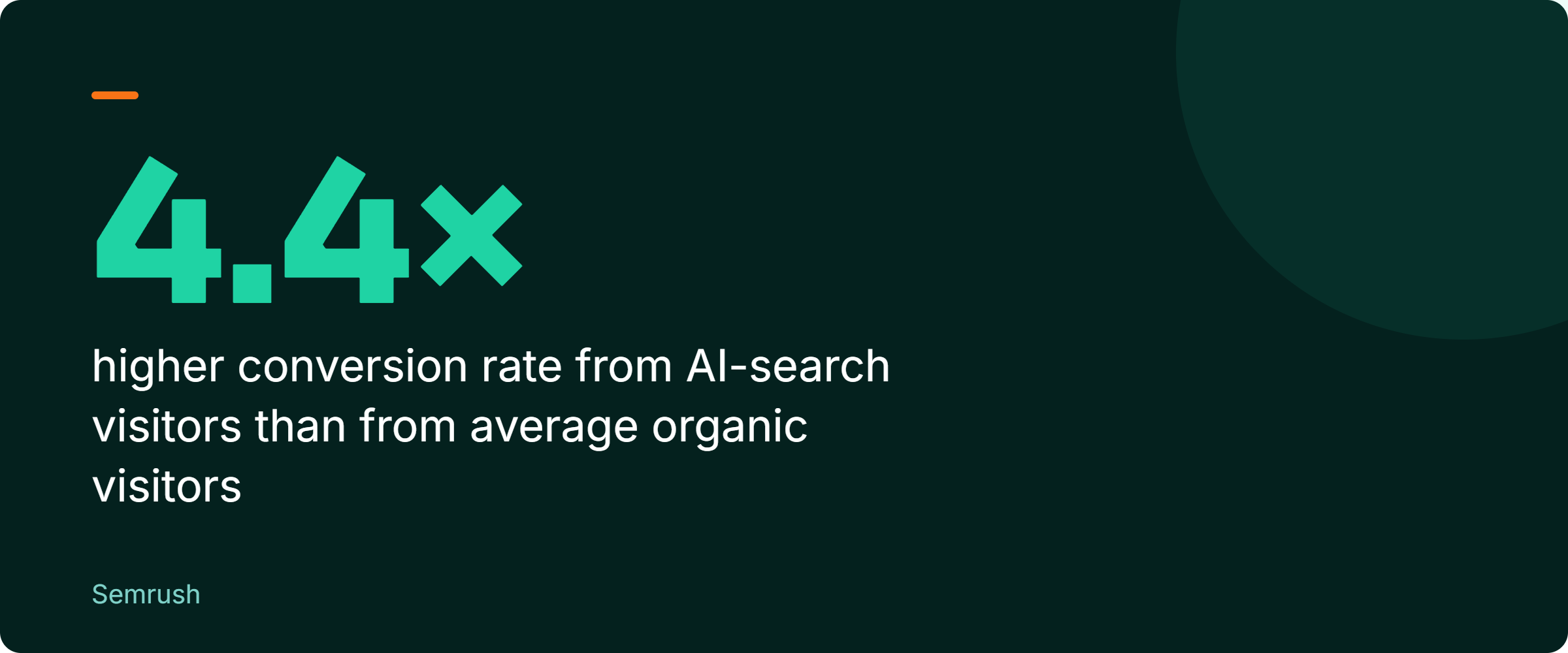
The stakes are worth taking seriously rather than ignoring until 2027. Pew Research Center found that when Google shows an AI summary, users click traditional results in only 8 percent of searches, roughly half the rate of pages without one. Ahrefs measured that AI Overviews cut the click-through rate of the top organic result by 34.5 percent in April 2025, and by their December 2025 update the reduction had reached 58 percent. Meanwhile the traffic AI does send is unusually good: Semrush found visitors from AI search sources convert at about 4.4 times the rate of average organic visitors, because the AI has already qualified them before they arrive. Fewer clicks overall, but the clicks and recommendations that remain are worth more. Being the business the AI names is becoming a revenue question, not a curiosity.
What this means for your business: the work is legitimate, but it only pays if it's sequenced. A beautiful answer-formatted page that AI crawlers can't read produces nothing. A thousand brand mentions pointing at an entity the models can't disambiguate from three other companies with similar names produces confusion. Order matters more than effort.
Why Most Businesses Get This Wrong
The mechanism is predictable. AI visibility advice gets sold as a checklist of tactics, and tactics are easy to buy, so businesses buy them in whatever order they encounter them. Usually that means starting at the most visible, most marketed layer instead of the most broken one.
The clearest example is llms.txt, a proposed file that's supposed to guide AI systems to your best content. It became a default line item in AI optimization packages through 2025. Google's John Mueller was asked about it directly and his answer should have ended the trend:
"FWIW no AI system currently uses llms.txt." John Mueller, Google Search Advocate
He compared it to the keywords meta tag, which search engines have ignored for two decades. Google's Gary Illyes confirmed at Search Central Live in 2025 that Google doesn't support it and isn't planning to. Yet businesses keep paying for it while their actual blocker, often something as basic as client-side rendering, goes undiagnosed. That's the pattern in miniature: the tactic was purchasable, the diagnosis wasn't.
The second driver is that the foundational layers are invisible. No owner gets excited about server-side rendering or a consistent NAP listing. Mentions and citations, layer four, feel like marketing, so that's where the energy goes. But the Vercel research team and others who analyzed AI crawler behavior found that none of the major AI crawlers execute JavaScript. Pre-render analysis of over 500 million GPTBot requests found zero evidence of JavaScript execution. If your site is a React or Vue app without server-side rendering, ChatGPT and Claude and Perplexity may be reading a nearly empty page. Every dollar spent above that layer is spent on a building with no ground floor.
The third driver is platform blindness. Businesses optimize for "AI" as if it were one system. It isn't. Profound's analysis of citation patterns found ChatGPT draws most heavily on Wikipedia, Perplexity draws most heavily on Reddit, and Google's AI Overviews cite YouTube more than any other domain. A separate audit found only 11 percent overlap between the domains ChatGPT and Perplexity cite. If your customers ask Perplexity and your entire mention footprint is trade press, you've optimized for an engine they don't use.
What the Data Actually Shows
Three findings should shape which layer you prioritize, and they all point away from where most budgets currently go.
The strongest evidence concerns layer four, mentions. Ahrefs studied 75,000 brands to find what correlates with visibility in ChatGPT, Google AI Mode, and AI Overviews. Branded web mentions correlated with AI Overview visibility at about 0.66. Backlinks, the thing SEO agencies have sold for twenty years, came in at roughly 0.22. The strongest single factor across platforms was YouTube mentions, in titles, descriptions, and transcripts, at about 0.74. Correlation studies have limits and Ahrefs says so plainly, but the consistency across three separate AI surfaces is hard to dismiss. Machines appear to trust breadth of credible conversation about a brand more than link graphs.
The second finding concerns how AI systems choose what to cite, and it's moving fast. In mid-2025, Ahrefs found 76 percent of pages cited in AI Overviews also ranked in Google's top 10 for the query. By early 2026, that overlap had fallen to 38 percent. Google's query fan-out, which splits one question into many hidden sub-queries, now pulls citations from a much wider pool. The practical read: ranking well still helps, but it no longer guarantees citation, and not ranking number one no longer disqualifies you. Content that answers a specific sub-question cleanly can get cited from position fifteen. That raises the value of extractability, layer three, relative to pure rank chasing.
The third finding is about scale and patience. Similarweb data reported by TechCrunch put AI platform referrals at about 1.13 billion visits in June 2025, up 357 percent year over year, against 191 billion from Google search. AI referrals are typically around 1 percent of a site's traffic today. Anyone promising to transform your business through AI visibility in a quarter is selling against the math. The case for doing this work now is the growth rate, the 4.4x conversion premium, and the fact that the businesses getting cited today are accumulating a compounding advantage in the answers models give tomorrow.
One more verified point, because it protects you from a common upsell: there is no evidence that schema markup is a magic key to AI citations. It's useful, it helps machines disambiguate your entity, and Google uses it for rich results. But it sits in the supporting cast of layer two, not at the top of the stack.
How to Fix It: Diagnose the Stack From the Bottom Up
Work through these in order. Stop at the first layer that fails, fix it, then move up. Each step is something you can do yourself or hand to a developer or marketer with a clear instruction.
Step one: test technical accessibility. Have someone fetch your key pages the way an AI crawler does, raw HTML, no JavaScript. The quick version: in Chrome, disable JavaScript in developer tools settings and reload your homepage and your top three money pages. If the core content disappears, that's your bottleneck, full stop. Also have your developer check the server logs or Cloudflare dashboard for GPTBot, ClaudeBot, and PerplexityBot activity, and confirm robots.txt isn't blocking them unintentionally. Until this layer passes, do nothing else on this list.
Step two: audit your entity. Ask ChatGPT, Gemini, and Perplexity, with web access on, "What is [your business name] and what do they do?" If the answers are wrong, vague, or confuse you with someone else, the models lack a coherent entity to recommend. Fix the corroborating record: a clear about page stating what you do, who you serve, and where; consistent name, address, and category across Google Business Profile, LinkedIn, and the directories that matter in your industry; Organization schema on your site; a Wikipedia or Wikidata presence only if you legitimately qualify. Boring work, high leverage.
Step three: make your content extractable. Pick the ten pages that answer your customers' highest-value questions. Restructure each so the question is a heading and a complete, self-contained answer sits in the first two sentences beneath it, with specifics, numbers, and your name where natural. AI systems quote passages, not pages. A 40-word direct answer gets lifted; a 400-word wind-up gets skipped.
Step four: build mentions where your engines actually look. First find out which AI platforms your customers use, then match the channel to the engine. Reddit threads and community answers matter for Perplexity. YouTube presence matters disproportionately for Google's AI surfaces. Industry publications, podcasts, and review sites feed everything. This is digital PR with new targeting, and it's the layer with the strongest correlation data behind it, but only after layers one through three pass.
Step five: only now buy or build measurement. A tracking tool pointed at a broken stack just documents your absence in higher resolution. Measurement is the top layer for a reason.
What to Measure and When to Expect Results
Keep the scorecard small and tied to money.
Run a monthly prompt audit: 15 to 20 real customer questions through ChatGPT, Gemini, and Perplexity, recording mentions, citations, sentiment, and which competitors appear. Track the trend, not any single week, because AI answers vary run to run. This is your share-of-voice metric and a spreadsheet handles it fine at small scale.
Segment AI referral traffic in your analytics, visits from chatgpt.com, perplexity.ai, gemini.google.com, copilot.microsoft.com, and watch conversion rate rather than volume. The volume will stay small for a while. The Semrush 4.4x finding is the reason the conversion column is the one that matters.
Watch branded search impressions in Google Search Console. Many people who see you in an AI answer never click it; they search your name later. Rising branded demand is the cheapest reliable proxy for AI-era exposure. And log lead sources manually: "ChatGPT recommended you" is showing up in intake forms now, but only if you ask.
Timelines, honestly stated. Layer one fixes can reflect in AI answers within weeks, since retrieval-augmented systems fetch fresh content. Entity and extractability work typically shows in two to three months. Mention-building compounds over six to twelve months. The vanity traps to refuse: composite "AI visibility scores" with undisclosed methodology, citation counts with no revenue column next to them, and celebrating a mention in an answer no customer ever asks. Tie everything back to leads and sales or you're decorating a dashboard.
For the full map of which layers to fix and in what order, read my AI search visibility guide.
Frequently Asked Questions
How do I find out which layer is my bottleneck?
Test from the bottom up, in order, and stop at the first failure. Load your key pages with JavaScript disabled to check technical accessibility, then ask three AI assistants what your business does to check entity clarity, then look at whether your top pages contain direct, liftable answers, then search your brand name to gauge your mention footprint. The first test that fails is your bottleneck, and fixing anything above it is wasted spend until it passes. Most businesses I see fail at layer one or two while paying for work at layer four.
Do I need an llms.txt file or special AI schema to show up in AI answers?
No. Google's John Mueller has said that, as far as he knows, no AI system currently uses llms.txt, and Google has confirmed it doesn't support the file and has no plans to. Standard schema markup like Organization and FAQ is worth having because it helps machines understand your entity, but it's a supporting signal, not a ranking key. The things with actual evidence behind them are server-rendered crawlable content, clearly structured answers, and brand mentions across credible sources, so spend your budget there first.
How long until AI visibility work produces actual revenue?
Expect a layered timeline. Technical fixes can change what AI assistants say about you within four to eight weeks because these systems retrieve live content. Entity cleanup and content restructuring usually show in citation audits within two to three months. Mention and authority building is a six-to-twelve-month compounding play. Revenue impact depends on volume, and AI referrals are still around 1 percent of typical site traffic, so judge the channel on conversion rate and lead quality, where Semrush's data shows AI visitors convert at roughly 4.4 times the rate of average organic visitors.
The uncomfortable truth about AI visibility is that the unglamorous layers decide the outcome. Most businesses don't have a mentions problem or a tooling problem, they have a foundation problem wearing an AI costume. Run the bottom-up diagnostic this month, fix the first thing that fails, and only then move up the stack. If you'd rather have someone run the diagnostic for you, that's exactly the kind of work worth delegating before you spend another dollar on tactics.