You Don't Have an AI Visibility Problem. You Have Five of Them.

You hired someone to fix your "AI visibility," they ran a generic GEO playbook across every engine, and your dashboard shows movement that nobody can tie to a single piece of pipeline. That's not bad execution. That's a category error. There is no such thing as one AI visibility number to win, because the major engines cite almost entirely different sources and recommend different brands most of the time. I will show you that the engines barely overlap and why the one-size-fits-all approach is structurally guaranteed to underperform. Then I will give you a default weighting for your report and a way to spend your next marketing dollar on the one engine your buyers actually use.
The Engines Aren't Reading the Same Internet
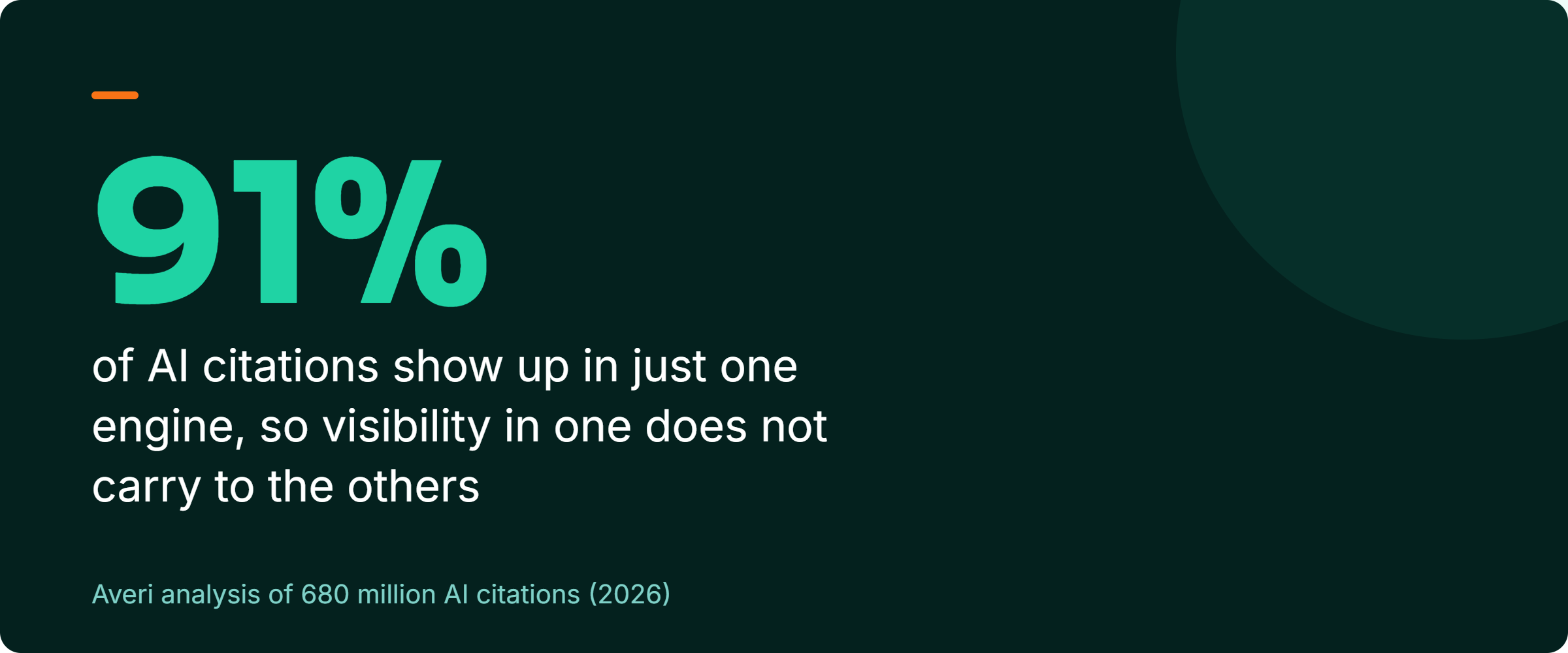
One number should reframe everything. According to an Averi analysis of 680 million AI citations in early 2026, only 11% of the domains cited by ChatGPT and Perplexity overlap. Drill down to the actual page level and it gets worse. Only about 2% of cited URLs appear across AI Overviews, ChatGPT, and Perplexity together, and 91% of citations show up in just one engine. A separate Whitehat SEO study of 118,000 responses found the same pattern. These are not three windows onto the same web. They are three different webs that happen to share a few addresses.
Translate that to your business. When you pay for "AI visibility," you are implicitly assuming the engines pull from a common pool of trusted sources. You assume winning trust once earns you presence everywhere. That assumption is false. If your agency optimized you into ChatGPT's source diet and your buyers actually use Perplexity, you spent real money becoming visible to an audience that isn't yours. The disjointness means a single generic push is, by the math, mostly wasted on whichever engines you didn't target.
It's not just the sources that diverge. BrightEdge's AI Catalyst benchmark found the engines disagree on which brands to recommend 61.9% of the time, and only 33.5% of queries surface the same brands across all three platforms. Even when two engines happen to read a similar source, they frequently arrive at a different recommendation. Your competitor can be the default answer in one engine while you are the default in another. A blended score would hide that from both of you.
Why Most Businesses Get This Wrong
The mistake keeps happening because the entire SEO industry trained us, correctly, on a world where there was one index to rank in. For two decades, "win Google" was a coherent goal because Google was a single system with a single ranking. The reflex carried straight into the AI era: people assume "win AI" is the same kind of unified target. It isn't. Each engine has built its own retrieval system on its own preferred surfaces, and those systems were never designed to agree.
Conventional GEO advice makes this worse by selling a universal cure. The pitch is comforting: build entity authority, clean up your schema, earn citations, and you'll be recommended everywhere. But "everywhere" is exactly the assumption the data destroys. An 11% domain overlap and a 62% brand disagreement rate mean entity authority earned on one engine's preferred surface does not automatically transfer. You can be an authority on Wikipedia and a ghost on Reddit, and those two facts can coexist for the same brand on the same day.
There's a deeper shift underneath all this that explains why a single static target is disappearing. Mike King of iPullRank, in Search Engine Land's 2026 predictions, frames where this is heading.
"In 2026, personalization stops being a feature and becomes the operating system. Google's Nested Learning work makes the direction obvious."
Mike King, iPullRank, via Search Engine Land
King calls the emerging discipline "Relevance Engineering," and his point matters for owners. If results are personalized in real time and fragmented across engines, there is no fixed "Position 1" to capture once and bank. You are not optimizing for a single leaderboard anymore. You are earning presence inside several different retrieval systems that each define relevance their own way. Treating that as one problem is the root mistake.
What the Data Actually Shows
Start with the source diets, because they are the most actionable evidence. Profound studied 30 million citations between August 2024 and June 2025 and found each engine leans on a distinctly different surface. ChatGPT leans heavily on Wikipedia, which made up roughly half of its top citations. Perplexity leans on Reddit, which accounted for nearly half of its top citations. Google AI Overviews spread their citations more evenly, with Reddit narrowly ahead of YouTube at the top. Claude favors blogs. Read those splits directionally. The exact percentages move. PikaSEO's 2026 data, for instance, reports YouTube overtaking Reddit as the top social source for AI citations overall, and some roundups put Google AI Overviews closer to Reddit. The headline survives every revision: each engine has its own dominant source, and the splits drift while the disjointness holds.
Even inside Google's own house, the fragmentation shows up. Google AI Overviews and Google AI Mode cite the same URLs only 13.7% of the time, according to an Ahrefs study of 730,000 responses published in December 2025. That makes "optimize for Google's AI" two different jobs, not one. Cross-platform overlap with Google's classic top 10 organic results is around 12% in Ahrefs' query-level analysis. Your blue-link ranking tells you very little about your AI presence.
How fragmented your specific problem is depends heavily on your vertical, and this is where many owners overcorrect. BrightEdge's 2026 data shows retail, travel, and tech categories see the engines agree 88% to 97% of the time on brands. Healthcare is around 60%. Finance is around 71%. If you sell software, the engines may largely agree and your job is mostly to be in the consensus set. If you're in healthcare or finance, the engines are genuinely recommending different providers, and a one-engine bet is far riskier. You have to know your own number before you decide how hard to spread your effort.
The currency has shifted too, and most budgets haven't caught up. Ahrefs studied 75,000 brands in December 2025 and found unlinked brand mentions correlate with AI citations at 0.664 on a Spearman scale, versus 0.218 for backlinks. That's roughly three times the relationship. In plain terms, being talked about without a link now predicts AI citation far better than the links you've been paying for. Rand Fishkin has argued a related point for years: the zero-click shift began around 2011, long before AI. Brands should build influence where buyers already gather, on LinkedIn, Reddit, YouTube, and inside the LLMs themselves. His position is that aggregate brand presence is measurable even when individual AI answers are inconsistent. That is the lens this whole problem needs.
The stakes are real and quantified. One 2026 report from Omni Eclipse found that 77% of businesses ranking on Google page one are invisible in ChatGPT. A 5W Public Relations analysis of Brandlight data measured the overlap between top Google links and AI-cited sources collapsing from roughly 70% to under 20%. Meanwhile eMarketer projects 31.3% of the US population will use generative AI search in 2026. A widely cited 2026 figure shows brands cited in AI Overviews earning about 35% more organic clicks and 91% more paid clicks than non-cited brands. Perplexity adds a freshness lever: content published within the prior 14 days made its top-three citations 72% of the time, regardless of domain authority. That single fact tells you Perplexity rewards a fundamentally different behavior than ChatGPT does.
Before you panic and reallocate everything, hold the counterweight. Non-branded organic traffic is still roughly 47 times larger than ChatGPT traffic and drives the majority of ecommerce revenue, per ALM Corp's 2026 summaries, even as ChatGPT traffic reportedly converts about 31% higher. Google's own AI search guide, covered by Search Engine Journal, calls AEO and GEO "still SEO." This is not abandon-Google advice. It's allocation advice. The enterprises already act on it: Conductor's 2026 CMO report found 94% plan to increase AEO and GEO investment this year, making it the number one marketing priority above paid media.
Which AI Engines to Track First, and Which to Demote
Knowing the engines disagree tells you to split the work. The market numbers tell you where to start, and they are lopsided. For a local or service business the biggest AI surface is Google's own. AI Overviews appeared on 43% of US searches by May 2026, up from 15% a year earlier, and reach about 2.5 billion users a month. AI Mode has passed 1 billion monthly users, and around 93% of AI Mode sessions end without a click.
Give that layer its own section in your report, above the assistants. Split it into two lines as well. In the Ahrefs study above, AI Overviews and AI Mode cited the same URLs only 13.7% of the time.
The assistants come next, and their traffic is just as uneven. Similarweb measured share of visits across seven AI assistants in May 2026.
| AI assistant | Share of visits, May 2026 | Where it goes in your report |
|---|---|---|
| ChatGPT | 53.9% | Its own line, every month. |
| Gemini | 27.9% | Its own line, every month. Rising. |
| Claude | 9.2% | Promote it only if you sell B2B or to enterprise. |
| DeepSeek | 4.1% | Quarterly monitor block. |
| Grok | 2.4% | Quarterly monitor block. |
| Perplexity | 1.3% | Quarterly monitor block. Drop it from the headline. |
| Copilot | 1.3% | Promote it if your buyers work inside Microsoft 365. |
Perplexity's referral share, a separate measure from visits, is shrinking as well. StatCounter's worldwide AI chatbot referral data has Perplexity falling from 7.91% in June 2026 to 4.31% in August 2026. Gemini climbed from 7.94% to 10.9% over the same three months. A tracker that weights those two engines equally reports a trend that runs opposite to the market.
| Referral share | June 2026 | August 2026 | Direction |
|---|---|---|---|
| Perplexity | 7.91% | 4.31% | Nearly halved in three months. |
| Gemini | 7.94% | 10.9% | Rose while Perplexity fell. |
When I run the same buyer prompts in ChatGPT and Gemini for the businesses I track, the two engines often name different companies. My ChatGPT and Gemini gap check compares the two lists for your market in an afternoon. Include Perplexity in that first pass as a baseline. After that, move it to the quarterly block unless your buyers use it.
Demote the small engines and keep them on the report. Greg Jarboe of SEO-PR drew that line in Search Engine Journal on September 9, 2026, after calls on LinkedIn to strip Perplexity out of trackers entirely.
Jarboe backs it with 2002, when the standard agency report tracked Yahoo, Excite, Lycos, AltaVista and Ask Jeeves. Google was not on the list. A monitor-only row in a spreadsheet is free. Deleting it throws away the trend line you would need to spot the next Google while it is still small.
That gives you a default report. It is built on Jarboe's tiers, with Google's AI layer moved to the top for local and service businesses:
- Google's AI layer. AI Overviews and AI Mode, each on its own line.
- ChatGPT and Gemini. Tracked separately and never averaged. Add Claude if you sell B2B or to enterprise, and Copilot if your buyers work inside Microsoft 365.
- The monitor block. Perplexity, Grok and DeepSeek, collected every month and read once a quarter.
Treat that as the starting weighting for a report you have not tuned yet. Your own buyers overrule it. If Step 1 below shows your customers lean on Perplexity, Perplexity moves up.
How to Fix It: Step-by-Step
You don't have an AI visibility problem. You have three to five of them, and they don't share answers. Here is how to treat them as the separate problems they are.
Step 1: Find out which engine your buyers actually use. This is a conversation, not a tool. Ask your sales team, your support reps, and your last ten customers a single question: which AI tool, if any, did you use before you contacted us? You'll often find a clear lean, and it frequently isn't the engine you assumed. Combine that with the BrightEdge vertical data. If you're in tech or retail the engines mostly agree and you can move fast on consensus. If you're in healthcare or finance, expect genuine divergence and plan to fight on more than one front. Start from the default tiers above and move an engine up or down on what your customers tell you. The deliverable from this step is a ranked list of engines by buyer relevance.
Step 2: Audit where your top engines source answers in your category. Take the real prompts your buyers use, the actual questions and never your branded keywords. Run them in Google AI Overviews, AI Mode, ChatGPT and Gemini, plus any engine Step 1 moved up. For each one, record which brands show up and which sources the engine cites to justify the answer. After fifteen or twenty prompts you'll see the pattern. Maybe one engine keeps citing a specific subreddit and two review sites in your space. That citation list is your actual target. Hand it to whoever owns content as the list of surfaces you need to appear on.
Step 3: Match your effort to each engine's preferred surface. If your buyers live in ChatGPT, build Wikipedia-grade factual presence. Keep your brand facts consistent everywhere they're stated, clean up entity and schema markup, and earn an accurate, well-sourced Wikipedia entry if you qualify. If they lean on Google AI Overviews or AI Mode, you need real Reddit and YouTube investment, because those are the surfaces those answers draw from most. The Profound study above does not cover Gemini. For Gemini buyers, start from the citation list Step 2 gave you. Clovion AI's study of 36 B2B software and fintech categories, reported by Greg Jarboe in Search Engine Journal on July 7, 2026, found Gemini leans on marketing material and video. If Step 1 moved Perplexity up, you need Reddit and forum presence plus genuine freshness, because of that 14-day, 72% top-three window. Same brand, different production plans. Don't let an agency run one checklist on every engine.
Step 4: Spend the marginal dollar on earned mentions, not links. Given the Ahrefs finding that unlinked mentions correlate with AI citations roughly three times more than backlinks, your next budget increment should buy you being talked about on the surfaces your target engine reads. That means podcast appearances, inclusion in industry roundups and comparison pieces, active and useful community participation, and getting named in the "best X for Y" content that lives where your engine sources answers. Tell your PR or outreach person their goal is mentions in the right places, not link counts.
Step 5: Format every page answer-first. Lead each page with a short, direct answer to the question it targets, then support it with clean H2 and H3 structure, one topic per section, and appropriate FAQ or product schema. This helps every engine retrieve you cleanly. One important caution: do not artificially chop your content into robotic chunks to game the LLMs. Google's Danny Sullivan was blunt that "we don't want you to do that." Write for a human, structure it well, and let the structure do the work.
Step 6: Make sure you're not invisible by accident. Before spending on any of the above, confirm the engines can even reach you. Check that your robots.txt isn't blocking AI crawlers and your CDN isn't challenging them. Make sure key content isn't trapped behind a login wall. Your pages should render server-side so that the content exists without JavaScript. Plenty of brands missing from AI answers never lost a content battle. They locked the door by accident. This is a one-hour question for your developer that can save a quarter of wasted content spend.
What to Measure and When to Expect Results
Measure per engine and never as one blended "AI visibility score." Averaging is how you hide the exact problem you're trying to solve. Track citation share and brand mention rate separately for Google AI Overviews, AI Mode, ChatGPT and Gemini. Check those monthly because these systems shift constantly. Tie each one to revenue signals instead of raw appearances. A clean way to run this is a monthly log of your top buyer prompts per engine, marking whether you appeared and who was named instead. Add referral and conversion data segmented by AI source where your analytics can see it.
Read that referral data with care. Most AI Mode sessions end without a click, and a customer can read about you, decide and call without ever showing up as an AI visit. Once a quarter, open the monitor block of Perplexity, Grok and DeepSeek and look for a sudden move. Gemini's jump in the StatCounter data took three months. Revisit the weighting at the same time, with the new share data in front of you.
On timelines, set realistic expectations. Entity and schema cleanup can show up in retrieval within a few weeks. Earned mentions compound over a quarter or two, because the engines need to encounter the new references repeatedly before they treat them as signal. Perplexity's freshness window means well-timed content can show up fast there, sometimes within days, while ChatGPT's Wikipedia-heavy diet moves slowly and rewards patience. Roughly speaking, expect early per-engine movement inside 30 to 60 days and meaningful, revenue-linked shifts over one to two quarters. Anyone promising uniform results across all engines in a month is selling the very myth this article is dismantling.
Do not celebrate a blended citation count that doesn't break out by engine. The Conductor case study showing a 448% lift in AI citations and 185% lift in AI mentions is impressive, but it never specifies which engine. As a buyer, always ask which engine before you celebrate. A 448% gain in an engine your buyers don't use is a vanity number. Don't measure total AI mentions without checking whether the mention is accurate and favorable; being named in a comparison where you lose is not a win. And don't let your team report "we're showing up in AI" as a binary. Showing up in one of five systems, for prompts your buyers don't ask, on an engine they don't use, is not the same as visibility that moves pipeline.
I break the whole stack down, layer by layer, in my complete guide to AI search visibility.
Frequently Asked Questions
If the engines disagree so much, should I just pick one and ignore the rest?
Pick the one your buyers actually use first and keep the others on the report at a lower weight. Ask sales and support which AI tool people mention before they contact you, then put the bulk of your effort behind that engine's preferred surface. Move the smallest engines to a monitor-only block you read quarterly. Perplexity had 1.3% of assistant visits in Similarweb's May 2026 data, and Greg Jarboe's advice in Search Engine Journal on September 9, 2026 was to demote it and keep tracking it. The standard agency report in 2002 tracked Yahoo, Excite, Lycos, AltaVista and Ask Jeeves without Google. A cheap monitor row is how you notice the next Google early.
Doesn't ranking well on Google mean AI will cite me anyway?
No, and that assumption is costing businesses real visibility. One 2026 report found that 77% of businesses ranking on Google page one are invisible in ChatGPT. Brandlight measured the overlap between top Google links and AI-cited sources falling from roughly 70% to under 20%. Your Google ranking is a head start in some categories and almost irrelevant in others. Verify it by running your buyers' actual prompts instead of assuming.
Should I stop investing in regular Google SEO to fund all this?
Absolutely not. Non-branded organic traffic is still roughly 47 times larger than ChatGPT traffic and drives the majority of ecommerce revenue. Google's own AI search guide calls AEO and GEO "still SEO," meaning the fundamentals carry over. This is a reallocation decision, not a replacement. Fund the AI work from the margin, from new earned-mention budget, not by gutting the channel that still pays your bills.
The whole industry is selling you a single dashboard number because a single number is easy to sell. The data says that number is a fiction. The engines read different internets, cite different sources, and recommend different brands most of the time, and the gap is widening, not closing. The next time someone shows you an "AI visibility" report with one trend line, ask them the only question that matters: which engine, which buyers, which prompt. If they can't answer that, you're not looking at visibility. You're looking at an average that's hiding exactly where you're losing.