Google's New AI Lives Inside Your Ad Account. Don't Hand It the Keys.

You will get an invitation, soon, to talk to your Google Ads account in plain English and let it make changes for you. The pitch will be that you no longer need to understand the dashboards. That is exactly the part to distrust. Google's new Ask Advisor is a fast, capable junior analyst working inside the accounts you already pay for. It is good at the job. The chat box still invites you to approve budget shifts and audience changes you have no way to sanity-check.
Treat Ask Advisor like a junior hire with real talent and zero accountability. Let it read your data and draft your campaigns, and verify its work before it executes anything. Never confuse "it built me a campaign" with "it built me a good campaign." Owners who win treat it like delegation with oversight. Owners who lose treat it like a slot machine and pull the lever.
The chat box quietly moves the steering wheel into the agent's hands
Google announced Ask Advisor at Google Marketing Live in June 2026, and the description matters more than the demo. According to Search Engine Land's coverage and Google's own blog at blog.google, Ask Advisor is a Gemini-powered "collaborator." It spans four products at once: Google Ads, Google Analytics, Merchant Center, and the Google Marketing Platform. It is in beta, English-language accounts only, with more capabilities arriving later in 2026.
Four products is easy to read past. Make it concrete. On the Google Ads side, a plumber types "I want more emergency call jobs this month" and the agent drafts a search campaign, picks keywords, and sets a daily budget. That work used to mean an afternoon of clicking or a retainer check. In Google Analytics, a boutique owner asks "why did online sales drop last week" and the agent reads the traffic data. It answers in a sentence instead of leaving her to export reports she does not know how to read. In Merchant Center, a dental office that sells whitening kits says "promote my best whitening product," and the agent pulls the product feed, the price, and the photo straight into a new campaign. Nobody re-types a thing. Across the Google Marketing Platform, the cross-surface layer, a contractor asks "show me which campaigns brought real new customers, not repeat clicks" and the agent stitches reporting from all four systems into one view. Different surface, same move every time: one sentence in, a stack of decisions out.
The example Google itself gave is the tell. A marketer asks it to "find new customers for my hair care products." It pulls the product details out of Merchant Center, then helps build the campaign in Google Ads. Four systems, one sentence of input. For an owner who has spent years squinting at conversion columns, that feels like a gift.
It also does something subtler. It connects the spend in Ads to the behavior in Analytics and answers "why did this happen," not just "what happened." When sales dip, the old way was to open three tabs, export two reports, and guess. The new way is to type a question and read a paragraph. That is genuinely useful, and that is the trap, because a paragraph reads like a conclusion even when it is a guess wearing a suit.
That boutique owner's case shows both the gift and the trap in one frame. She asks why last week's online sales fell, and the agent comes back with a clean answer: mobile traffic dropped after a checkout page started loading slowly, and fewer carts converted. That is the good version. It is plausible, it points at something fixable, and it saved her an hour of digging. The trap is what happens next. If she treats that paragraph as fact and goes off to "fix" the checkout, she may have aimed at the wrong thing entirely. The agent surfaced one plausible cause and presented it with the calm confidence of a settled finding. Three other explanations fit the same week just as well: a competitor ran a sale, a supplier delay left her bestseller out of stock, or the dip is plain week-to-week noise. The fix is not to distrust the agent. Treat its explanation as the first source, not the only one, and check it against a second. She has her own sales records and her stock list. She can also load the checkout page on her phone and see whether it is actually slow. A cause you verified against a second source is worth acting on. A cause you accepted because it was phrased well is how owners spend a week solving a problem they never had.
Think about who is driving now. With a dashboard, you point and click, and the tool only does what you told it. With a conversational agent, you describe an outcome and it decides the steps. The agent picks the audience. The agent suggests the budget. The agent proposes the bid change. You said four words. It made forty decisions. If you cannot name those forty decisions, you are not delegating, you are gambling, and the house has your card on file.
Why a useful tool turns into an expensive habit
The mistake is not laziness. It is relief. You did not want to learn Google Ads. You wanted the leads. When a tool finally speaks your language, the temptation is to stop checking its work, because checking the work was the part you hated in the first place.
Agencies have trained owners into this for years. A roofer in Tampa gets a monthly PDF, sees the word "optimized," sees a green arrow, and approves the invoice. Ask Advisor removes even the agency from that loop. Now the green arrow and the explanation come from the same system spending your money, which is a little like asking the contractor to also be the inspector.
The deeper reason owners get burned is that the interface hides the stakes. "Shift budget toward your best-performing audience" sounds like obvious advice. It can also mean pulling spend out of the campaign that actually drove new customers and pouring it into one that was quietly taking credit for sales it never earned. I have written before about how your Performance Max ROAS often takes credit it did not earn. An agent will cheerfully optimize toward that exact blind spot if you let it act without a check. A confident sentence is not a verified outcome. The whole point of an analyst is that someone reviews the analyst.
What the data says about agents that nobody supervises
This is not a hunch about one Google product. It is the documented pattern for the entire category. In August 2025, Fortune reported on MIT's NANDA "GenAI Divide" study, built from 150 leader interviews, a survey of 350 employees, and a review of 300 public AI deployments. The finding: roughly 95% of enterprise generative-AI pilots delivered no measurable impact on profit and loss.
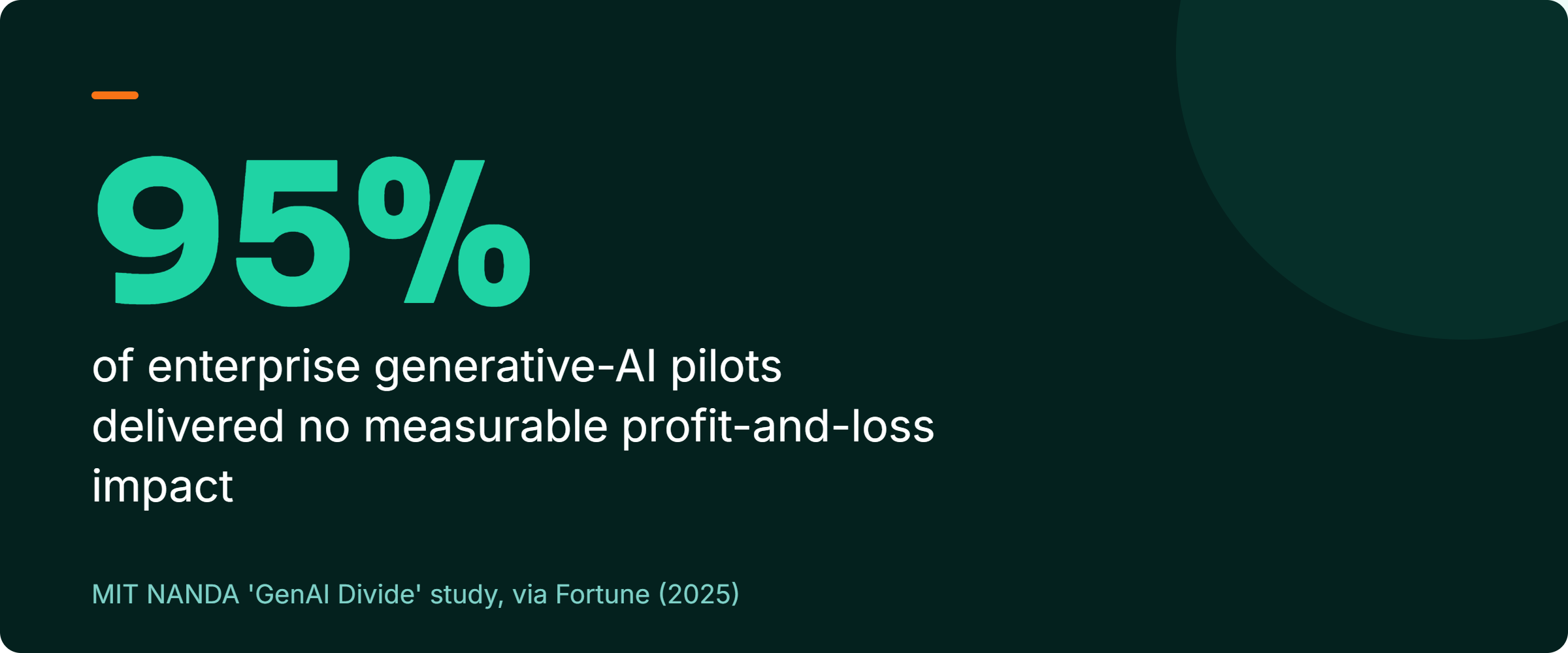
Read the reason, because it reframes everything. The failures were not caused by weak models. The models were fine. The gap was integration and learning, the human work of fitting the tool into a real workflow and judging its output. Ninety-five percent of pilots added no measurable value to the bottom line. The missing ingredient was a person who knew what good looked like and made the tool deliver it.
Google is now handing you the most integrated agent yet, one already wired into Ads, Analytics, and Merchant Center. The integration excuse goes away. What remains is the judgment gap. If an owner adopts Ask Advisor and skips the judgment, the most likely outcome is quieter and worse than a disaster: a flat result that looks busy. Spend moved around, campaigns rebuilt, dashboards humming, and the same revenue at month's end. I have made this argument in the context of speed before, that AI making you faster is not the same as it making you money. Ask Advisor is about to test that distinction in your own account.
A verify-before-you-trust routine a non-analyst can actually run
You do not need to learn Google Ads to supervise this thing. You need a habit. Here are five steps, and you can do the first four yourself in a few minutes each.
First, draw a hard line between advise and act. Let Ask Advisor read, explain, and draft as much as it wants. Reading reports, spotting a dip, sketching a campaign, that is all upside with no money at risk. The moment it proposes to change a budget, a bid, or an audience, that is the line. Advising is free. Acting spends. Treat the two as different permissions, the way you would let a new hire write a proposal but not wire funds.
Second, make it show its work in money and time, not adjectives. When it says a campaign is performing well, ask it the plain follow-up: how much did we spend, how many new customers did we get, and what did each one cost? If the answer is a number you can compare to what a customer is worth to you, good. If the answer is "engagement improved," you have caught a vanity metric, and you stop there.
Third, ask it to argue against itself. Type: "What would have to be true for this recommendation to be wrong, and what should I check before I approve it?" A junior analyst worth keeping can tell you where their own advice is shaky. If the agent cannot name a single risk in shifting your budget, that is your signal to slow down, not speed up. This is the same discipline that protects the boutique owner from acting on the first cause she is handed. An agent forced to name its own weak spot will often admit it only looked at one explanation. That is your cue to go pull the second source yourself.
Fourth, make one change at a time. If you let it act, approve a single change, then wait two weeks and look at sales and cost per new customer before approving the next. Owners who let an agent rewrite five settings at once lose the ability to tell which change helped and which one quietly bled money. One lever, then measure, then the next lever.
Fifth, when you are out of your depth, this is the exact question to send your agency or a freelance specialist: "Ask Advisor wants to do X to my account. Walk me through, in dollars, what we gain if it is right and what we lose if it is wrong, and tell me what you would check first." If they answer in plain numbers, keep them. If they answer in jargon, you have learned something about them too. Before you let any agent reshuffle spend, confirm the account is not already leaking 25 cents on every dollar through waste an agent will happily optimize around instead of fixing.
A general chatbot can reason about a report you copy in, but it is guessing about a snapshot, blind to the live account and unable to touch it. Ask Advisor works inside the real systems, sees current numbers, and can pull the trigger. That is more powerful and more dangerous in the same breath. The verify step is optional when you are just asking a chatbot to explain a chart. Here it is not.
What to watch on Monday, and the green arrow to ignore
Two numbers tell you whether Ask Advisor is earning its place, and most of what it puts on your screen is not among them. New customers acquired, and what each one cost you. Everything else it can show you, impressions, click-through rate, engagement, "optimization score," is a means to those two ends, and any of them can climb while the two that pay your rent sit flat.
The vanity trap to name out loud is the optimization score and any tidy green arrow the agent surfaces. A rising score measures how closely you followed Google's suggestions. It does not measure whether those suggestions made you money. An account can hit a high score by accepting recommendations that broaden targeting and lift spend, which looks like progress and reads, on your bank statement, like a raise you gave Google. If you take one number into the meeting, take cost per new customer, and watch it across a few weeks, not a few days.
Time matters as much as metric. Give any change two to four weeks before you judge it. A two-day spike is noise, and the agent will be tempted to react to it and nudge you to react too. The same patience applies to the explanations it hands you. When the agent says sales dipped because of one cause, being wrong costs more than a wasted afternoon. You end up with a fix aimed at the wrong target while the real cause keeps draining you. Slower judgment is the supervisor's edge. The agent moves fast. Your job is to be the part of the system that does not.
Do not refuse the tool. Refusing would be its own mistake, the same one people made in the three "SEO is dead" panics I have watched come and go: freezing while the useful part passes them by. Ask Advisor will save real hours reading reports you dreaded and drafting campaigns from a sentence. Take those hours. Just do not also hand over the judgment, because the judgment was always the job.
Frequently Asked Questions
Is Google's Ask Advisor safe to let run my ad campaigns automatically?
Let it read your data, explain what is happening, and draft campaigns freely, since none of that spends money. Draw the line at acting. Before it changes a budget, bid, or audience, require it to show the expected gain and risk in dollars, and approve one change at a time. Treat acting as a separate permission from advising, the way you would let a new hire write a plan but not move funds without sign-off.
How is Ask Advisor different from just pasting my Google Ads data into ChatGPT?
A general chatbot reasons about a snapshot you paste in. It is blind to your live account and cannot change anything. Ask Advisor works inside Google Ads, Analytics, Merchant Center, and the Marketing Platform, sees current numbers, and can execute changes directly. That makes it more useful and more dangerous in the same breath. Verifying its work before it acts matters more here than with a chatbot that can only talk.
What is the one number I should watch to know if Ask Advisor is actually helping?
Cost per new customer acquired. Most metrics the tool shows, impressions, click-through rate, engagement, optimization score, can rise while your real results stay flat. Track what each new customer costs you and compare it to what a customer is worth to your business. Watch it over two to four weeks, not two days, because short spikes are noise that an agent may tempt you to chase.
The version of you that wins with this tool is not the one who learns Google Ads. It is the one who runs Ask Advisor the way a good manager runs a sharp, fast junior hire. That manager is clear about the goal, skeptical of the confident answer, and the final yes on anything that spends. Ethan Mollick, the Wharton professor, made this case in his essay on management as an AI skill.
The skills that are so often dismissed as "soft" turned out to be the hard ones.
Ethan Mollick, Wharton professor, "Management as AI Superpower"
If managing the agent is the real skill, and the MIT numbers say it is, then the question stops being whether Ask Advisor is smart enough to trust. It already is. The question is whether you are willing to keep doing the one job it cannot do for you, which is the same job you were hoping to hand off in the first place. For more on why that supervisory instinct, not technical fluency, is the advantage worth building, I have made the broader case that your real AI advantage is management, not tech skills. The chat box will not remind you of any of this. It will just ask what you would like to do next.