Your Homepage Is Now an AI Landing Page

You opened your analytics this month and saw a referral source that used to be a rounding error climbing up the list. ChatGPT. Real visits, real people, more of them every week. For a second it felt like good news, and it is. Then you looked at where those visitors arrive and what they do, and the picture got murkier. They hit your homepage, look around for a few seconds, and a surprising number buy or book or call. Many more bounce, and you have a nagging feeling the page they reached was built for a completely different kind of visitor.
It was. In May 2026 ChatGPT started turning brand names and URLs in its answers into clickable links. Referral traffic from it jumped sharply, and that traffic appears to convert better than ordinary Google search. Almost all of it arrives at your homepage, a page you built years ago to greet people who already knew who you were. Everyone in marketing is busy optimizing articles to get cited by the AI, and almost nobody is fixing the page where the click actually ends up. That homepage is now your most important landing page, and it is probably not ready.
The May 7 branded-link update turned mentions into clicks
For a long time, when ChatGPT recommended a business, it just said the name in plain text. No link. The person reading had to copy your name, open a new tab, and go search for you, and plenty of them never bothered. You got the mention but not the click.
That changed on May 7, 2026. ChatGPT began making brand names and URLs in its answers into live, clickable links straight to the businesses it recommends. The change got nicknamed the "branded link update," and the effect on traffic was immediate and large. The source matters more than the headline here. Look at where each figure comes from before you trust it.
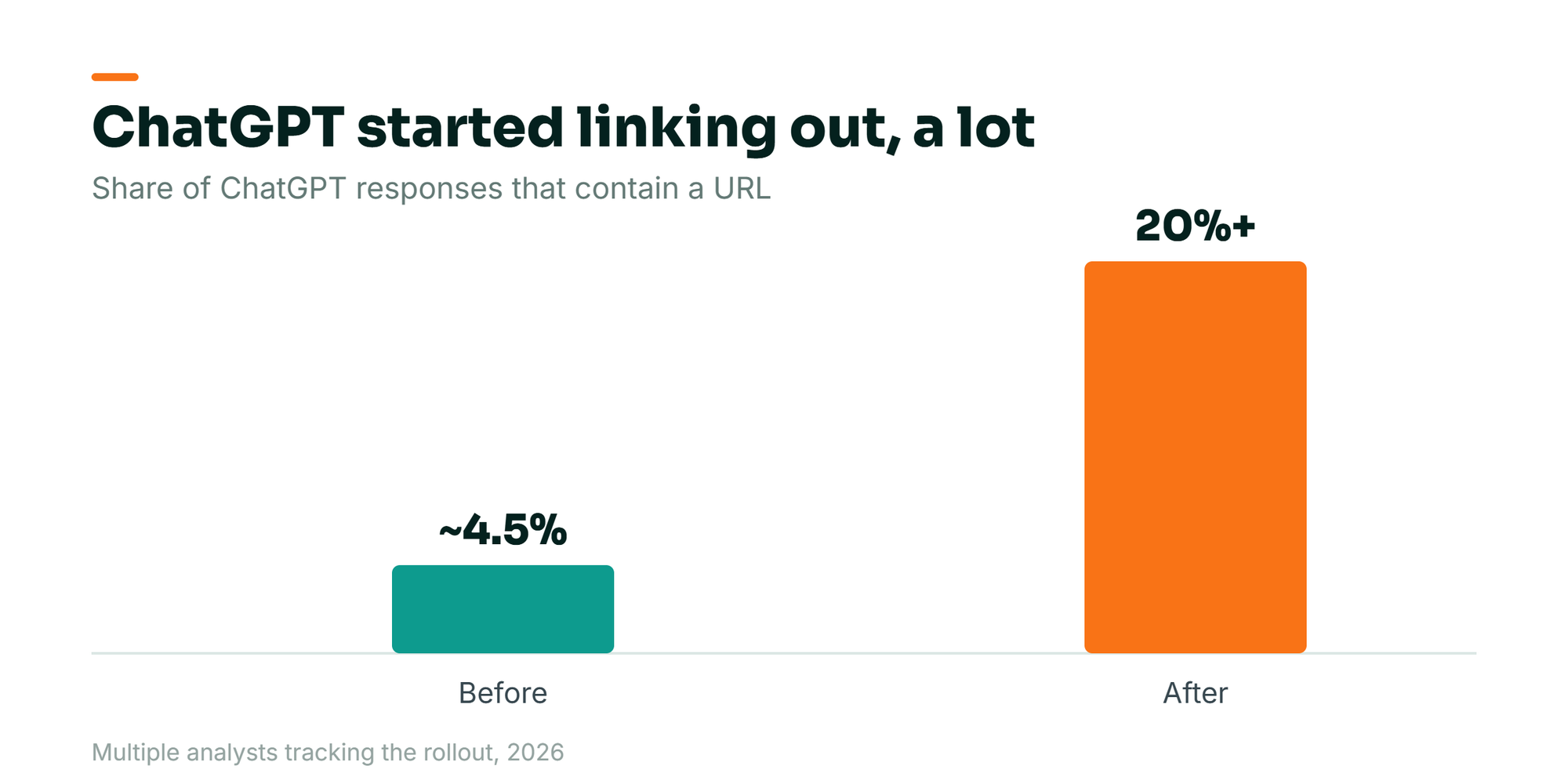
Multiple analysts tracking the rollout found that the share of ChatGPT responses containing a URL rose from roughly 4.5 percent to over 20 percent essentially overnight. Several firms watching the change reported that figure consistently. Similarweb, a company that measures web traffic for a living, reported that ChatGPT referral traffic to the sites it monitors surged week over week after the update. Search Engine Roundtable covered the same Similarweb finding, which gives it a second source.
Week-on-week, total ChatGPT referrals increased by 157.7%.
Similarweb, web traffic analysis, May 2026
One more shift should make you sit up. Several early analyses found that homepage referrals specifically surged after the update. A growing share of those ChatGPT clicks went to brand root domains instead of individual articles. The exact percentages vary by firm and cover a short window. The safe read is directional. The AI started sending people, and it started sending most of them to your front door, not your blog.
The warm visitor converts because someone already vouched for you
If ChatGPT were sending you tire-kickers, you could ignore it. It is not. Early agency analysis of AI referral traffic has pointed in one direction with unusual consistency: visitors arriving from ChatGPT convert at meaningfully higher rates than visitors arriving from ordinary Google organic search. The client studies circulating among analytics teams show the gap running several times over, far wider than a point or two.
Numbers like that need a warning label, because caveats are the only thing that makes a statistic useful. Gaps that wide almost always come from a single client with a long, research-heavy buying process, measured over a short window, and that context inflates the multiple. Do not promise your boss a specific lift. Treat these early figures as a strong directional signal that AI-referred visitors convert better, not as a guarantee of any particular multiple for your own business. I am hedging here on purpose, because the precise number is still settling and you should not build a forecast on one client's quarter.
Even discounted heavily, the logic holds for a simple reason rooted in mindset. The Google searcher typed a query, got ten blue links, and is comparison shopping with six tabs open, owing you no loyalty. The ChatGPT visitor asked an assistant for a recommendation, got told "this business is a good fit for what you described," and clicked. They arrive pre-sold. Someone they were treating as an advisor just vouched for you, which puts them far closer to a decision than a cold searcher. The conversion pattern reflects exactly that difference. This is the same effect I described in how buyers decide before they ever reach your website: by the time the click happens, most of the persuasion already happened somewhere you never saw. You inherit a visitor who is most of the way to yes, and your only job is to not break the spell.
Your homepage was built for visitors who already know you
The marketing world's entire response to AI search has been about getting cited. How do I get ChatGPT to mention me. How do I optimize my articles so that the AI quotes them. That work matters, and I have written about the content formats AI actually cites. It stops one step too early. Getting mentioned is only half the transaction now. The other half is the click, and the click does not go to the clever article you optimized. It goes to your homepage, because that is the link ChatGPT attaches to your brand name.
Now think about who your homepage was actually designed for. Most homepages were built for one of two visitors. The person who already knows your brand and typed your name in directly. Or the person who clicked your logo to return to the start after browsing around. Both already have context. They know what you sell and roughly why they are there, and homepages built for them tend to be broad and a little vague. A nice hero image. A tagline that sounds good but does not say what you do. Navigation to twelve different sections. Something for everyone, and a crisp answer for no one.
Drop a ChatGPT visitor onto that page and watch what happens. They arrived mid-decision, warm, expecting confirmation of what the assistant just told them. Instead they meet a vague hero image and a clever tagline, and within a few seconds the question forming in their head is "wait, is this even the thing the AI was talking about." That hesitation is where warm traffic goes cold. You did the hard part, earning the recommendation and the click, and then the landing page fumbled the handoff at the one-yard line.
Four fixes turn your front door into a real landing page
The fix is not a redesign. It is a shift in what the homepage is for. It now carries a job it did not used to have: convince a warm stranger, in the first screen, that they are in the right place and should take the next step.
Say exactly what you are, above the fold, in plain words
The first thing a visitor sees must answer "what is this and is it for me" without making them scroll, click, or decode a metaphor. Not "Reimagining how teams thrive," which tells them very little. Say "Bookkeeping for restaurants and cafes, done for you, starting at $400 a month." Boring beats clever here every time. The ChatGPT visitor was told you do a specific thing, and the first words on your page need to confirm that thing in language a tired human reads in two seconds. If your hero text could belong to any company in any industry, it is failing the exact visitor who matters most right now.
Show proof immediately, not three scrolls down
The AI vouched for you, but a recommendation from software is not the same as a recommendation from a human, and your visitor knows the difference. Back the claim up fast. Real customer names or logos. A genuine review with a real person attached. A number you can defend, like "trusted by 1,200 local businesses." Put it high on the page, near the top, not buried at the bottom where most testimonials hide. You are closing the small gap of doubt between "the AI said so" and "okay, I believe it." Proof closes that gap. Stock photos of smiling strangers widen it.
Make the next step obvious and singular
A warm visitor who decides to act needs one clear thing to do, not a menu of twelve. Decide what the single most valuable action is, whether that is book a call, start a trial, get a quote, or see pricing. Then make that one action the loudest element on the page, with a button that says exactly what happens when they click it. "Get my free quote," not "Submit." When you offer ten equal options, you make the visitor do the work of choosing, and a meaningful share of them will choose to leave instead. One obvious path keeps the momentum the AI handed you.
Answer the obvious follow-up questions right there
The visitor arrives mid-decision and carries specific questions. A forced scavenger hunt through your navigation loses them. How much does it cost. Do you serve my area or my industry. How fast can you start. Is there a contract. You do not need to answer everything on the homepage. The three or four questions every prospect asks should be answerable within a click, with clear, scannable links to pricing, service areas, and how it works. The less work you make a warm visitor do to confirm you fit, the more of them convert.
Measure conversion on warm referrals, not raw AI visit counts
There is a strategic wrinkle worth knowing, because it shapes where this is heading. Early studies of AI citations in 2026 suggest the two big assistants recommend largely different sets of businesses, with only a modest overlap between the domains ChatGPT cites and the ones Perplexity does. Being the brand ChatGPT loves does not mean Perplexity has ever heard of you, and the reverse holds too. I will not put a precise share on that overlap, since these counts vary by methodology and the field is young, but the pattern of low overlap shows up across independent looks.
The field is wide open and worth pursuing, but the moment you start earning recommendations on any platform, the homepage has to be ready to receive the warm clicks they send. Watch the right number. The vanity metric here is raw ChatGPT visit count, the figure that feels exciting because it is climbing. A rising visit count with a flat conversion rate means you are earning the recommendation and wasting the click. That is the most expensive mistake available right now, because warm traffic is the rarest and most valuable kind you get.
Segment your analytics so you can see conversion rate by source, then watch what AI-referred visitors do after they arrive. Track the share that takes your one primary action, not the share that merely arrives. Bounce rate on AI referrals is a useful early warning. A high bounce on warm traffic almost always points at a homepage that failed the "am I in the right place" test in the first screen. Do not celebrate the inbound number. Celebrate the action number, and fix the page until the two move together.
Your homepage is one asset you control. I put it in context with the rest in my complete guide to AI search visibility.
Frequently Asked Questions
How do I find ChatGPT traffic in my analytics?
Open your referral or source report and look for entries like chatgpt.com, chat.openai.com, or anything labeled OpenAI. Most analytics platforms list these under referral sources, not search. That placement is part of why this traffic gets overlooked. Check both the volume and the landing page column, because the landing page tells you whether visitors are arriving on your homepage or on the article you optimized. For most sites the answer is more than last quarter, and mostly the homepage.
Does AI referral traffic really convert better than Google search?
Early agency analyses point that way with unusual consistency, with some client studies showing AI-referred visitors converting several times better than organic search visitors. The wide gaps usually come from single clients with long buying processes. Treat them as a directional signal. They do not promise a specific multiple. The underlying logic is sound: a visitor who was just personally recommended by an assistant arrives warmer than a cold searcher comparing ten blue links. Measure your own conversion rate by source before assuming any particular number applies to you.
Should I redesign my whole website to capture this traffic?
No, a full redesign is overkill and slow when the problem is concentrated on one page. The homepage carries most of the AI-referred clicks. The highest-return work is making that single page answer who you are, show proof, present one clear next step, and address the obvious questions. Those changes usually take days, not months, and they help every visitor, not only the AI-referred ones. Start with the front door and only widen the project if the data tells you to.
The AI is doing something it never did before. It is personally walking warm, pre-sold visitors up to your door and pointing at the handle. The least you can do is make sure that when they step inside, the first thing they see tells them they came to the right place. The better your articles get at earning the recommendation, the more it will hurt to watch those warm visitors bounce off a homepage you stopped looking at years ago.