Your Buyers Decide Before They Ever Reach Your Website

Most business owners still treat their website like the front door of the business, the place where buyers first discover them. That assumption is now wrong, and it is quietly wasting marketing budgets every month. Your buyers are researching you through AI assistants, review platforms, and search results they never click, long before they ever load your homepage. By the time they arrive, most of the decision is already made, and your strategy needs to catch up to that.
Your Website Is the Last Stop, Not the First
Let's start with what the research says about how buyers actually behave, because it is more extreme than most owners realize.
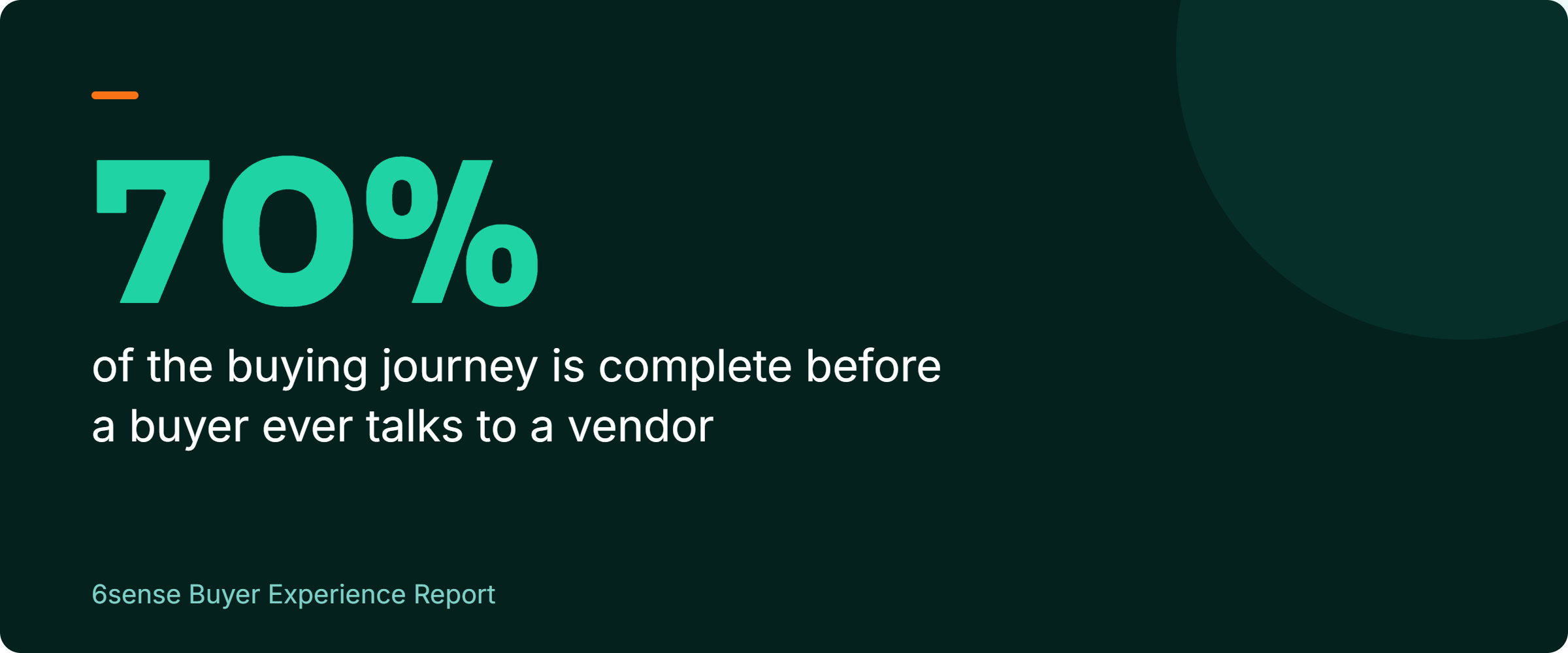
6sense, a company that studies B2B buying behavior at scale, has been tracking what they call the point of first contact for years. Their Buyer Experience Report found that buyers complete roughly 70 percent of their buying journey before they ever talk to a vendor. In their 2025 report, based on responses from more than 4,000 buyers across North America, EMEA, and APAC, that number moved to around 61 percent. Still well past the halfway mark. In their earlier research, 84 percent of deals were won by the first vendor the buyer contacted. The 2025 data tells the same story, with 77 percent of buyers contacting the eventual winner first.
Read that again. By the time a buyer reaches out, they have usually already picked a winner. The calls they make to everyone else are due diligence, not genuine evaluation. 6sense also found that 78 percent of the time, buyers have already established their requirements, including budget, before they engage a single seller.
Gartner's research on the B2B buying journey points the same direction. Buyers spend only about 17 percent of their total buying time meeting with potential suppliers. Split that across three or four vendors under consideration and any one company gets maybe 5 or 6 percent of the buyer's attention. The other 80-plus percent of the journey is self-directed research that happens entirely outside your view.
What this means for your business is simple and uncomfortable. The contest is not happening on your website. It is happening in the research phase you cannot see, on platforms you do not control, and it is mostly over before your analytics ever register a visit. Your website has shifted from a discovery tool to a closing tool. It is no longer where buyers find you. It is where buyers who have already shortlisted you come to confirm their decision or kill it.
Why Most Businesses Get This Wrong
This is not a story about lazy marketers. There is a structural reason almost every business misreads this situation, and it comes down to what you can and cannot measure.
Your analytics start counting when someone lands on your site. Google Analytics, your CRM, your heatmaps, your conversion tracking. All of it begins at the moment of the visit. Everything that happened before that visit, the ChatGPT conversation where someone asked for recommendations in your category, the twenty minutes spent reading your Google reviews, the Reddit thread comparing you to a competitor, the AI Overview that summarized your industry without anyone clicking a thing, is invisible to you. None of it shows up in a dashboard.
And humans manage what they measure. If the only data you have describes on-site behavior, you will keep optimizing on-site behavior. You will redesign the homepage again. You will A/B test button colors. You will hire someone to write more blog posts aimed at strangers who were supposedly going to discover you through search. Meanwhile, the actual decision-making environment, the reviews, the third-party mentions, the AI answers, gets no budget at all because it generates no convenient report.
The second reason is an outdated mental model. The classic marketing funnel assumed your website sat near the top: stranger searches, stranger clicks, stranger reads your content, stranger becomes a lead. That model was reasonably accurate in 2012. It described a web where Google sent clicks generously and buyers had to visit websites to learn anything. Neither condition holds anymore. The funnel did not disappear, but most of it moved off your property, and the part that still happens on your site is the bottom, not the top.
The third reason is that plenty of agencies are still selling the old model, because rankings and traffic are easy to report and easy to invoice against. If your monthly SEO report is a list of keyword positions and a traffic graph, you are looking at a picture of the part of the journey that matters least to the final decision.
What the Data Actually Shows
Here are the verified numbers, with sources, so you can judge the scale of this shift yourself.
Search results increasingly end without a click. SparkToro and Datos analyzed clickstream data and found that in 2024, for every 1,000 Google searches in the US, only about 360 clicks went to the open web. Nearly 60 percent of searches ended with no click at all. SparkToro's follow-up analysis in 2026 found the situation had worsened, with less than one third of Google searches still sending a click anywhere. People are getting their answers on the results page and leaving.
AI summaries accelerate that pattern. Pew Research Center studied the real browsing behavior of 900 US adults in March 2025. When a Google search page included an AI summary, users clicked a traditional result only 8 percent of the time, compared to 15 percent when no summary appeared. Clicks on the sources cited inside those AI summaries happened on just 1 percent of visits. Google's own AI now answers the question, and almost nobody clicks through to check the receipts.
AI assistants are now a mainstream research channel. OpenAI's Sam Altman announced in October 2025 that ChatGPT had reached 800 million weekly active users. On the B2B side, 6sense's 2025 Buyer Experience Report found that 94 percent of buyers used large language models during their buying process, mostly to summarize reviews, compare options, and organize research. That is near-total adoption of a research tool that did not exist in mainstream form three years earlier, and it operates entirely outside your analytics.
Reviews remain a primary decision input. BrightLocal's Local Consumer Review Survey 2025 found that 71 percent of consumers read online reviews regularly when browsing for local businesses, and only 4 percent say they never read them. Google is the dominant platform at 73 percent usage. Notice the loop forming here: 6sense says buyers use AI to summarize reviews. Your review profile is no longer just social proof on a listing page. It is raw material being fed into AI-generated recommendations.
The visitors who do arrive are worth more. Semrush's research on AI search traffic found that the average visitor arriving from an AI search tool converts at a rate that makes them roughly 4.4 times as valuable as the average traditional organic search visitor. Semrush also tracked outbound referral traffic from ChatGPT growing 206 percent across 2025. Fewer visitors, but far warmer ones. That is exactly what you would expect if the research phase is happening before the visit: the people who show up have already qualified themselves.
Put these together and the picture is consistent across every independent data source. Discovery has moved off your website. Evaluation has moved off your website. What lands on your website is a smaller stream of people who are close to a decision, which means every page they touch is doing closing work, whether you designed it for that or not.
How to Fix It
You do not need to become a technical SEO expert to act on this. You need to redirect attention and budget to where decisions actually form. Here are five concrete moves, all of which you can do yourself or hand to whoever runs your marketing.
1. Audit how you show up where the decision happens. Open ChatGPT, Perplexity, and Gemini. Ask each one the questions a buyer would ask: "best [your category] in [your city]," "alternatives to [your biggest competitor]," "is [your business name] any good." Then read your Google reviews, your industry-specific review platforms, and search Reddit for your brand and category. Write down what you find. Most owners have never done this once, and it takes an afternoon. You cannot fix a picture you have never looked at.
2. Invest in being mentioned, not just ranked. Ahrefs studied 75,000 brands and found that brand mentions across the web correlate with AI visibility far more strongly than backlinks do, 0.664 versus 0.218. In plain English: AI systems recommend businesses they see talked about in many independent places. Industry publications, local press, supplier directories, podcast appearances, professional association listings, community involvement that gets written up. This used to be called PR. It is now also AI visibility work. Delegate it as a standing monthly activity, not a one-off campaign.
3. Run reviews like a sales process, because they are one. Set up a consistent system for asking every happy customer for a review, responding to every review you get, and addressing negative ones with specifics rather than canned apologies. Remember the chain: buyers feed reviews into AI tools to summarize them. A thin or stale review profile reads as a weak option, both to humans and to the machines summarizing on their behalf.
4. Rebuild your key pages as closing pages. Look at your most-visited pages and ask one question: does this page help someone who is 80 percent decided get to 100 percent? Late-stage buyers want pricing or at least pricing logic, honest comparisons against alternatives, specific proof like case studies and named results, answers to objections, and a clear path to talk to a human. They do not need another paragraph about your passion for excellence. If your homepage reads like an introduction to a stranger, rewrite it for someone doing final due diligence, because that is who is actually reading it.
5. Ask every lead how they found you, and treat the answers as data. Add a "how did you hear about us" field to your forms and have whoever takes sales calls ask the question out loud. Self-reported attribution is imperfect, but it is the only instrument that sees the invisible journey. When leads start saying "ChatGPT recommended you" or "I read your reviews for a week," and they will, you will have evidence your dashboards can never give you.
What to Measure and When to Expect Results
The old scorecard was rankings and traffic. This scorecard matches how buyers actually behave.
Track branded search volume, meaning how many people search your business name each month. You can see this for free in Google Search Console. When off-site visibility grows, branded search grows, because people who hear about you go check on you. Track direct traffic alongside it for the same reason. Track your AI presence with a simple monthly routine: run the same set of ten buyer questions through ChatGPT, Perplexity, and Gemini, and log whether you are mentioned, how you are described, and who else is named. Track review velocity, the number of new reviews per month and your rating trend, not just the total. And track lead quality: close rate and sales cycle length, because if this strategy works, leads arrive warmer and close faster even if there are not more of them.
On timelines, be realistic. Reworking your key pages into closing pages can show up in conversion rates within four to eight weeks. Review velocity improves within a quarter once a real process exists. Brand mentions and AI visibility are slower, typically three to six months before you see your name appearing in AI answers more often, and six to twelve months before the compounding effect is obvious in branded search. Anyone promising AI visibility in two weeks is selling something.
Total traffic is the big one. In a zero-click world, your traffic can fall while your business grows, because the research that used to require a visit no longer does. Judging your marketing by raw sessions is like judging a store by foot traffic on the sidewalk outside. Keyword rankings alone are the second trap: ranking position three means much less when, per Pew's data, only 8 percent of people click any traditional result on pages with an AI summary. Impressions are the third. Watch conversions, close rates, branded demand, and mentions instead. Those are the numbers attached to revenue.
This shift is one part of the larger system I map in my AI search visibility guide.
Frequently Asked Questions
If buyers decide before visiting my website, should I stop investing in the website?
No, the opposite. The website matters more per visitor than it ever has, because each visit now carries closing-stage weight. A buyer who is 80 percent decided can still be lost by vague pages, hidden pricing, or weak proof. What should change is the job description: build pages that confirm a nearly-made decision rather than introduce you to strangers. Shift the discovery budget toward reviews, mentions, and AI visibility, and make the site ruthlessly good at converting the warm traffic that remains.
How do I find out what AI assistants are saying about my business?
Ask them directly, the same way a buyer would. Run questions like "best [your category] in [your area]" and "alternatives to [competitor]" through ChatGPT, Perplexity, and Gemini, and do it monthly because answers change. Log whether you appear, how you are described, and which competitors get named instead. If you are absent or described inaccurately, that usually traces back to thin reviews, few third-party mentions, or unclear information on your own site. There are paid tools that track this at scale, but a manual monthly check costs nothing and tells you most of what you need.
Does traditional SEO still matter if most searches never produce a click?
Yes, because the systems generating zero-click answers still pull from search indexes. Seer Interactive's research found that brands ranking on page one of Google showed a strong correlation, around 0.65, with being mentioned by AI tools. Ranking well makes you eligible to be the answer, even when no click follows. What has changed is that ranking is no longer the finish line. It is one input into a bigger visibility picture that also includes reviews, brand mentions, and how clearly your site states what you do and who you serve.
The shift is not coming. The data says it already happened, and the businesses winning right now are the ones being recommended in conversations and AI answers their competitors never see. Spend less energy trying to get discovered through your website and more energy being credible everywhere the decision actually forms. Then make sure that when the nearly-decided buyer finally lands on your site, every page does its real job: closing.