AI Is on Main Street Now. The Winners Aren't Buying Better Tools.

Two in three small businesses now run on AI, and you are probably one of them. The adoption rate is the wrong number to lose sleep over. The one that matters is the gap between owners who say AI made them faster and owners who can point to a dollar it earned. The small companies that win with AI picked one boring, repeatable task and learned to manage the machine doing it. The habit is the moat. I run my own operation the same way. Every local AI tool I built, from a live meeting transcriber to a PDF desk, started because one specific task was eating a slot in my week.
What the headline number hides
BizBuySell's quarterly Insight Report, which tracks roughly 50,000 small businesses across more than 70 U.S. markets, found that nearly two in three small businesses now use AI and 83% report measurable performance gains. Adoption nearly tripled since 2023, when just over one in four owners used it. It hit 60% in early 2025, a 127% jump, then kept climbing about 6% year over year into 2026.
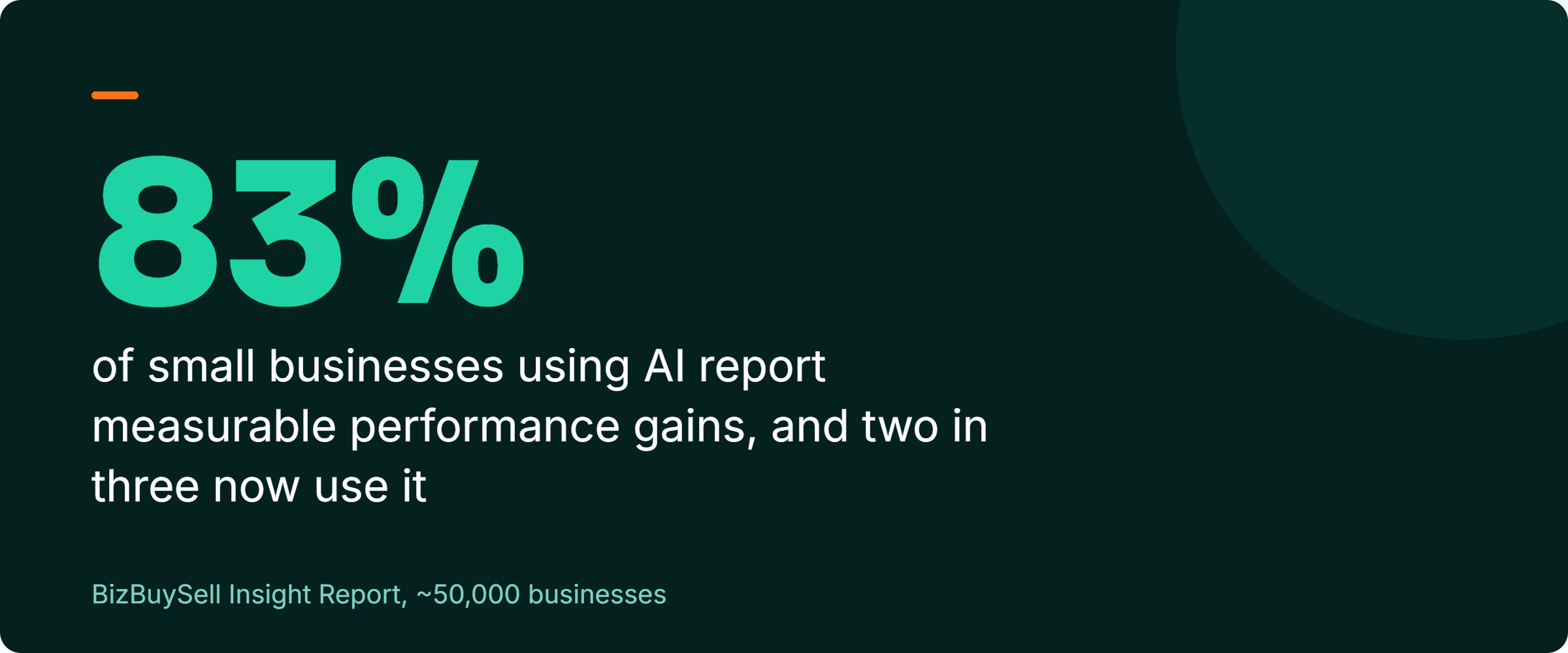
Read that 83% again, because it is doing something sneaky. It measures owner perception of performance, not audited profit. The same report quotes an owner saying that while AI improved their individual output, its effect on overall business performance is "still unfolding." BizBuySell's own framing is the most honest line in the study: AI adoption "is a process, not a switch."
Now set that next to the enterprise data. MIT's Project NANDA studied 300 public AI deployments, interviewed 150 leaders, and surveyed 350 employees for its July 2025 report, The GenAI Divide. The finding: despite $30 to $40 billion in enterprise spending, 95% of generative AI pilots delivered no measurable return. Only 5% pulled real money out. Gartner expects more than 40% of agentic AI projects to be canceled by the end of 2027, citing unclear business value and runaway cost.
Which is true, the 83% who feel gains or the 5% who book them? Both. AI reliably makes individuals faster and unreliably makes businesses richer. The distance between those two facts is where your money is won or lost. I wrote more about that exact gap in why feeling faster rarely shows up on the bottom line.
Feeling productive is not the same as being profitable
Here is how the trap springs. You draft a proposal in nine minutes that used to take an hour. The relief is real. Your brain files it as a win and moves on. Multiply that across a week and you feel transformed. What you have not done is ask whether those saved 51 minutes turned into a booked job, a collected invoice, or a single extra customer. Usually they turned into more drafts.
BizBuySell's data shows where this energy goes. Seventy-eight percent of owners cite productivity as their top reason for using AI, with analysis and insights at 60% and automating routine tasks at 56%, the last up 94% in two years. The most common entry point is marketing, used by 77% of adopters, followed by analytics at 56% and search and research at 42%, which more than doubled from 21% in early 2024. Marketing is the easiest place to feel busy and the hardest place to trace a dollar. You can generate forty social posts in an afternoon and have no idea which one, if any, brought revenue.
This is not an argument against using AI for marketing. It is an argument against confusing motion with progress. The 95% of stalled enterprise pilots did not fail because the models were weak. MIT pinned the failure on a "learning gap" in how organizations integrate the tools, not on the AI itself. The same logic scales down to a three-person shop. The owner who treats AI as a faster typewriter gets a faster typewriter. The owner who treats it as a worker gets output that moves the business.
What the winners actually do is older than AI
Ethan Mollick, the Wharton professor who has tracked AI in real work more closely than almost anyone, ran an experiment in January 2026. He gave executive MBA students, mostly working doctors and managers who had never coded, four days to build a startup using AI tools. The results were, in his words, "an order of magnitude further along" than what he used to see from students working a full semester before AI.
His explanation is the part worth tattooing on the wall:
"The skills that are so often dismissed as 'soft' turned out to be the hard ones."
Ethan Mollick, "Management as AI Superpower," One Useful Thing, January 2026
His students did not win because they were technical. They won because they already knew how to scope a problem, define what a finished deliverable looks like, give feedback, and spot when a financial model or a medical summary was wrong. Those are management skills. Mollick's framing is that working with AI is "management 101": explain what you need, give effective feedback, design a way to evaluate the work. He puts the new scarcity bluntly. The talent is now abundant and cheap. "What's scarce is knowing what to ask for."
That maps cleanly onto the BizBuySell winners. The owners reporting real gains are concentrated in firms with ten or fewer employees, where 85% of small businesses sit. They do not have an IT department to overthink this. They picked a task, told the AI what good looked like, checked the output, and corrected it, the same loop a decent manager runs with a new hire. The AI revolution rewards the least glamorous skill set in business: clear instructions and quality control.
Your first 90 days, in plain steps
Stop shopping for tools. Two in three of your competitors already pay for AI; 70% of adopters now treat it as a budget line, not a free toy. The edge was never the subscription. This is the sequence that separates the 5% from the 95%, written for an owner who has a business to run.
Pick one task you already understand cold. Not the flashiest one. The one you could grade in your sleep, because you need to recognize bad output instantly. Invoicing follow-ups, first-draft job quotes, turning a phone call into a clean summary, weekly numbers into a plain-English readout. The 56% of owners automating routine work are not chasing magic. They are removing the same friction every week.
Before you commit, run the delegation math Mollick uses. Weigh how long the task takes you by hand, how likely the AI is to get it right on a given try, and how long the request and the check take. A job that would cost you ten hours is worth several rounds of back and forth, even if the AI stumbles twice. A fifteen-minute job is worth it only when it repeats. The brief gets written once, and because you picked a task you can grade in your sleep, each check stays short. A weekly fifteen-minute invoice follow-up pays for its brief again every week it comes around. A fifteen-minute one-off rarely covers the cost of briefing and checking.
Write the brief for a junior employee who started yesterday. Mollick's point is that every profession already invented this document, from a contractor's scope of work to a director's shot list. You do not need a new skill. You need to write down what is already in your head, and a complete brief answers five questions.
Answer those in writing and the AI behaves like a competent worker. Skip them and you get a confident guess. Take a bookkeeper who spends a full day each month turning a client's messy transaction export into a clean financial summary. Handed the data with a vague "summarize these numbers," the AI returns something plausible and quietly wrong, and she spends the day fixing it anyway. Handed the same data with a real brief, it returns a draft she can verify in twenty minutes. That brief names the categories she uses, the format the client expects and the three sanity checks she always runs. Same tool, same numbers, and most of a working day saved by the instructions alone.
Run it, then grade the output against your standard. This is the step almost everyone skips. Grading is the skill that decides whether AI pays, as I explain in why verification beats prompt engineering. If the output is wrong, do not fix it yourself in silence. A silent fix leaves the AI making the same mistake the next time and trains you to expect failure. Tell the AI exactly what missed and why, the way you would coach an employee who will do this task again next week. Two or three rounds and most routine tasks lock in.
Save the brief the moment it works. Most owners pull a great result from AI, use it once and start from scratch the next time. When a brief produces work you would sign your name to, save it as a template, and the next job starts most of the way done. A roofing company that gets its AI estimate format right once never has to explain it again. A clinic that finds the right tone for patient reminders reuses that brief every week.
Treat corrections the same way. When the AI repeats a mistake, write the fix into the standing instruction, where it stays fixed. Over a year that file becomes a training manual for a worker who never forgets. Saved briefs are Level 2 on the four-level ladder I lay out in the gap between buying AI tools and building a system, one rung up from copy-paste.
Only once that one task is boringly reliable do you add a second. Owners who try to AI-ify their whole operation in week one are the ones who quietly abandon it by week six. Adoption is a process, not a switch. The same caution that earned you customers applies here.
If you cannot tell good output from bad in an area, do not delegate it to AI yet. AI is most dangerous exactly where you cannot judge it.
Measure money and time, not vibes
The reason 83% of owners feel gains while 95% of enterprise pilots show none is almost entirely a measurement failure. Feelings are easy to collect and useless to bank. Before you scale any AI task, write down the honest before number: hours per week on it, or dollars it touches. Two weeks later, measure the same thing. If you cannot state the saved time or the moved revenue in one sentence, you have a hobby, not a system.
Watch for vanity traps. First, raw output volume. Forty AI blog posts that nobody reads is worse than four that rank, because now you also pay to store and manage them. Second, time saved on tasks that never mattered. Automating a report no one reads is just faster waste. Third, tool count. The market is consolidating hard, with ChatGPT at 82% of adopters, Gemini at 50%, and Claude at 39%, precisely because owners learned that five overlapping subscriptions create work instead of removing it.
AI has not become a layoff machine on Main Street. Only 8% of owners cut roles because of AI, 6% added roles thanks to AI gains, and 69% have not reduced headcount at all. The roles most commonly added are marketing and operations. If you have been told to fear AI for your own small team, the field data says otherwise, at least so far. The owners winning are spending their saved time on growth. I made the same case in why the loudest AI reactions are usually the wrong ones.
If a worry is stopping you from starting, it is probably privacy, knowledge or cost. Among owners, 35% name data privacy and security as their top concern, 23% cite a plain lack of knowledge, and another 23% point to cost. One in three report no concerns at all. The privacy worry is legitimate and deserves a real rule: do not paste client financials or private records into a free consumer tool, and check whether your plan trains on your data. The knowledge worry mostly dissolves the day you treat AI as a junior hire instead of a science project. Paid tools cost a few hundred dollars a year. A competitor who manages AI better than you do costs more. Buyers already think this way: 76% of business buyers say AI gives them practical skills to run a business outside their expertise. The systems you build now become value the day you sell.
Frequently Asked Questions
Do I need to learn to code or understand the technology to get real value from AI?
No. The owners reporting the strongest gains are mostly running teams of ten or fewer with no technical staff. The skill that pays off is management, not engineering. If you can explain a task clearly, recognize good work, and give specific feedback, you have what you need. Mollick's research found non-technical MBA students outperformed precisely because they already knew how to scope work and judge quality. Treat AI like a fast junior employee, not a gadget.
Which task should I hand to AI first?
Pick a repetitive task you already understand well enough to grade instantly, with low stakes if it goes wrong. First-draft quotes, invoice follow-ups, meeting notes turned into summaries and weekly numbers turned into plain readouts are good starts. Then weigh how long it takes you by hand, how reliably the AI gets it right and how long the brief and the check take. A short task earns its place when it repeats every week. Avoid handing AI anything you cannot personally judge, because you will not catch its confident mistakes.
How do I know if AI is actually making me money or just making me feel busy?
Measure one number before and after. Write down the hours per week a task takes or the dollars it touches, adopt AI for two weeks, then measure the same thing. If you cannot state the saved time or moved revenue in a single sentence, it is not working yet. Feeling faster is not the same as being more profitable, and that gap is exactly why most enterprise AI projects show no return.
The owners pulling real money out of these tools are using a skill their grandparents would recognize. Tell someone exactly what you want, check the work, fix what is wrong and write the fix down for next time. The technology got abundant overnight. The judgment to direct it did not. Before you buy another subscription, open a blank page and write the five-part brief for the one task you repeat every week. If you cannot say what good looks like, a new tool will not say it for you.