Meta Put an AI Agent in Your Inbox. Don't Let It Run Free.

On June 3, 2026, Meta switched on a Business Agent inside Messenger and WhatsApp, and told every business owner it was free to activate. Most owners will read "free" and "AI that answers customers for you" and flip it on the way you'd flip a light switch. That is the mistake. Turn it on, but hire it like a junior employee with one narrow job and a named supervisor. Never treat it like a storefront manager you hand the keys to and walk away from.
Every reply that agent sends is spending your reputation
Think about who normally answers a customer's question. A person who knows your return policy, your lead times, and the promise you never make because it burned you last year. Now picture that answer coming from software that learned your business in an afternoon and speaks with total confidence whether it is right or wrong. Meta says there are more than one billion active threads between people and businesses every day across WhatsApp, Messenger, and Instagram. That is a billion moments where a wrong answer, delivered in your name, reads to the customer as your official position.
The cost of a bad deployment is not a software bug. It is a customer who was told the wrong price, quoted a lead time you can't hit, or promised a booking slot that doesn't exist. That customer now trusts you less than before they messaged. You can refund a bad order. You cannot easily refund the person who screenshots a confidently wrong answer and posts it. An unsupervised agent does not just answer questions. It makes commitments you are then on the hook for.
Meta pitches the agent as "AI that lets every business show up for every customer as if they had an infinite team behind them." That is Meta's marketing line. An infinite team is exactly the fantasy. But an infinite team of untrained staff, each free to speak for you and none of them supervised, is not an asset. It is a liability that scales.
"Free to activate" is the on-ramp, not the price
Read Meta's own announcement and the pricing plan is stated openly. "In the coming months, businesses will access the agent through paid subscription offerings, with options for businesses of every size." CNBC reported on June 3, 2026 that the Business Agent will fold into Meta's paid "Meta One" subscription, and framed the whole launch as Meta's push to earn money from something other than ads. The free tier is a trial. You are being invited to build a workflow around a tool, get your customers used to it, and then get a bill.
That is not a reason to refuse. It is a reason to treat the free window as a paid pilot with the invoice deferred. If the agent can't prove it made or saved money while it's free, it will not suddenly earn its keep once you're paying a subscription for it. Owners get this backwards. They activate a free tool with no goal, let it run, and never notice it drifting because no invoice forced them to look. This is the same trap I wrote about in the difference between buying an AI tool and building a system around it. A tool you switched on is not a system. A system has a job, an owner, and a number it has to hit.
| The offer | What it means for you |
|---|---|
| Free today | Activation is free during the launch window and the agent answers from your existing Meta channels and website. |
| Paid soon | Meta’s own announcement: paid subscription offerings “for businesses of every size.” CNBC reports it folds into the paid Meta One bundle. |
| The hidden line item | Confidently wrong answers sent in your name, plus the human hours to review threads every week. |
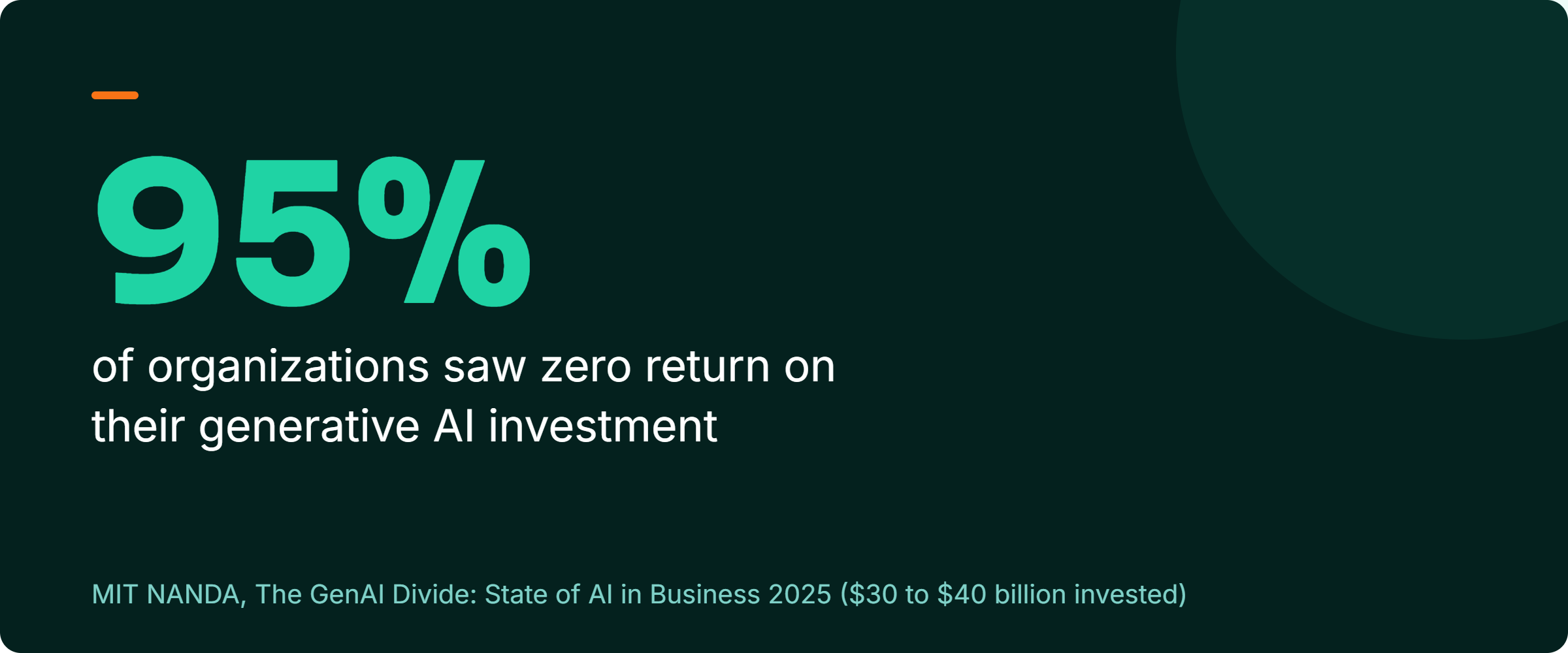
The broader numbers should keep you honest. Enterprises have put $30 to $40 billion into generative AI, according to the MIT NANDA initiative's August 2025 report "The GenAI Divide: State of AI in Business 2025." The same report found that despite that investment, 95% of organizations were getting zero return. Zero. Not a modest return, not a disappointing one. These were companies with budgets and staff, and the tools still produced no measurable result for nearly all of them. A small business flipping on a free agent with no plan is not better positioned than they were. It is worse.
The people who saw it work also saw exactly where it breaks
Lars Maat attended Meta Conversations 2026 in London and wrote it up for Search Engine Land on July 17, 2026. He is not a skeptic. In live demos he watched agents answer support tickets, qualify leads, check real-time inventory through API connections, and walk a buyer through checkout, all inside a single WhatsApp thread. His word for how these differ from the old rule-based chatbots is worth holding onto: they understand context, handle back-and-forth conversations, and hold a brand voice across languages. This is a real step up from the "press 1 for hours, press 2 for location" bots you already hate.
Then Maat names the catch, and it is the whole ballgame.
Garbage in, garbage out. That applies to everything we do with AI, from data analysis to prompting. High-quality input is essential for high-quality output.
Lars Maat, Search Engine Land, July 17, 2026
The agent learns from your Meta channels and your website, and you can feed it your own pricing and inventory. Feed it a stale price list, and it quotes stale prices to every customer, instantly, at scale. Maat also flags a shift owners should feel in their gut: customers "may never reach your website," because the browse-and-buy can finish entirely inside WhatsApp or Instagram Direct. He calls WhatsApp discovery "a new, high-intent search engine inside one of the world's most popular apps." If more of your selling moves into a thread you don't watch, the quality of what the agent says in that thread becomes your storefront. Buyers already decide before they ever reach your site, and this pushes that even further. The decision, and now the purchase, can happen in a chat window you never opened.
One more piece of context keeps the hype in proportion. Reuters reported in July 2026, from an internal Meta town hall, that Mark Zuckerberg acknowledged the company's AI agent technology is progressing slower than expected. The people building this are telling you it is not finished. Treat it accordingly.
Give it one narrow job, one supervisor, and a 30-day deadline
Here is how you actually deploy this without spending your reputation. The framing is the same one I use for handing any part of your business to an AI: it is a junior hire, not a department head. I made this case in detail about handing your ad account to Google's AI when it suggested you'd hired an advisor. Same logic applies here, and five concrete moves make it work.
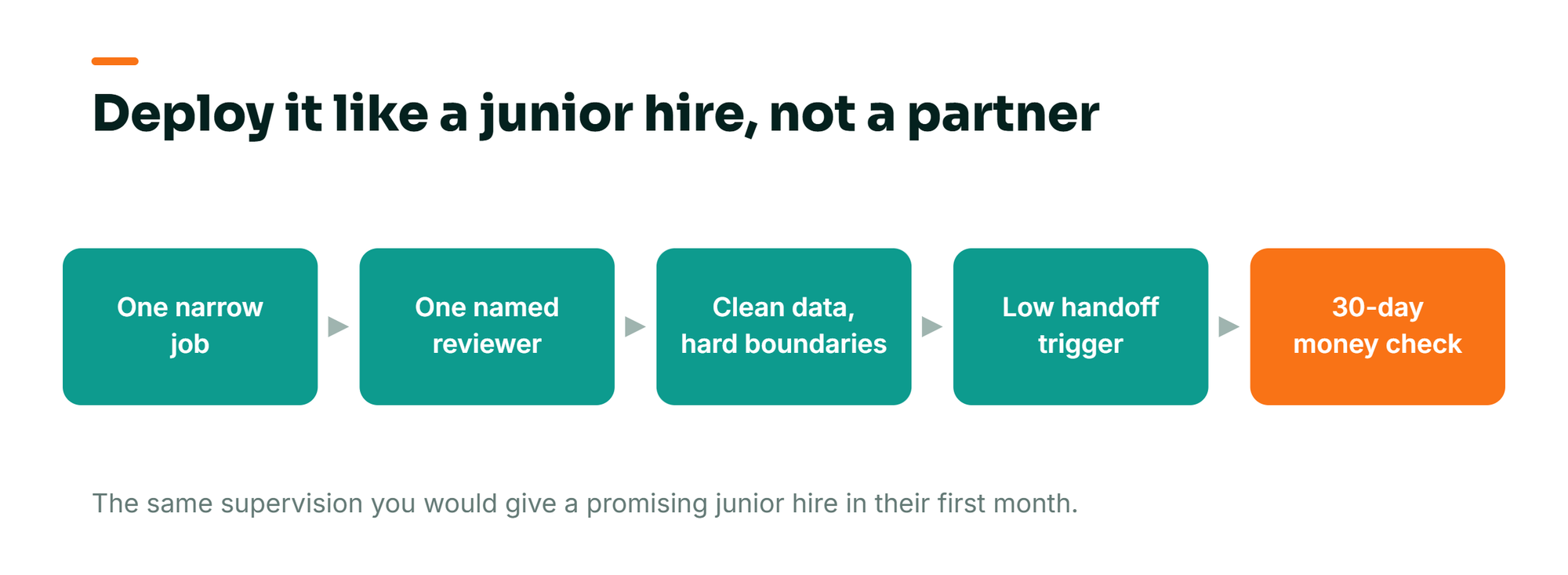
Give it exactly one job. Not "handle customer service." Pick after-hours replies, or lead qualification, or answering your five most common questions. One narrow lane. The demos show the agent doing everything at once, and that is precisely what you should not let it do on day one. A junior employee with one clear task and a script outperforms a confused generalist. Do this yourself in the setup; it takes an afternoon.
Name the human who reviews it. Meta built the controls for this, and Maat calls them critical to whether adoption works at all. You can monitor active conversations, hand selected chats to a person, and give the agent feedback it learns from. Assign a real name to that job. Not "the team." A person whose Monday includes reading yesterday's agent threads. If nobody owns the review, the review does not happen.
Feed it clean data and set the boundaries. You can add instructions that control tone, decide when the agent is active, and define how it represents you. Use every one of those. Write down the three promises it must never make and the prices that must be current. Then define the exact moment it hands off to a human, the words "let me get someone from our team," not a guess. Garbage in, garbage out cuts both ways. Clean, current data in is the only version that protects you.
Set the handoff trigger low, not high. When a customer asks anything about a refund, a complaint, a custom order, or anything with money and emotion attached, the agent should tap out to a person immediately. The narrow job is answering the easy, repetitive, low-stakes questions fast. Everything with teeth goes to a human. If you are delegating this to staff or an agency, that handoff rule is the single most important line in the brief.
If an agency is setting this up for you, ask them one question and watch their face. "Show me the exact list of questions the agent is allowed to answer on its own, and the exact trigger that sends a chat to a human." If they can't produce both lists, they have not configured a supervised junior hire. They have turned on a storefront manager and left the building.
Measure money in 30 days, and ignore the number Meta shows you first
The agent comes with a "morning briefing" that catches you up on chats missed overnight and hands you insights on your threads. That is genuinely useful, and it is also the vanity-metric trap. Threads handled, messages answered, response time: those numbers will look great immediately, because answering fast is all the agent is guaranteed to do. Fast and wrong is still wrong. Volume of replies tells you the machine is running, not that it is helping.
Measure outcomes instead. First, conversion: of the qualified leads or after-hours chats the agent handled, how many turned into a booking, a sale, or a real next step? Second, escalations that went sideways: how many customers the agent should have handed to a human but didn't, which you find by reading a sample of threads by hand every week. Third, the reputation check: did any confidently wrong answer go out in your name? One is a problem. A pattern is a fire.
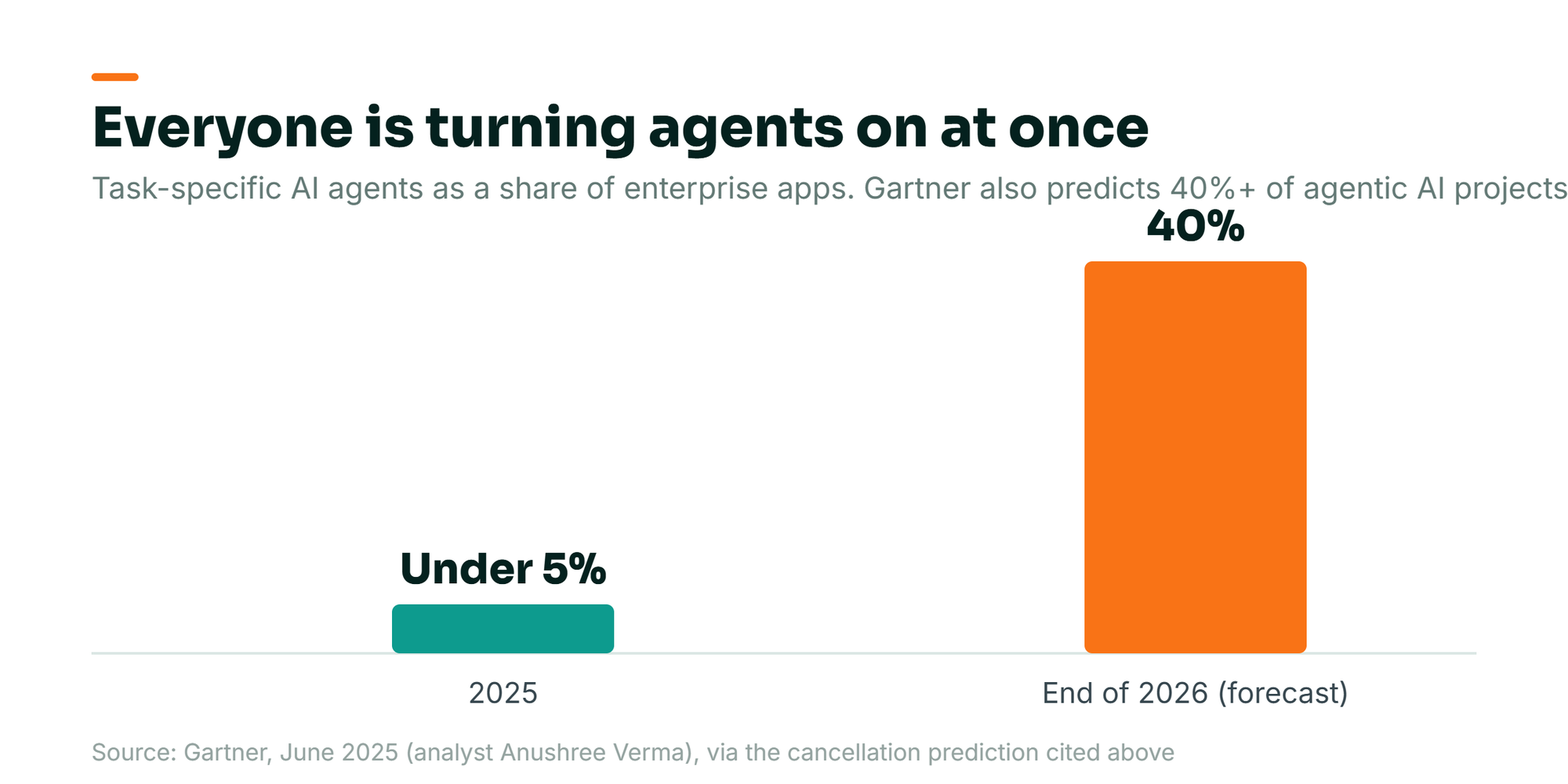
Put a date on it. Thirty days after you activate, sit down and answer one question: did this make or save money I can point to? Proving that the time saved is real, not just felt, is its own discipline, and I've written a full method for checking whether AI's five-hours-a-week claim actually holds up. Apply it here. Gartner predicted in June 2025, through analyst Anushree Verma, that more than 40% of agentic AI projects will be canceled by the end of 2027. It cited "escalating costs, unclear business value and inadequate risk controls." Notice the timing. Gartner also expects task-specific agents to reach 40% of enterprise apps by the end of 2026, up from under 5% in 2025. Everyone is turning them on, and nearly half will be turned back off. The projects that survive are the ones that could name the money. Yours needs to be one of those.
Picture a busy physio clinic. The agent's narrow job is booking and rescheduling after 6pm, when the front desk has gone home. In 30 days you count how many of those after-hours bookings actually showed up. You also read a dozen threads to make sure it never quoted the wrong price for an initial assessment or promised a slot the therapist didn't have. That is a measurable junior employee doing one job under supervision. That is the version that earns its subscription when the bill arrives. The version that "handles customer service" for the whole clinic, unwatched, is the one that quietly tells a new patient the wrong thing about their injury at 11pm on a Tuesday.
Frequently Asked Questions
Is the Meta Business Agent actually free, or will I get charged later?
Getting started is free right now, but that is the on-ramp, not the price. Meta's own June 2026 announcement says businesses will soon access the agent through paid subscription offerings, and CNBC reported it will be part of Meta's paid "Meta One" bundle. Treat the free window as a trial run with the invoice deferred. If the agent can't prove it made or saved money while it's free, it will not suddenly earn its keep once you're paying for it.
What is the single biggest risk of turning it on?
A confidently wrong answer sent in your name. The agent replies instantly whether it is right or wrong. A stale price, a lead time you can't hit, or a booking slot that doesn't exist gets delivered to the customer as your official word. The fix is to give it one narrow job, feed it current data, and set the handoff to a human on a low trigger. Anything involving money, refunds, or complaints goes straight to a person.
Should a small business use it or wait?
Use it, but scope it tightly, because the advantage is real and so is the failure rate. Gartner predicts more than 40% of agentic AI projects will be canceled by the end of 2027 over unclear value and weak controls. An MIT study found 95% of organizations got zero return on generative AI. The businesses that win give the agent one measurable job, keep a named human reviewing its work, and check at 30 days whether it made money. Waiting for the tool to be finished is not the same as deploying it carelessly now.
Meta handed you an employee that never sleeps, never calls in sick, and will say absolutely anything you let it. The owners who treat that as a gift will find out, one screenshot at a time, that speed without supervision is just a faster way to be wrong. Give it one job. Name its supervisor. Check the money in 30 days. If you want a second set of eyes on how to scope and measure it before you switch it on, book a call and we'll map the narrow job it should actually do. The real question isn't whether the agent can answer your customers. It's whether you'd stand behind every answer it gives when you're not looking.