80% of Your SEO Budget Is Still Fighting the Last War

Pull up your last SEO invoice. If it lists keyword rankings, a monthly blog post quota, and a fixed number of backlinks, you are paying for tactics designed to win a fight that ended around 2021. The battlefield moved to AI answers, entity authority, and brand citations, and most budgets never followed. The result is money spent efficiently on the wrong war.
The battlefield moved. Most budgets didn't.
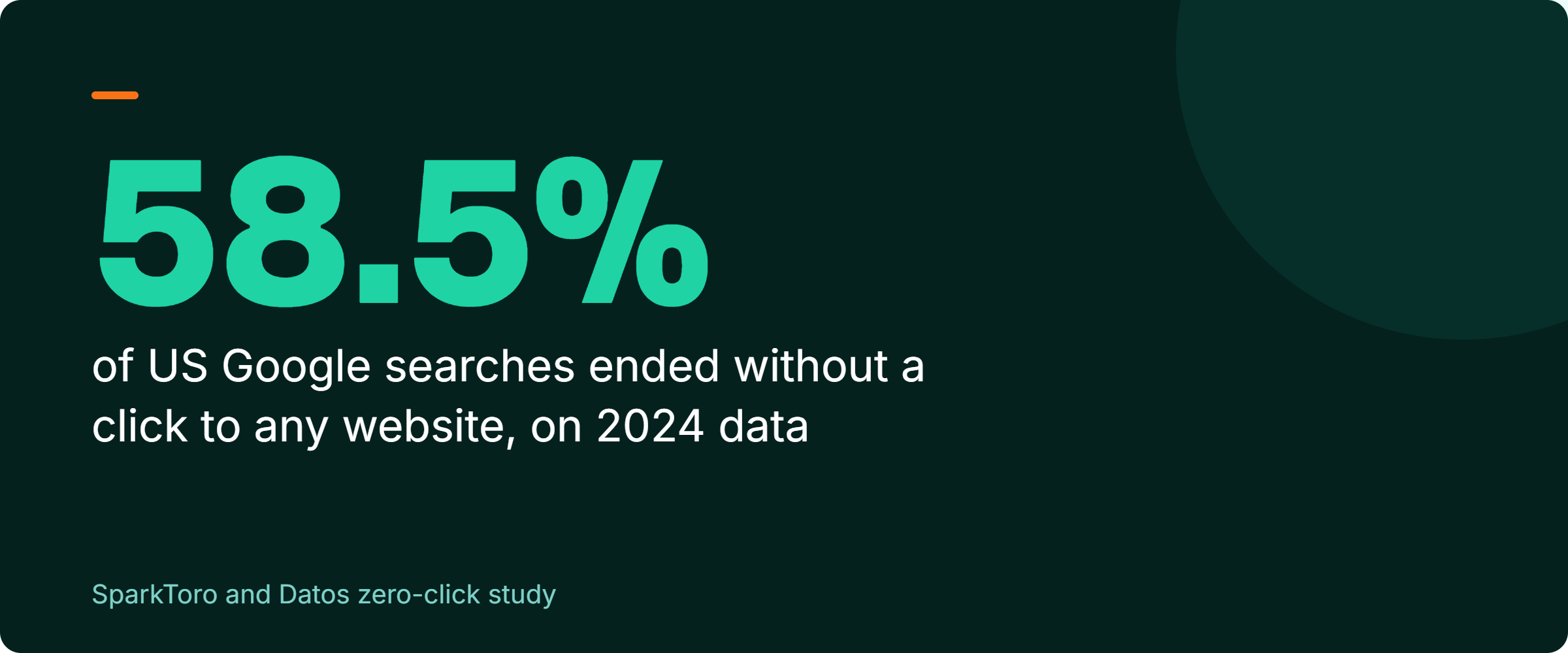
The math is uncomfortable. SparkToro and Datos published a zero-click study showing that for every 1,000 Google searches in the US, only 360 clicks go to the open web. That means 58.5% of American Google searches end without anyone clicking through to a website at all. In the EU it is slightly worse. And that study used 2024 data, before AI Overviews rolled out at scale.
Then AI Overviews arrived in force. Semrush analyzed over 10 million keywords and found AI Overviews appeared on just 6.49% of tracked queries in January 2025, surged to nearly 25% by July, and settled around 16% by late 2025. More important than the raw percentage is what changed inside it. Early on, about 91% of queries triggering AI Overviews were informational. By October 2025 that share had dropped to roughly 57%, because commercial and transactional queries, the ones tied to revenue, started triggering them too.
What happens to clicks when an AI Overview shows up? Seer Interactive tracked 25.1 million organic impressions across 42 organizations and found organic click-through rates on affected queries fell 61%, from 1.76% to 0.61%. Pew Research Center ran an independent study of real US browsing behavior. It found users clicked a traditional result on roughly 8% of visits when an AI summary appeared, versus 15% when it did not.
A meaningful slice of the demand you used to capture with a ranking now gets answered before the click. Say your budget is still 80% allocated to producing more pages and buying more links to win positions that fewer people click. Then you are funding capacity in a shrinking channel while the growing channel goes unfunded.
Why most businesses keep funding the old playbook
This is not because business owners are lazy. It is because the entire supply chain of SEO services is built to sell 2021 deliverables.
Agencies sell what they can package and price. Four blog posts a month is easy to scope. Ten links a quarter is easy to scope. "Become the entity that ChatGPT, Gemini, and Google's AI Overviews cite when someone asks for a recommendation in your category" is hard to scope. Most retainers avoid it. You get a tidy monthly report full of rankings and deliverables, and nobody on either side has an incentive to ask whether those deliverables still map to revenue.
The second mechanism is lagging metrics. Rankings and organic sessions respond slowly. A budget that stopped working in 2024 can still look defensible in a 2026 dashboard. Traffic declines get explained away as seasonality or algorithm volatility, when the structural cause is that the answer now appears above your listing.
The third mechanism is that the new work looks unfamiliar. Entity authority, structured data, digital PR that earns brand mentions, content engineered to be quotable by language models. None of that resembles the keyword-and-link procurement most owners learned to buy. When a tactic is unfamiliar, the default is to keep renewing the familiar one. That default is now expensive.
And to be blunt about the worst offender: content mills. Publishing thirty thin articles a month targeting long-tail informational keywords was already a marginal strategy. Those are precisely the queries AI Overviews answer first, and precisely the kind of undifferentiated content language models have no reason to cite. You are paying to manufacture the most replaceable asset in search.
What the data actually shows about where value moved
If the old channel is shrinking, where did the value go? The research points to three places: citations, brand mentions, and AI referral traffic.
First, citations. Seer Interactive's data shows the penalty for invisibility cuts both ways: brands actually cited inside an AI Overview earned 35% more organic clicks, and 91% more paid clicks, than those that were not. Being the cited source is the new position one. Ahrefs' follow-up research found that by late 2025, the presence of an AI Overview correlated with a 58% lower click-through rate for the top-ranking page. Ranking first and being cited are no longer the same thing, and only one of them protects your traffic.
Second, brand mentions. Ahrefs studied visibility factors across roughly 75,000 brands in ChatGPT, Google's AI Mode, and AI Overviews. The strongest correlates of AI visibility were branded web mentions and YouTube mentions. Brand mentions correlated about three times more strongly with AI visibility than backlinks did. Read that again if your retainer still has a link quota in it. The signal AI systems lean on is whether credible third parties talk about you, not whether you bought anchor text.
Third, the traffic that does arrive from AI is worth more. Semrush's study of AI search traffic concluded that an AI search visitor is, on average, 4.4 times as valuable as a traditional organic visitor, measured by conversion outcomes. People arrive having already done their comparison shopping inside the chat.
The expert consensus has moved with the data. Mike King of iPullRank, named Search Engine Land's 2025 Search Marketer of the Year, argues the discipline itself has to be rebuilt around what he calls relevance engineering. The work is structuring content and entities so retrieval systems and language models can find, understand, and reuse them. Chasing ten blue links that fewer people see is no longer the job. And Rand Fishkin of SparkToro has been making the demand-side argument for years, summed up in the title of his essay "In a Zero-Click World, Traffic is a Terrible Goal." The influence happens on the search surface whether or not the click follows. You have to compete for the surface.
Your budget also has to account for platforms that do not agree on sources. Profound's analysis of citation patterns found ChatGPT leans heavily on Wikipedia and news outlets, Perplexity favors Reddit, and Google's AI Overviews pull disproportionately from YouTube and other multi-modal content. The overlap between platforms is very small. There is no single placement to buy. There is a reputation footprint to build.
Where the money should move, line by line
You do not need to be technical to redirect a budget. You need to change what you ask for and what you accept as proof of work. The reallocation goes in the order I would do it.
Line one: cut the content mill, fund fewer and deeper assets. Take the budget currently producing high-volume, low-differentiation blog posts and reassign it to a smaller number of pieces. Each should contain something a language model cannot get elsewhere: your proprietary data, your pricing logic, your documented results, named opinions from named people. Information that exists nowhere else is the only content with a structural reason to be cited. If your provider cannot tell you what is original about a proposed piece, do not commission it.
Line two: convert the link quota into a mention engine. Stop paying for links by the unit. Redirect that spend to digital PR, podcast appearances, industry data reports journalists want to reference, and contributed expertise in trade publications. The Ahrefs brand study is your justification: mentions outpredict backlinks for AI visibility by roughly three to one, and good earned coverage usually brings the link anyway. Ask your agency to report mentions and citing domains, not just "links built."
Line three: fund entity and structure work once, properly. This is a project, not a retainer. Get your organization schema, author profiles, product and service markup, and consistent business information cleaned up. Do it across your site, your Google Business Profile, Wikipedia or Wikidata where legitimate, and the major directories in your industry. The goal is that machines parsing the web encounter one coherent, corroborated description of who you are, what you do, and for whom. A competent technical SEO can deliver this in weeks, and it keeps compounding afterward.
Line four: show up where each AI system actually looks. Since the platforms cite different sources, audit where buying conversations in your category happen. If Reddit threads dominate your category's AI Overview citations, your founder or team should be genuinely participating there, not astroturfing. If YouTube keeps showing up in the AI Overviews for your category, a modest set of plain-spoken videos answering your customers' real questions earns visibility a blog post cannot. This is unfamiliar work for most SEO retainers. That unfamiliarity keeps it underpriced right now.
Line five: keep a defensive core, around 20 to 30%. Traditional SEO is not dead. Transactional and local queries still drive clicks, technical health still matters, and the same crawlable, well-structured site that ranks in Google is what AI crawlers ingest. Keep funding the basics. Just stop letting the basics consume 80% of the budget while the front line goes unmanned.
What to measure, and when to expect results
If you change the spending but keep the old scoreboard, the old scoreboard will pressure you back into the old spending. Update both.
Track AI visibility directly: how often your brand is mentioned or cited when ChatGPT, Gemini, Perplexity, and Google's AI features answer the questions your buyers actually ask. Tools now exist for this, but even a monthly manual check of your 20 most valuable buyer questions, logged in a spreadsheet, beats not measuring it. Track branded search volume in Google Search Console, because people who meet you in an AI answer often verify you with a branded search afterward. Track AI referral sessions in your analytics (ChatGPT now tags much of its outbound traffic), and watch lead quality from those sessions, since the Semrush data says they should convert meaningfully better. And track mentions: new citing domains, podcast and press placements, third-party pages that name you.
Be honest about timelines. Entity and structure cleanup can influence how AI systems describe you within one to two months, because these systems refresh their retrieval sources continuously. Mention-driven visibility typically takes three to six months to show up in AI answers. Original research and authority content compounds over six to twelve months. Anyone promising AI citations in two weeks is selling you the 2021 playbook with a new label.
And name the vanity traps so nobody on your team hides behind them. Total organic sessions will likely keep drifting down even while revenue from search-influenced buyers grows, because low-intent informational clicks are evaporating first. Average rankings for big keyword lists are increasingly decorative. Domain authority scores were always a proxy and are now a proxy for the wrong thing. Judge the program on cited visibility, branded demand, and lead quality, not on traffic volume.
Frequently Asked Questions
Should I stop investing in traditional SEO completely?
No, and anyone telling you to is overcorrecting. Transactional, local, and navigational searches still produce clicks, and the technical foundation that makes a site rankable is the same foundation AI crawlers need to read and cite you. The argument is about proportion, not abandonment. Keep roughly a quarter to a third of your budget on fundamentals and rebalance the rest toward citations, mentions, and entity authority. The mistake is leaving 80% of the budget in tactics that target a shrinking share of buyer attention.
How much should a small business actually budget for this shift?
Mostly you are reallocating, not adding. Industry surveys put typical small business SEO spend between $500 and $5,000 per month, and the shift described here fits inside that envelope. The one-time entity and structured data cleanup is usually a few thousand dollars of project work. The ongoing change is swapping content volume and link quotas for fewer original assets and earned mentions, which costs about the same but buys a different outcome. Expect a transition quarter where output looks thinner on paper while the new work ramps.
How do I know if my current agency is fighting the last war?
Ask three questions. First, can they show you where your brand appears, or fails to appear, in ChatGPT, Perplexity, and Google AI Overviews answers for your top buyer questions? Second, do their reports lead with rankings and traffic, or with citations, mentions, and lead quality? Third, when you ask what they changed in the last 12 months because of AI search, do you get specifics or reassurance? An agency with good answers is worth keeping. An agency that responds by defending the link quota has told you everything.
The frustrating part of this moment is that the old tactics still produce reports that look like progress. Plenty of businesses will keep buying them for another two years and wonder why the phone got quieter. The opportunity is that most of your competitors are in that group, and the citation real estate in your category is still cheap. Move the budget before they do.