Your 4.8 Stars Aren't Winning You Customers. The Work Is.

You paid someone to get you more five-star reviews. The number moved from 4.7 to 4.9, and the phone rang about the same as before. That is not bad luck, and your vendor did not exactly lie to you. The star average on your listing is a vanity metric, and I can now point to peer-reviewed proof that the number itself does not move revenue. What moves it is the unglamorous work behind the number, and that same work is now what decides whether ChatGPT recommends you at all.
The number on your profile is not the thing making your phone ring
Start with the study that reframed this for me. In 2026, researchers Eddie Inyang and Juliana White surveyed 251 US small-business owners for the Journal of Small Business Strategy. They used a statistical method called PLS-SEM that tests which factors actually predict an outcome and which just travel alongside it. They ran six hypotheses. Five held up. The one that failed was the one every review vendor sells you on: that your Google star rating, on its own, predicts how the business performs.
It did not predict it. What did predict performance was active online reputation management, meaning the ongoing habit of responding to reviews, keeping your information current, and staying present where customers look. That effect was strongest in competitive markets, which is to say the markets most of you are actually in. A plumber in a metro with forty other plumbers does not win because his average is a tenth of a point higher. He wins because he answers.
| Factor | Predicts business performance? |
|---|---|
| Star rating on its own | No. It traveled alongside success; it did not drive it. |
| Active reputation management (responding, correcting, keeping information consistent) | Yes. The ongoing operational work is what predicted performance. |
The study has limits and I will not oversell a single paper. It is self-reported. Owners graded themselves. It is cross-sectional, a snapshot in time. And correlation is not causation. It shows association, not a proven lever. But the direction lines up with what I have watched across 300-plus businesses, and it lines up with how customers behave when they are standing in your reviews deciding whether to call.
Ignoring it costs you real calls. Birdeye's 2025 State of Online Reviews, drawn from more than 150,000 US businesses, found review volume up 13 percent year over year and response rates climbing from 63 to 73 percent. Read that second number as a warning. Three in four of your competitors now reply. If you are in the quarter who still let reviews sit, you are the visibly absent business on a page where absence reads as "they stopped caring." That is a lost call, and lost calls are the whole game. Your ranking can look fine while your phone quietly disagrees, and an unanswered review page is one of the reasons.
Owners chase the decimal because it is the only part you can screenshot
The decimal is easy to see and easy to sell. A vendor can show you a dashboard where 4.7 becomes 4.9 in ninety days, and that looks like progress you can screenshot. Replying to every review by Tuesday, fixing the phone number that is wrong on Yelp, making sure your hours match across three sites: none of that produces a satisfying before-and-after graphic. It gets skipped and the shiny number gets chased.
There is also a comfort story in the average. If your rating is high, you get to believe the marketing is handled and the problem is somewhere else, maybe the website, maybe the economy. I understand the appeal. It is less pleasant to accept that a great rating and a half-managed profile can sit side by side, and that customers feel the gap even when they cannot name it. Picture a dental clinic with a 4.9 and thirty reviews, eleven of them unanswered, and a phone number on Facebook that rings a fax line the practice retired two years ago. The average says "excellent." The experience of trying to actually reach them says "maybe not." Customers trust the experience.
The last reason is that the old advice never got updated. "Get more reviews, raise your stars" was decent guidance in 2016. It aged into a reflex. Meanwhile the thing customers use to find you changed underneath it, and the reflex kept firing at a target that no longer decides the outcome.
AI names roughly 30 times fewer businesses than the map does
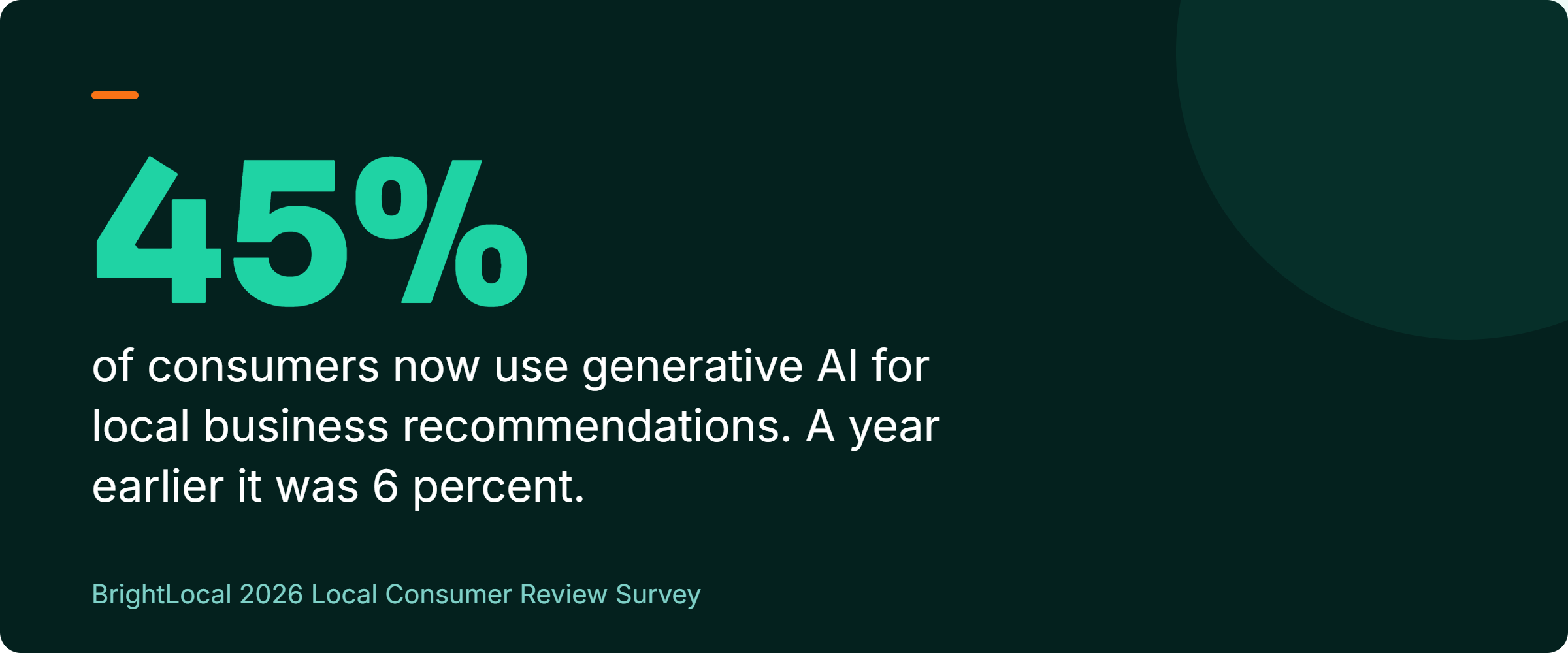
This is where the operational work stops being a nice-to-have and becomes the whole reason you show up at all. BrightLocal's 2026 Local Consumer Review Survey found that 45 percent of consumers now use generative AI, tools like ChatGPT, to get local business recommendations. The year before, that number was 6 percent. Nearly half your prospective customers are now asking a machine "who's the best near me," and the machine is far stingier than the map ever was.
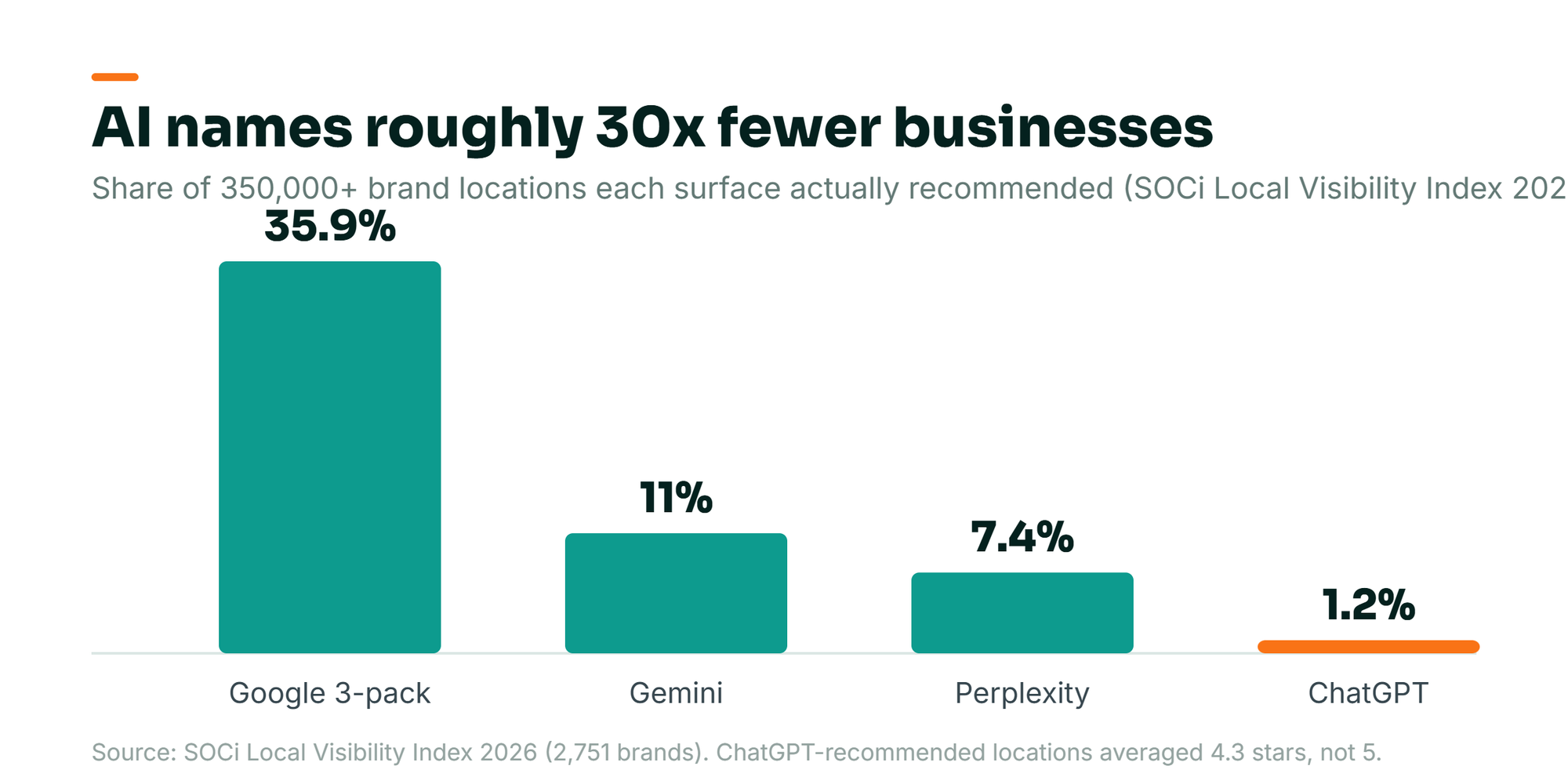
How much stingier is the part that should reset your priorities. SOCi's 2026 Local Visibility Index studied more than 350,000 locations across 2,751 brands. Google's local three-pack surfaced 35.9 percent of the brand locations it looked at. ChatGPT recommended 1.2 percent. Gemini 11 percent, Perplexity 7.4 percent. SOCi's own summary is that AI is roughly 30 times more selective than local search. And only 45 percent of the brands that win in local search also win in AI recommendations. Being great on Google buys you a coin flip on whether AI even names you.
"Google's AI-driven local results are showing fewer businesses and, in many cases, fewer ways for customers to contact you."
Joy Hawkins, Sterling Sky
Fewer businesses shown, fewer ways to reach them. If the funnel is narrowing to a handful of named options, the whole contest is getting into that handful. What gets you in? Not the star average by itself. SOCi found the locations ChatGPT recommended averaged 4.3 stars, not a flawless 5. The model is not simply ranking by decimal. It is weighing whether your information is consistent, complete, and corroborated everywhere it can check.
"Your Google Business Profile is no longer just for Google."
Justin Silverman, Merchynt
"AI favors businesses that show up everywhere with aligned information."
Meg Clarke, Clapping Dog Media
Read those two together and the strategy writes itself. The peer-reviewed study tied consistency work to real performance: matching details across sites, staying present, staying responsive. That same work is exactly what an AI model uses to decide you are a safe thing to recommend. One habit, two payoffs. It earns trust with the customer reading your reviews and it earns eligibility with the model deciding whether to name you. Before changing anything, learn how to check whether AI is actually recommending your business. Do not assume your Google presence carries over.
The fix is a habit, not a campaign
None of this requires a technical hire. It requires a routine that a non-technical owner can start Monday morning. This is the sequence I give clients, in the order that pays off fastest.
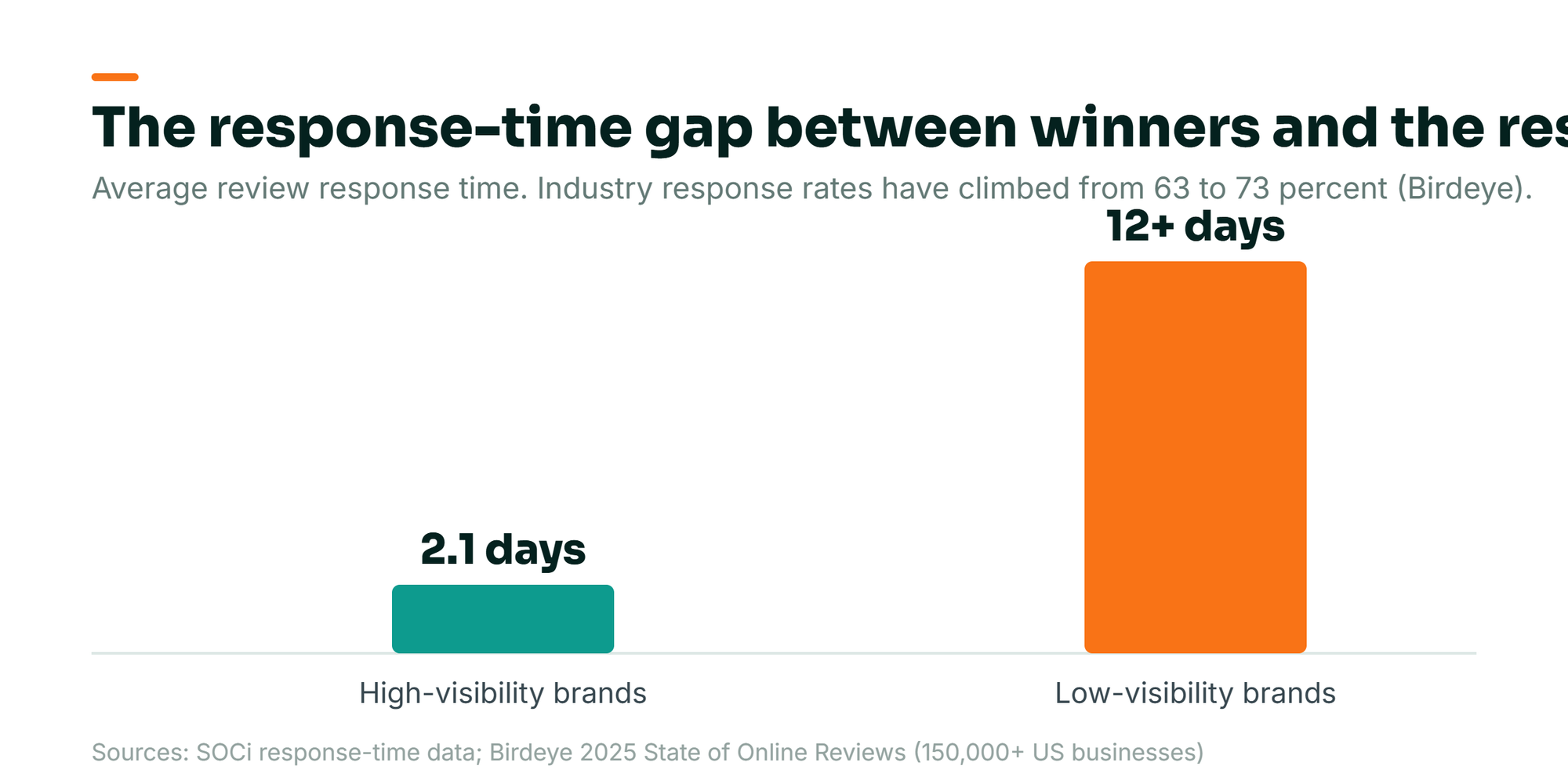
Reply to every review within 48 hours, good and bad. Not templated thank-yous. A specific sentence that shows a human read it. SOCi's 2024 data found high-visibility brands respond in about 2.1 days, while low-visibility brands mostly do not respond inside 12 days at all. Two days is the bar. Put a standing 15-minute slot on your own calendar, Monday and Thursday, and clear the queue. If you want to delegate it, hand a staff member a simple rule: reply to everything, escalate anything angry to you before posting. If you would rather a tool draft the first pass, know the tradeoffs first, because there are real ones in letting Google's AI write your review replies.
Make your core facts identical everywhere. Open Google, Yelp, Facebook, Apple Maps, and Bing side by side. Check the business name, phone number, address, and hours. They must match to the character. A single wrong phone number on Facebook is not a small typo. It is a customer who called a dead line and moved to the next result, and it is a mismatch that makes an AI model less certain you are one real, well-run business.
Claim and fill the third-party profiles you have been ignoring. Presence everywhere is what the experts named. That means the industry directories for your trade, the Apple and Bing listings most owners forget, and any local association pages. You do not need dozens. You need the handful your customers and the models actually consult, each one complete and matching.
Ask for reviews in a steady trickle, not a burst. A calm, ongoing flow of honest reviews reads as a healthy business to both people and models. This is also a safety point. Buying reviews or funneling them through a gimmick can get your profile flagged, and Google's enforcement has gotten aggressive enough that even honest reviews are what win the local top three, not manufactured ones. Stop paying for "get more 5-stars" schemes. Build the trickle instead.
Write down who owns this and when. A habit with no owner dies in three weeks. One named person, two recurring time slots, one place to note what got done. That is the entire system. It is boring, and boring is the point, because boring is what compounds.
Ask your agency: "Show me our review response rate and average response time for the last 90 days, and show me our name, phone, address, and hours across the five main platforms, matched." If they answer with a stars-over-time chart instead, you have found the gap.
Measure response rate and consistency, not the stars chart
Stop making the star average your headline metric. Track it, sure, but demote it. The three numbers that reflect the work are your response rate, your average response time, and the consistency of your core facts across platforms. Response rate should climb toward and past that 73 percent industry mark from Birdeye. Response time should be about two days, the 2.1-day mark that separated high-visibility brands from the rest in SOCi's data. Consistency is pass or fail: either your name, phone, address, and hours match everywhere or they do not.
Be wary of the "review velocity" dashboard that only ever shows stars going up. It flatters you without predicting performance. That is the whole finding of the Inyang and White study. Another trap is treating one lucky AI mention as proof you have arrived. You have not. A single check tells you very little. Measuring AI visibility takes repeated, structured checking, not a one-off question.
The honest timeline: the response habit shows up in customer sentiment and call quality within a few weeks, because people notice an answered page fast. The consistency work compounds more slowly, over a couple of months, as platforms and models re-crawl and re-corroborate your details. Off-site trust always moves slower than you want. Start now, measure monthly, and stop refreshing the stars every day.
I have spent about 17 years in search, and I have watched owners pour money into the one number the data says does not move revenue. For a straight read on where your review operations and your AI visibility actually stand, with no stars-going-up theater, book a short call with me. We will look at the real levers together.
Frequently Asked Questions
Does my Google star rating still matter at all?
It matters as a floor, not a lever. Customers and AI tools both expect a solid rating. ChatGPT-recommended locations averaged 4.3 stars in SOCi's 2026 study. You do want to be clearly in good standing. What the peer-reviewed 2026 study by Inyang and White found is that the rating on its own did not predict business performance. Your ongoing reputation management did. Keep the rating healthy, then put your real effort into responding and staying consistent.
How fast do I need to respond to reviews?
Aim for under 48 hours, every review, positive and negative. SOCi's data found that high-visibility brands respond in about 2.1 days, while low-visibility ones often do not respond within 12 days at all. That gap is the difference you can close this week. Put two short slots on your calendar and clear the queue each time. Speed and consistency matter more than a polished, delayed reply.
Why would ChatGPT recommend a competitor with fewer reviews than me?
Because AI recommendations weigh consistency and corroboration, not just your star count. SOCi found AI is roughly 30 times more selective than Google's local pack, and only 45 percent of local-search winners also win in AI. If your name, phone, address, and hours differ across Yelp, Facebook, and Google, a model has reason to doubt which listing is really you. A competitor with aligned information everywhere looks like the safer answer, even with fewer reviews.
Go look at your own review page right now, on your phone, the way a customer would. Count how many reviews have no reply. That number, not the average glowing above it, is the one deciding whether the next person calls you or the business that bothered to answer.