Agentic AI, Explained: Why 40% of Projects Will Fail

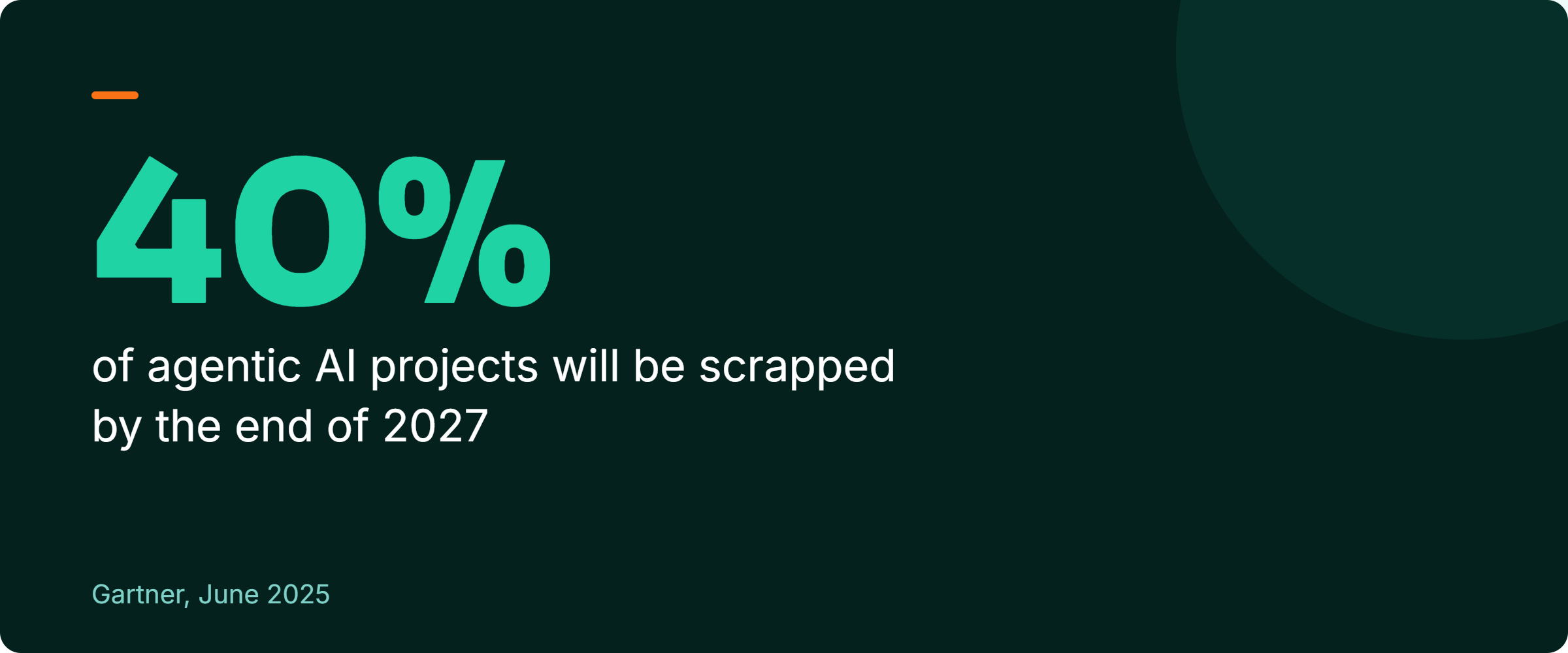
Your inbox is filling up with the word "agent." Software vendors promise AI agents that run your marketing, handle your books, answer your phones, and book your jobs while you sleep. Some of that is real. Most of what is being sold to small businesses right now is a chatbot wearing a costume. Gartner expects more than 40% of agentic AI projects to be canceled by the end of 2027. Before you sign anything, you deserve a plain explanation of what an AI agent actually is, why so many of these projects collapse, and the narrow cases where one is worth your money.
My position is simple. Agentic AI is real and occasionally powerful, but for most small businesses in 2026 it is being oversold, and the right move is patience plus a very short leash.
What an agent actually is, without the hype
A regular AI tool answers. You ask, it responds, you decide what to do next. An agent acts. You give it a goal, and it takes a series of steps on its own to reach it: looking things up, making decisions, using other software, and producing a finished result rather than a suggestion. The difference between "write me an email" and "find everyone who hasn't paid, draft the right reminder for each, and send them" is the difference between a tool and an agent. One hands you a draft. The other does the job, including the parts where it can go wrong without you watching.
That autonomy is the whole pitch and the whole risk. A chatbot that writes a bad sentence wastes ten seconds. An agent that emails the wrong reminder to the wrong client, or pays the wrong invoice, creates a real mess in the real world. The capability and the danger scale together, which is exactly why these projects fail more often than the marketing admits.
Why Gartner expects 40% to be scrapped
Gartner's June 2025 finding is worth quoting accurately. More than 40% of agentic AI projects will be canceled by the end of 2027, driven by escalating costs, unclear business value, and inadequate risk controls. Their analysts describe most current projects as early-stage experiments and proofs of concept "driven by hype and often misapplied." Translation for an owner: a lot of companies are spending real money to automate things that did not need automating, then quietly killing the project when the bill arrives and the payoff does not.
There is a sharper warning underneath. Gartner calls out widespread "agent washing," the rebranding of old chatbots, basic automation, and assistants as cutting-edge agents. By their estimate, of the thousands of vendors claiming agentic AI, only about 130 are the real thing. Let that number set your default suspicion. When a sales rep says "agent," the base rate says they probably mean a glorified autocomplete with a new price tag.
The broader business record reinforces the caution. MIT's Project NANDA reviewed 300 AI deployments for its July 2025 report and found that 95% of generative AI pilots produced no measurable return, despite $30 to $40 billion in enterprise spending. The failures were not about weak models. They were about businesses bolting AI onto processes without the integration and judgment to make it pay. If giant companies with budgets and engineers hit a 95% miss rate, a small business handing the keys to an autonomous agent on a vendor's promise should move carefully.
The hype is louder than the adoption
Notice the gap between what is sold and what is actually deployed. A January 2025 Gartner poll of more than 3,400 attendees found only 19% had made significant investments in agentic AI, with 42% making conservative bets, 31% waiting and watching, and 8% in for nothing. The serious money is hanging back on purpose. The breathless coverage is running well ahead of what real operators are committing.
This pattern should feel familiar. Every genuinely useful technology arrives wrapped in claims that outrun reality by a couple of years, and the people who buy at peak hype usually pay the tuition for everyone else. I made the broader case for ignoring the noise in why the loudest AI reactions are usually wrong. Agents are simply the current loudest reaction. The technology will matter. The timeline being sold to you is optimistic, and optimism is expensive when you are the one funding it.
When an agent is actually worth it for a small business
This is not a case for hiding from agents. It is a case for picking the rare spots where the math works and keeping a hand on the wheel. The good candidates share three traits: the task is repetitive and well-defined, a mistake is cheap and reversible, and you can check the work quickly. Sorting incoming emails into categories, drafting responses for your approval, pulling data from one system into a report, monitoring a number and flagging when it crosses a line. Notice these mostly stop short of taking irreversible action on their own.
You may also already own agent features without paying a cent extra. Several mainstream tools now bundle basic automation, scheduling assistants, and inbox triage into plans you probably already have. Before you buy a dedicated agent platform, check what the software in your stack can already do under supervision. Starting with a feature you already pay for keeps both your risk and your spend low while you learn what the technology is actually good at inside your business. The cheapest agent to test is the one already sitting in a tool you trust.
Keep the agent on a short leash, especially early. The safest setup for most owners is "agent proposes, human approves." Let it draft every overdue-invoice reminder and queue them, then you click send after a ten-second glance. You keep almost all of the time savings and almost none of the catastrophic-mistake risk. Only after weeks of clean output should you consider letting it act unsupervised, and even then, never on anything that moves money or touches a customer relationship without a checkpoint.
Make it concrete. A landscaping company drowning in "are you available" emails could put an agent on the inbox to read each message, draft a reply with the next open slot pulled from the calendar, and queue it for a one-tap approval. That is a clean fit: repetitive, easy to check, and reversible if a draft is off. The same company letting an agent autonomously book jobs, shuffle crews, and send price quotes with no review is the version that ends up in Gartner's 40%. The task did not change. The leash did.
Demand specifics from any vendor before you pay. Ask exactly what the agent does step by step, what happens when it is unsure, whether a human can review actions before they execute, and what it has saved a business your size in dollars or hours. A real product answers crisply. An agent-washed chatbot hides behind words like frictionless and intelligent. The same discipline of defining what good output looks like, which separates winners from the stalled 95%, applies double when the software can act on its own. I covered that core habit in what the small businesses actually winning with AI do differently.
That vetting conversation now has its own walkthrough: the three questions to ask before you buy an AI agent covers the exact wording plus the scoping procedure to run once the answers come back.
Count the downside, not just the upside
Every agent pitch leads with time saved. Almost none mention the cost of a confident mistake, which is where the real risk lives. An agent that misreads a calendar and double-books your two best crews on a Saturday did not save you an email, it cost you a job and a referral. One that fires off a tone-deaf reminder to a client in the middle of a dispute did not trim your admin, it strained a relationship worth thousands. These are not freak accidents. They are the predictable result of handing autonomy to a system that does not understand your business the way you do.
This is why the "human approves" setup is not training wheels you outgrow in a week. For anything that touches money, scheduling, or a customer's inbox, the review step is the product, not the overhead. The few seconds you spend approving an action are the cheapest insurance you will ever buy, and they keep nearly all of the speed. The projects that crater are the ones that treated approval as friction to delete rather than the control that makes autonomy survivable in the first place.
What to measure before you scale an agent
Treat an agent like a probationary hire, because that is what it is. Before you expand its role, get three answers in writing from your own records. How many hours or dollars did it actually save over a fair trial. How often did it produce something wrong, and how bad was the worst error. How much of your time did supervising it eat, because an agent that needs constant babysitting is just a slower way to do the task yourself.
The trap to avoid is paying for autonomy you never safely use. Plenty of owners buy the premium "fully autonomous" tier, then sensibly review everything it does anyway, which means they are paying agent prices for chatbot value. If you are checking every action, you do not need the agent tier yet. Buy the capability when you have earned the trust to let it run, not before. The 40% of projects Gartner expects to die are largely the ones that bought the dream and skipped this arithmetic.
One more number deserves a hard look: what the agent costs when it is idle or wrong, not just when it works. Subscription fees run whether or not the agent earns them, and a tool that handles forty tasks beautifully but botches the one high-stakes task each month may still be a net loss once you price the cleanup. Run the full tally, savings minus subscription minus your supervision time minus the occasional mess, before you call it a win. Vendors quote the best case. Your books should record the average one.
And keep the failure rate in perspective rather than in panic. A 40% cancellation rate is not proof the technology is fake. It is proof the technology is early, oversold, and unforgiving of sloppy deployment. The businesses in the surviving 60% are not luckier. They picked narrow, checkable tasks, kept humans in the loop, and measured honestly, the same unglamorous discipline that makes any AI investment pay. Faster is only valuable when it is also right, a point worth holding onto whenever a tool promises to run itself, which I argued in the gap between feeling faster and actually earning more.
Frequently Asked Questions
What is the difference between an AI agent and a regular AI chatbot?
A chatbot answers your questions and leaves the action to you. An agent is given a goal and takes multiple steps on its own to reach it, including using other software and making decisions, then delivers a finished result instead of a suggestion. The added power comes with added risk, because an agent can take a wrong action in the real world, not just write a wrong sentence. Many products marketed as agents are really just chatbots, a practice Gartner calls agent washing.
Should my small business invest in AI agents right now?
For most small businesses, only in narrow, low-risk spots. Gartner expects over 40% of agentic AI projects to be canceled by 2027, and the serious investors are mostly holding back. Good early uses are repetitive, well-defined tasks where mistakes are cheap and you can check the work, ideally with the agent proposing and you approving. Avoid handing an agent anything that moves money or touches customers without a human checkpoint.
How do I tell a real AI agent from an overhyped chatbot?
Ask pointed questions before paying. What does it do step by step, what happens when it is uncertain, can a human approve actions before they run, and what has it saved a business your size in hours or dollars. Real products answer specifically. Agent-washed ones hide behind vague words like intelligent and frictionless. Gartner estimates only about 130 of the thousands of self-described agent vendors are genuine, so a skeptical default is the right starting point.
Strip away the branding and an AI agent is just an employee you can hire in an afternoon and fire in a second, one that works fast, never tires, and occasionally does something confidently wrong with nobody watching. You would not give a new hire your bank login and your client list on day one. The vendors selling autonomy are betting you will skip the probation period you would never skip with a person. The owners in the surviving 60% are the ones who remembered that a thing that can act on your behalf is exactly the thing you should watch most closely.