Google's AI Max for Search Is Broad Match Wearing a New Badge

The mistake costing business owners money this month is trusting a toggle inside Google Ads called AI Max for Search, switched on with the gentle word "recommended" next to it. The case I will make: AI Max is not a free performance upgrade, and the burden of proof sits with the feature, not with you. Independent tests run for months show it can cost more than twice as much per sale as ordinary keywords while Google's own number says it helps. Both can be true, which is exactly why you test before you trust.
My position is plain. Turn AI Max off unless you deliberately switched it on for a controlled test, and if you want to try it, run it on one campaign with a hard daily budget cap, leave it a few weeks, then judge it by your own cost-per-sale and nothing else. Do not let Google's recommendation stand in for evidence. The toggle is a sales pitch with a checkbox.
A feature that quietly widens who sees your ads can drain a budget before you notice
Start with what AI Max actually does, in plain words. A "match type" is the rule that decides which searches trigger your ad. "Exact match" means your ad shows for the precise phrase you chose and very close variants. "Phrase match" is a little looser, allowing extra words around your phrase. "Broad match" is the loosest setting, letting Google show your ad for anything it judges related, which historically meant your ad appearing for searches you never wanted and paying for every one of those clicks.
AI Max for Search bundles loose, automated matching with automated ad copy and other machine-driven targeting, and it presents this as a new AI capability rather than a relaxed targeting rule. The risk is the same risk broad match always carried. When the system decides which searches are "related," it spends your money discovering that answer, and a small business with a 50-dollar daily budget can watch that budget evaporate on searches with no buying intent. A dentist in Phoenix bidding on "emergency dental near me" does not want to pay for clicks on "free dental school clinics," yet loose matching is precisely how that bill arrives.
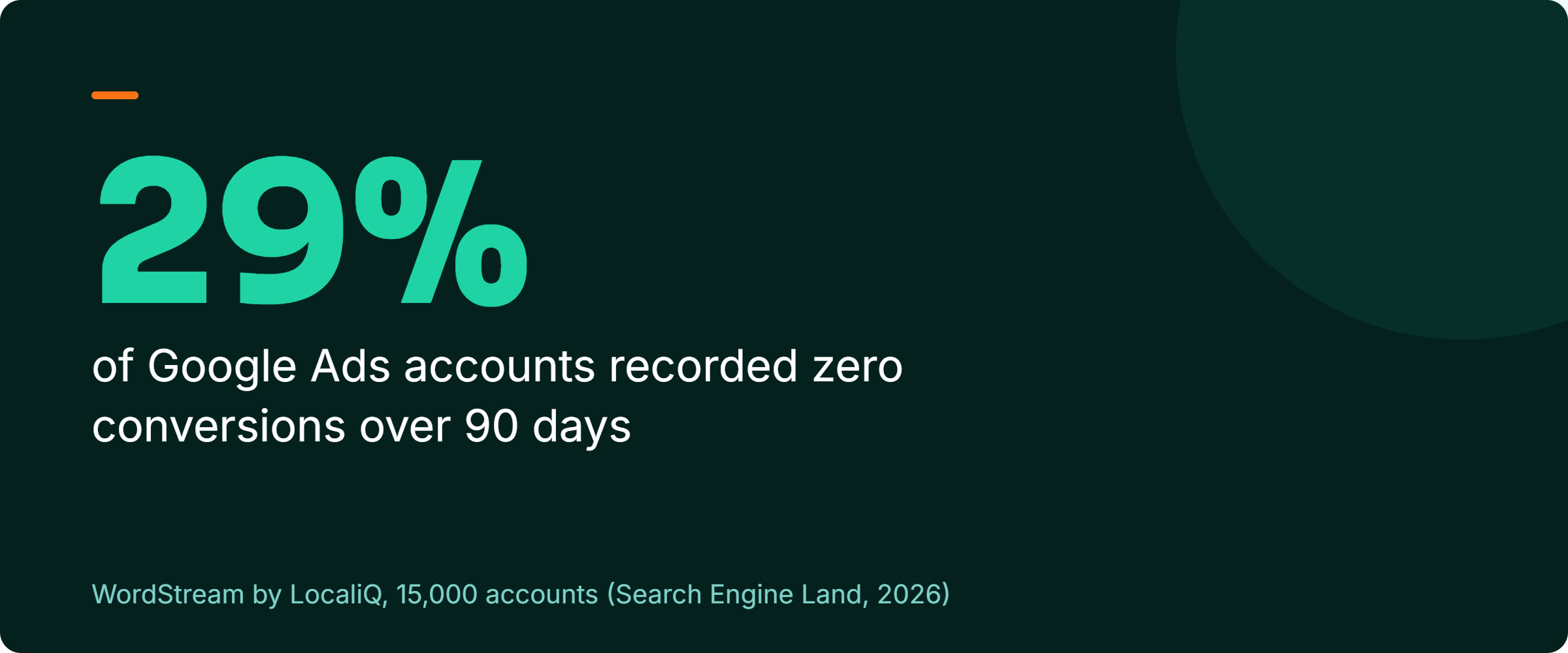
The cost of ignoring this is not theoretical. Account waste is the default state of Google Ads for a huge share of advertisers. A WordStream by LocaliQ analysis of more than 15,000 Google Ads accounts, reported by Search Engine Land on May 18, 2026, found that nearly 29% of those accounts recorded zero conversions over 90 days. Nearly a third of advertisers spent three months of budget and booked nothing. Layering a feature that broadens targeting on top of accounts already leaking money is how you turn a slow leak into a faster one. I have written before about how to find money already draining out of an account, and the same discipline applies here in my breakdown of how to run a wasted spend audit on a Google Ads account.
Owners switch it on because it arrives pre-checked and dressed as progress
Defaults decide behavior. When a feature shows up inside your campaign settings already leaning toward "on," with the word "recommended" beside it and a promise of more conversions, the path of least resistance is to leave it alone. Most owners are not reading release notes from Google's product team. They are running a business and trusting that the platform's suggestion is in their interest, which is a reasonable assumption about a hardware store and a dangerous one about an ad platform that profits from your spend.
There is a naming trick at work too, and one practitioner named it directly. Xavier Mantica, who ran a four-month test of AI Max documented by PPC Land on November 8, 2025, put the rebrand bluntly.
"They couldn't convince advertisers to use broad match because we know it burns budget on irrelevant searches. So they rebranded it as an 'AI-powered feature' with a shiny new name."
Xavier Mantica, reported by PPC Land, November 8, 2025
Whether or not you agree with his framing, the mechanism he describes is real. Advertisers learned over years to distrust broad match because it spent money on the wrong searches. A new name resets that learned caution. The second reason owners get this wrong is fear of being left behind, the sense that everyone else is using the shiny thing and you are falling behind by ignoring it. The adoption data says the opposite. Smarter Ecommerce, the analytics firm led in this research by Mike Ryan, examined more than 600 accounts and found AI Max active in only 12% of them, making up just 0.57% of account-level ad spend, about 5% within the campaigns where it is even switched on. You are not behind the pack by leaving it off. The pack has barely touched it.
This is the same trap I keep watching owners fall into with Google's other automated products, where the dashboard looks impressive and the bank account tells a different story. It mirrors the gap I covered between Performance Max ROAS and real incrementality, where another Google automation reports glowing numbers until you measure whether it actually drove sales you would not have gotten anyway.
Google's number for AI Max is real, and the independent tests point the other way
Google's claim deserves to be stated fairly, because it is genuine and it is the thing being scrutinized. Brian Burdick, Senior Director of Product Management for Google Ads, wrote on blog.google on May 6, 2025, that the feature delivers a measurable lift.
"advertisers that activate AI Max in Search campaigns will typically see 14% more conversions or conversion value at a similar CPA/ROAS. For campaigns that are still mostly using exact and phrase keywords, the typical uplift is even higher at 27%."
Brian Burdick, Senior Director of Product Management, Google Ads, blog.google, May 6, 2025
Read that carefully. A 14% lift in conversions at a similar cost per conversion, meaning the price you pay for each sale or lead, would be worth having if it held up in your account. The figure comes from Google's own internal data, it is not retail-specific, and no independent party verified it. It is the vendor describing its own product. That does not make it a lie. It makes it a starting hypothesis, not a finding, and the difference between those two words is your money.
Now the independent side, which is where the picture turns. Xavier Mantica's four-month test produced numbers that did not flatter the feature. AI Max cost him $100.37 per conversion, against $43.97 for phrase match and $52.69 for exact match. That is more than twice as expensive per sale as phrase match, paying about two dollars and thirty cents to get what a dollar of phrase match bought. His verdict was short.
"I'm done with AI Max. After 4 months of testing, the data is brutal."
Xavier Mantica, reported by PPC Land, November 8, 2025
One practitioner is an anecdote. A second source across a much larger sample is a pattern. Smarter Ecommerce, through Mike Ryan, analyzed more than 250 retail campaigns and found AI Max delivered roughly 35% lower return on ad spend than other match types, making it the worst-performing match type in their data by the numbers. For a retailer spending real money on inventory, 35% lower return is the difference between a campaign that funds itself and one that bleeds. An earlier test adds a third data point pointing the same direction. Ezra Sackett at Monks, documented by PPC Land on August 17, 2025, found that 99% of AI Max impressions generated zero conversions across about 30,000 search terms, meaning nearly every time the ad showed, it produced nothing.
Be honest about what this evidence is and is not. The independent tests are mostly retail and ecommerce, run by individual practitioners, not peer-reviewed studies. They are strong directional evidence, not proof that the feature is universally bad. Google's 14% is also real. The fair reading of both is not "AI Max is garbage." It is "the feature has not earned your trust yet, so make it earn that trust on a small slice of budget before it touches the rest."
One more piece of independent evidence reinforces why tight control tends to win. An Optmyzr study of match-type performance, analyzed by Navah Hopkins with data through the fourth quarter of 2023, found that 74.10% of accounts had better return on ad spend with exact match, by a median of 100.59% better, and 73.84% had a better cost per conversion with exact match. In roughly three of four accounts, the tighter, more controlled targeting beat the looser kind. The study's own summary, that exact match is where performance is and broad match is where testing lies, is the cleanest one-line description of how to treat AI Max that I have seen.
Switch it off first, then earn the right to switch it on
You can do most of this yourself in under an hour. The steps run from defense to controlled offense.
First, log into Google Ads and check the status. Open each Search campaign, go to its settings, and look for whether AI Max is toggled on. If you did not deliberately turn it on for a test, turn it off. This is the single highest-value move in this article and it costs you nothing but a few minutes. You are removing a setting you never chose.
Second, clean the foundation before you experiment with anything fancy. Add negative keywords, which are words you tell Google to never show your ad for, like a plumber adding "job," "salary," and "free" so the ads stop appearing for people who want plumbing careers rather than a plumber. The WordStream by LocaliQ data reported by Search Engine Land on May 18, 2026, found that accounts using negative keywords saw conversion rates up to three times higher. Three times. That is a larger, more reliable gain than any match-type rebrand is promising you, and it is fully within your control.
Third, if you still want to test AI Max after the basics are solid, run it on exactly one campaign with a hard daily budget cap, a ceiling you set so the feature cannot spend past a number you can afford to lose. Pick one campaign, set the cap low enough that a bad few weeks will not hurt, and leave the rest of your account untouched. You are buying information, and you are deciding in advance what that information is allowed to cost.
Fourth, leave the test running for a few weeks, not a few days. Short windows produce noise, not answers, and the practitioners who reached clear verdicts ran their tests for months, not afternoons. Resist the urge to judge it after a good Tuesday.
Fifth, if you delegate this to an agency or a freelancer, ask them one specific question and listen for a specific answer. Ask: "Show me the AI Max search-terms and expanded-matches report, and show me its cost-per-sale next to my normal keyword campaigns for the same period." A capable partner pulls that report without flinching. Anyone who answers with talk about impressions, clicks, or "AI optimization" instead of cost per sale is selling you activity, not results.
Judge it by cost per sale, and treat impressions as a trap
Measurement is where this decision lives or dies, so be precise about the one number that matters. Cost per conversion, the amount you pay to get one sale or one qualified lead, is the scoreboard. Run AI Max on its capped test campaign for a few weeks, then open the AI Max search-terms report, sometimes shown as expanded matches, and put its cost per conversion directly beside the cost per conversion of your normal keyword campaigns over the same dates. If AI Max costs more per sale, it loses. If it costs less, it earns a bigger slice. Mantica's test gave him $100.37 against $43.97, and that gap is the entire decision in two numbers.
The traps are the metrics that feel like progress and pay no bills. Impressions, how many times your ad appeared, will likely rise under AI Max because the whole point of loose matching is showing your ad more widely. More impressions feel like momentum. Recall that Ezra Sackett at Monks found 99% of AI Max impressions produced zero conversions across roughly 30,000 search terms, which is the cleanest proof that impressions and money are not the same thing. Clicks are the next decoy. A higher click count with a higher cost per sale means you are paying more people to visit and not buy, which is worse than fewer clicks that convert. Watch the cost of the sale, not the size of the crowd.
Beware the dashboards Google puts in front of you, because they tend to highlight the numbers that justify more spend. This is the same dynamic at work when owners hand bidding decisions to automated systems and watch the reported performance look healthy while the actual return slips, a pattern I dug into around the budget risk of handing bidding control to Google's automation. The reported metric and the banked result are two different things, and only one of them pays your rent.
Set a decision date before you start, because tests without deadlines become permanent by accident. Write down today that on a specific date a few weeks out you will pull the two cost-per-sale numbers and make a call. If AI Max wins on your numbers, expand it. If it loses or ties, switch it off and move on without sentiment. The feature does not deserve loyalty. It deserves a fair test against a hard number, and your own cost per sale is the only judge whose verdict spends.
Frequently Asked Questions
Is AI Max for Search just broad match with a new name?
In practical terms it behaves a lot like broad match, the loosest targeting setting that lets Google show your ad for searches it judges related rather than ones you specifically chose. Practitioner Xavier Mantica argued in a report published by PPC Land on November 8, 2025, that it was rebranded as an AI feature because advertisers had learned to distrust broad match for burning budget on irrelevant searches. The honest answer is that the mechanism is similar and the risk is similar. The fair move is to make the feature prove it pays in your account before you trust it.
Should I turn AI Max off right now?
If you did not deliberately turn it on for a controlled test, yes, turn it off today. Log into Google Ads, open each Search campaign's settings, and check whether the toggle is on. Leaving on a feature you never chose is how budgets leak on searches that do not buy. You can always switch it back on later for a proper test once your account basics are clean.
How do I test AI Max safely without wasting money?
Run it on exactly one campaign with a hard daily budget cap, a ceiling you set so it cannot spend past an amount you can afford to lose. Leave it running for a few weeks, not a few days, since short tests produce noise instead of answers. Then open the AI Max search-terms or expanded-matches report and compare its cost per sale against your normal keyword campaigns over the same period. Keep it only if your own numbers say it costs less per sale, and switch it off if it does not.
Three independent tests over many months, across retail, ecommerce, and tens of thousands of search terms, all point the same direction, while the one glowing number comes from the company that profits when you switch the feature on. That asymmetry is the whole story. You do not owe Google's recommendation the benefit of the doubt, and you do not owe a new feature your budget on faith. The next time a platform tells you a setting is recommended, ask who it is recommended for.