ChatGPT Sends Better Leads. Your Phone Loses Them.

Someone opened ChatGPT, asked for a clinic in your city, and it named you. They called. That caller already trusts the recommendation, and that trust makes them close better than a cold click off your Google listing. Then the phone rings out, or a staff member picks up and never asks for the booking. Getting named by AI is the hard, expensive part, and most owners are throwing that win away in the last three feet. Before you spend another dollar on visibility, fix the phone.
That is the whole argument. The recommendation does your pre-selling for free. The intake desk undoes it for free too, in the other direction.
The recommendation does your selling, then the phone drops it
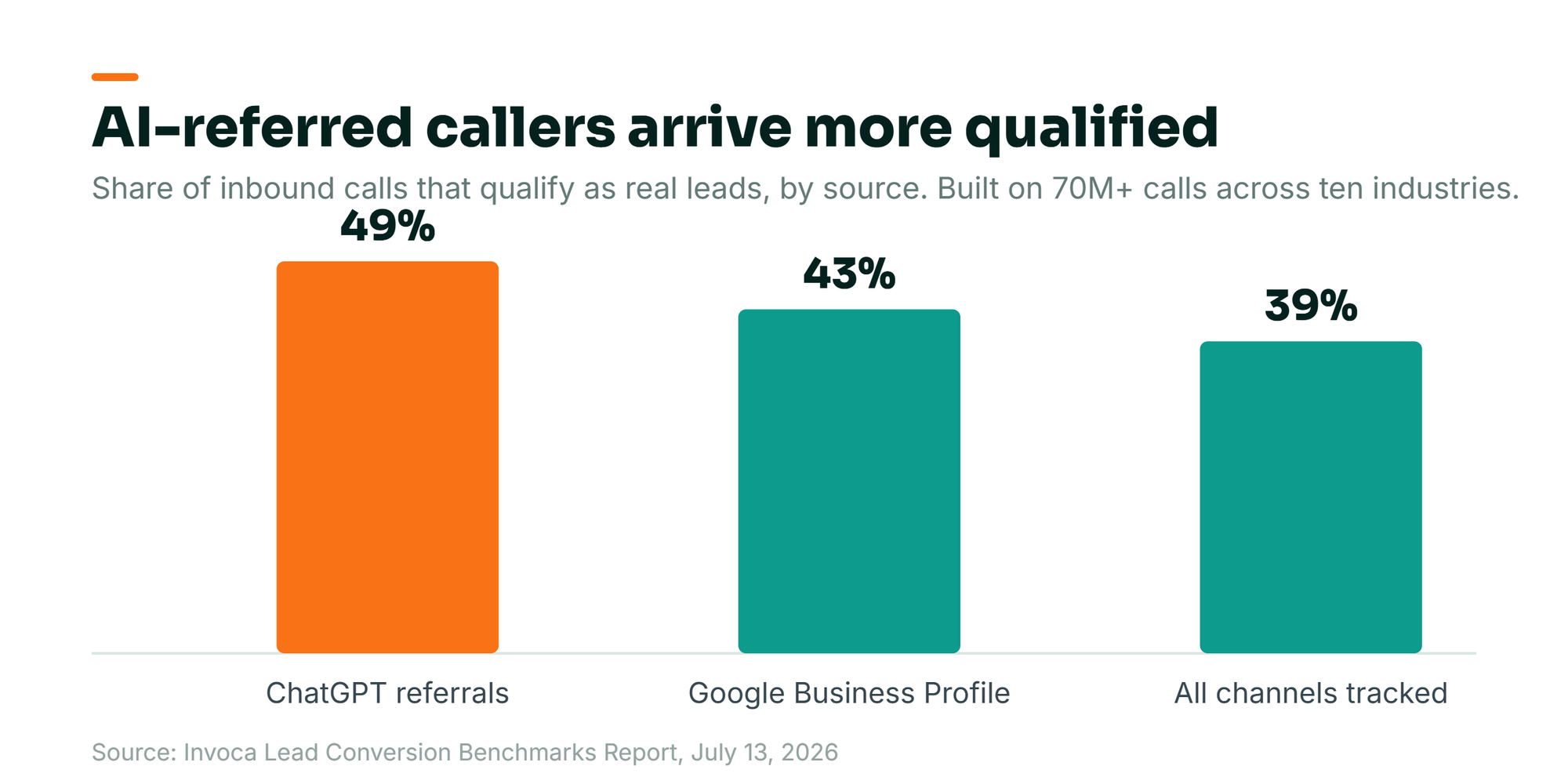
Invoca published its Lead Conversion Benchmarks Report on July 13, 2026, built on more than 70 million calls and 600 million minutes of talk time across ten industries. The number everyone quoted was this one: calls referred by ChatGPT qualify as real leads 49% of the time. Calls from a Google Business Profile qualify 43% of the time, and the average across every channel Invoca tracks is around 39%. In plain money terms, just under half the people who call after ChatGPT recommends you qualify as a real lead, versus a little over four in ten off your Google listing.
You would expect that head start to carry all the way to a sale. It does not. Those same ChatGPT-referred leads convert at 40%, a hair under the 42% all-channel average. Read that twice. The caller arrives warmer, then closes slightly worse than average. The entire advantage the recommendation handed you evaporates the moment a human picks up the phone, which tells you the problem is not the traffic. It is what happens after "hello."
This is the same pattern I have watched wreck good businesses for years, just wearing a new coat. I wrote about it when the culprit was search traffic in the piece on why your ranking looks fine while your phone disagrees. AI referrals move the failure one step later in the funnel, but the failure is identical: demand shows up, and the business is not built to catch it.
Everyone sells you the front of the funnel because it photographs well
Visibility is easy to sell. It has dashboards. It has a green line going up and to the right. An agency can screenshot your business appearing inside an AI answer and you feel like progress happened, because something visible did. Answered-call rates and whether your receptionist asked for the appointment do not screenshot well. Nobody puts them in a pitch deck. That is the reason the front of the funnel gets all the attention and the money.
The trap is that AI visibility is the single most expensive way to generate a phone call. You are not bidding in an auction like Google Ads. You are earning a mention inside a system that already decided you were credible, which takes real content, real authority, and real time. Mike King of iPullRank put the mechanism plainly in a Moz AMA on June 30, 2026.
When I talk about digital PR for AI search, I'm not talking about link building. The value is having your brand, message, and expertise covered on sites that AI systems already consider authoritative.
Mike King, iPullRank, Moz AMA, June 30, 2026
Getting covered on sources an AI already trusts is slow, deliberate work. It compounds over months. When a caller finally arrives carrying that hard-won recommendation and the phone rings eleven times, you did not lose a click. You lost the most costly lead in your whole marketing budget. A dropped call from a cold directory is a shame. A dropped call from someone ChatGPT personally vouched for is money set on fire.
There is a related confusion worth clearing up, because it feeds the same overspend. Being named by an AI and being genuinely recommended by it are not the same thing, a distinction I pull apart in the difference between a citation and a recommendation. But the Invoca data suggests that when the recommendation is real enough to make someone dial, the person is real too. The weak link is not the AI. It is the answer.
What Invoca actually measured, and what it left out
The 49% headline is being passed around like scripture and it should not be. Search Engine Journal covered the report on July 15, 2026, and did the useful thing of poking it. Invoca does not disclose how many ChatGPT-referred calls went into that 49%. It gives no measurement window. It does not explain how it attributed a call to ChatGPT in the first place. And it excludes Gemini, Claude, and Perplexity entirely. This is a ChatGPT-only slice of one company's customer base. On top of that, Invoca sells call tracking software. The report is also marketing for the product that produced it.
None of that makes the number a lie. It makes it directional, not gospel. Treat 49% as a signal that AI-referred callers tend to arrive more qualified, not as a promise that yours will hit exactly 49%. The direction is what matters for your decision this week. It is consistent with everything I have seen across 17 years and 300-plus businesses. A person who was told by a trusted source to call you behaves differently than a person who found you in a list of ten.
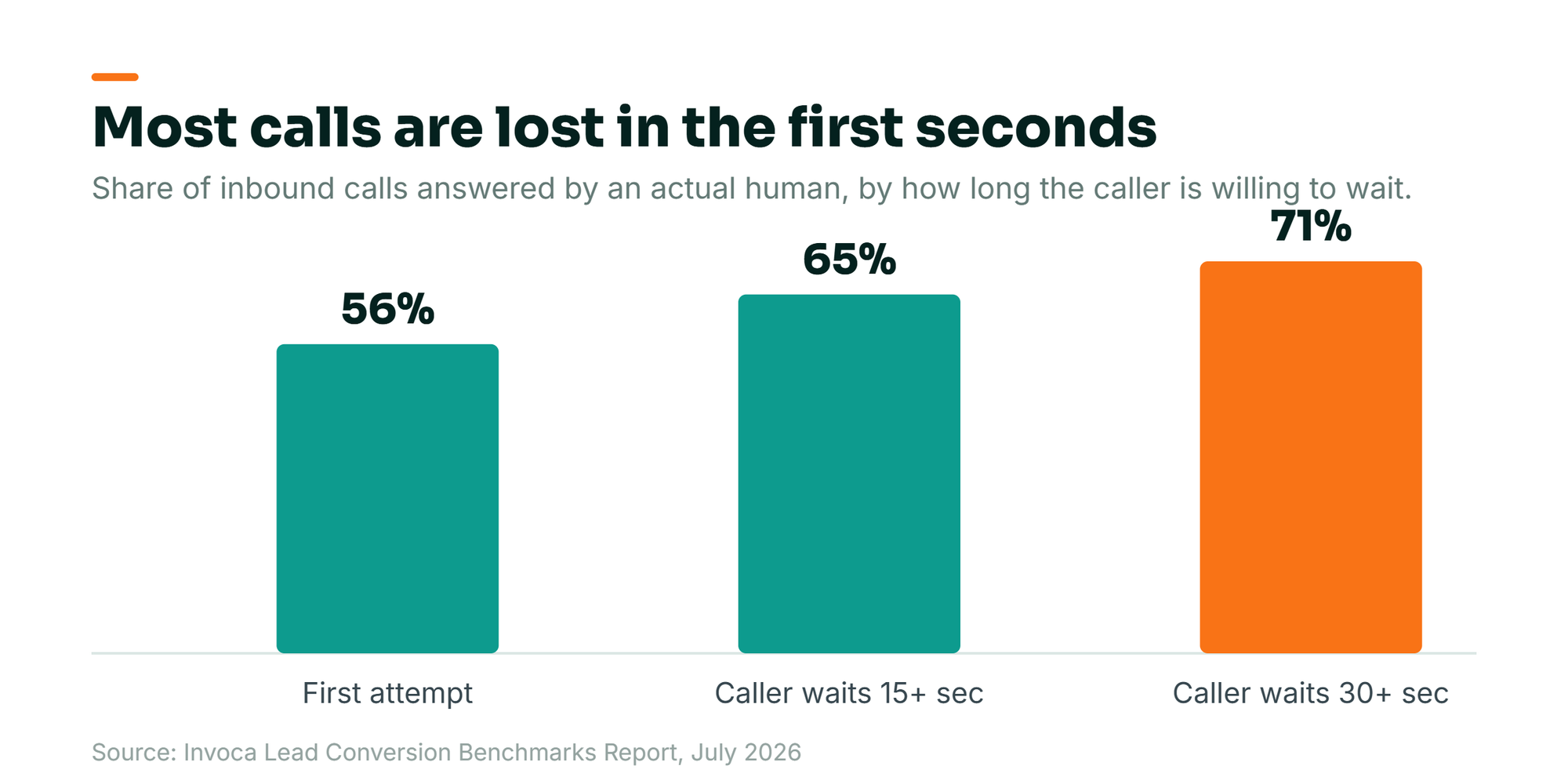
Follow the drop-off step by step. Invoca found about 56% of inbound calls get answered by an actual human. If the caller is willing to wait more than 15 seconds, that climbs to 65%, and past 30 seconds it reaches 71%. Flip those numbers around. Nearly half of first calls do not reach a person on the first try. You are relying on strangers to hang on through half a minute of ringing to rescue the ones that stall. Of the calls that do get answered, 38% qualify as leads and 42% of those convert. Each stage sheds people.
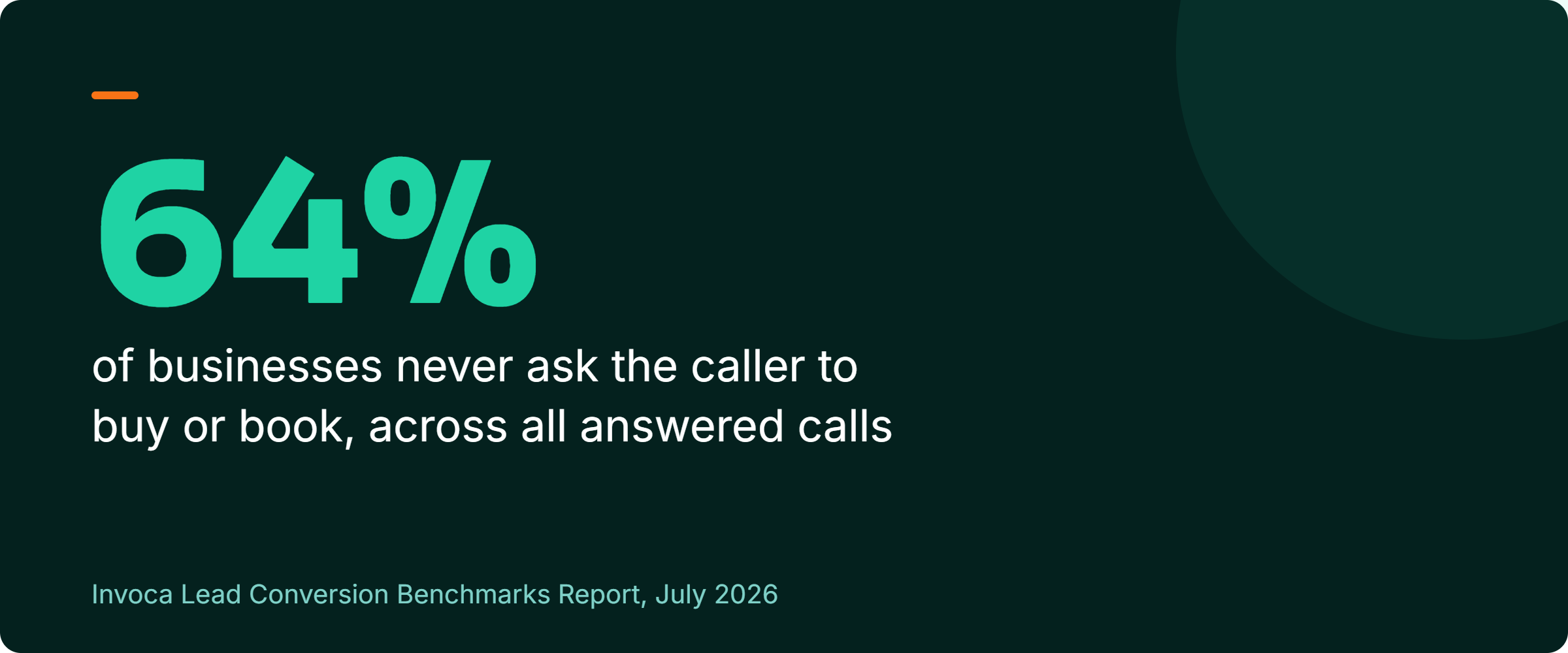
Then the finding that should sting the most. Across all those answered calls, 64% of businesses never ask the caller to buy or book. Two times out of three, a warm, pre-sold human reaches a real person, has a pleasant chat, and hangs up without ever being invited to make an appointment. The recommendation did its job. The AI did its job. The front desk treated the call like a customer service inquiry instead of a sale that walked in the door.
Run this five-part phone audit before your next visibility invoice
You can check every weak point above this week without buying a single tool or signing a single retainer. Do these in order.
One: count your unanswered calls. Pull your phone system's call log, or your mobile log if that is where business comes in, for the last two weeks. Count missed and abandoned calls against total inbound. If more than one in five went unanswered, you have found leaks bigger than any visibility gain a campaign will hand you this quarter. This costs you an hour and zero dollars.
Two: time your own ring cycle. Call your main line from a phone that is not yours, at 9am, at lunch, and at 4:30pm. Count the rings. If a real person is not on the line inside 20 seconds, you are betting the caller hangs on. Invoca's own ladder shows the payoff only comes for the ones who wait past 15 and 30 seconds. Note who eventually answers and how long it took.
Three: listen for the ask. If you record calls, pull ten answered ones at random and listen for a single thing: did your team ask for the booking, the appointment, or the sale, in words? Not "let me know if you have questions." An actual invitation to schedule. If you do not record, sit near the desk for a morning and tally it by hand. Expect to be unpleasantly surprised, because 64% of businesses fail this.
Four: script the close and make it non-optional. Give whoever answers one required sentence to end every qualified call: "I can get you booked in right now, does Tuesday or Thursday work better?" That is it. You are not training salespeople. You are removing the option to hang up without offering the next step. This is a five-minute team meeting, not a course.
Five: kill the after-hours black hole. Some of your AI-referred callers will reach out after hours. Decide what happens to a 7pm call. A human answering service, a same-day callback promise, even a voicemail that actually gets returned before noon the next day. Right now, for most owners, the honest answer is "the call just rings out," and that is the most expensive option.
If you do not want to run this yourself, put a specific question to your agency: "What is our answer rate, and are we asking for the booking on every qualified call?" If they can only talk about impressions and rankings, they are selling you the part of the funnel that photographs well and ignoring the part that pays you.
Measure the last three feet, not the first click
This is where owners get fooled by their own dashboards. Visibility metrics feel like results because they move and they are visible, but they are upstream of money. Being seen is not being called, and being called is not being booked. The full guide to AI search visibility for business owners covers how to earn the mention in the first place, and you should do that work. Just do not confuse earning the mention with banking the revenue.
Consider the upstream numbers on their own terms first. Seer Interactive's April 2026 analysis covered 53 brands, 5.47 million queries, and 2.43 billion impressions. It found that being cited in a Google AI Overview delivers 120% more organic clicks per impression versus not being cited on that same AI-Overview page. Cited pages still get 38% fewer clicks than pages on results with no AI Overview at all. Even winning the AI citation is a smaller click prize than the old plain-blue-links page used to hand you. Every click and every call that does make it through to you is more precious than it was two years ago. Dropping one at the phone now costs you more.
The vanity trap is measuring the click and stopping. The real scoreboard, checked monthly, is the percentage of calls answered by a human and the percentage of answered calls where someone asked for the booking. Add the percentage of qualified calls that booked and the calls that came in after hours with no path to a person. Those four move revenue. Impression counts do not, at least not on their own.
Picture a clinic. I once booked a London ADHD clinic solid for three straight months, and the demand ran so hard they hired more specialists and started outsourcing the overflow. That only worked because the intake could hold the weight. If the same demand had hit a phone that went to voicemail after 6pm and a front desk that never said "let me get you scheduled," the campaign would have looked like a failure. The story would have been "AI visibility does not work for us." The demand was never the variable. The catching was.
Frequently Asked Questions
How do I know if calls from ChatGPT are actually better for my business?
Invoca's July 2026 benchmark found ChatGPT-referred calls qualify as leads 49% of the time versus around 39% across all channels, but that is their aggregate data, not yours. Check your own by asking new callers a simple question at intake: "How did you hear about us?" Log the ones who say an AI assistant or ChatGPT, then compare how many of them booked against your other sources. You will have a real answer in a month, and it will be your number, not a vendor's.
What is a normal call answer rate for a small business?
Invoca's 2026 data puts human-answered inbound calls at about 56% on the first attempt, rising to 65% if the caller waits past 15 seconds. If you are answering fewer than half of first-attempt calls, you are below a benchmark built on 70 million calls and losing leads you already paid to generate. Pull your phone log for two weeks and count missed versus total to find your true rate.
Should I stop investing in AI visibility?
No, but sequence it correctly. If your phone goes unanswered 44% of the time or your team rarely asks for the booking, you are paying for visibility that generates calls you then drop. That is the most expensive way to lose a lead. Fix the answer rate and the closing ask first, since both are free to check and cheap to fix, then pour money into getting recommended by AI. Visibility into a leaky intake is a bad trade.
Go call your own business right now, from a number nobody at the desk recognizes, and see what happens. If it rings out, the campaign you were about to buy would have been funding a leak. If you want a second set of eyes on where your intake leaks, book a call with me and we will walk your numbers together. But if someone answers politely and never invites you to schedule, you have found the more expensive problem, the one an answered phone hides: 64% of businesses never ask. Picking up was never the finish line.