Bidding Smarter Won't Fix Your Rising Google Ads Costs

Your Google Ads bill went up again this quarter, and you didn't change a thing. Same campaigns, same keywords, same budget, more money out the door for the same number of leads. The instinct is to tighten the bidding, add negative keywords, and squeeze the account harder. That will not fix it, and this article will show you why the extra cost is decided before anyone clicks your ad, and where the durable fix actually lives.
CPC, the cost per click you pay every time someone taps your ad, is being pushed up by forces outside your account entirely. You can be the sharpest bidder in your industry and still watch the number climb. The teams keeping their margins intact are not out-bidding anyone. They built demand the auction can't tax.
The extra money left your account before the auction opened
Across industries, the average Google Ads cost per click is now $5.42, according to WordStream's 2026 benchmark data. That is more than double what it was a decade ago. For a business buying even a modest volume of clicks each month, the climb is from a few dollars to five and a half per click. That is the difference between a manageable ad line and a number that makes you flinch when the invoice arrives.
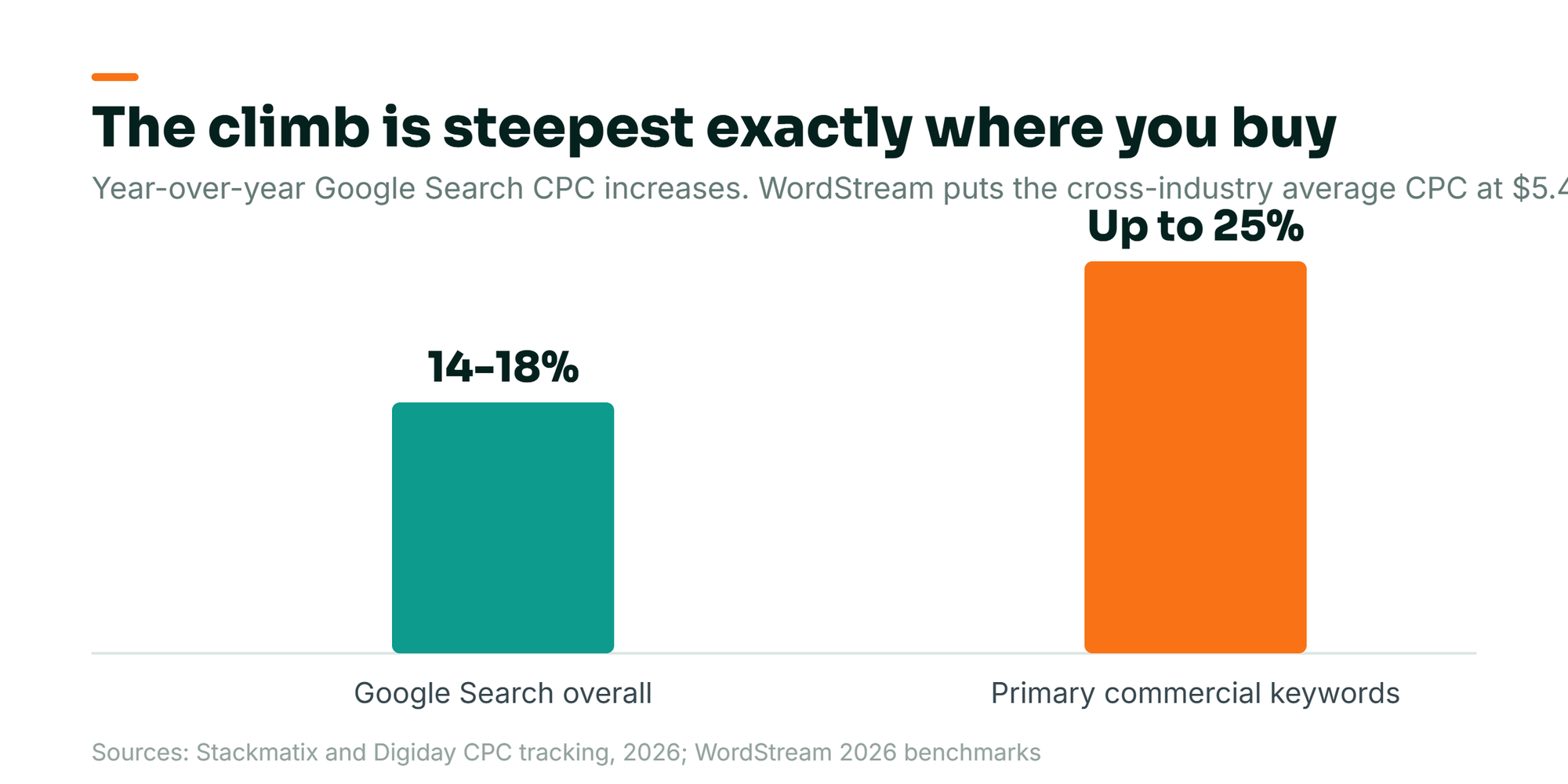
The climb is not slowing. Stackmatix and Digiday put Google Search CPCs up 14 to 18 percent year over year. The rise reaches as high as 25 percent on primary commercial keywords, the exact terms with buying intent that you most want to show up for. A quarter more expensive, on the words that matter most, in twelve months. You did not cause that. Your competitor didn't outsmart you. The floor under the whole auction rose. Google is also selling a new place to put that money, and the ad slot inside its AI answers is a different deal than it looks.
Ben Wood, performance director at Hallam with more than fifteen years in paid search, framed it plainly in a July 2026 piece for Search Engine Land: CPC inflation now starts before the auction. The bidding war you think you're fighting is downstream of the real problem. By the time two advertisers are trading bids on a keyword, the price has already been set by how many bidders showed up and how few clicks are left to win.
Thirty-five percent more advertisers just walked into your auction
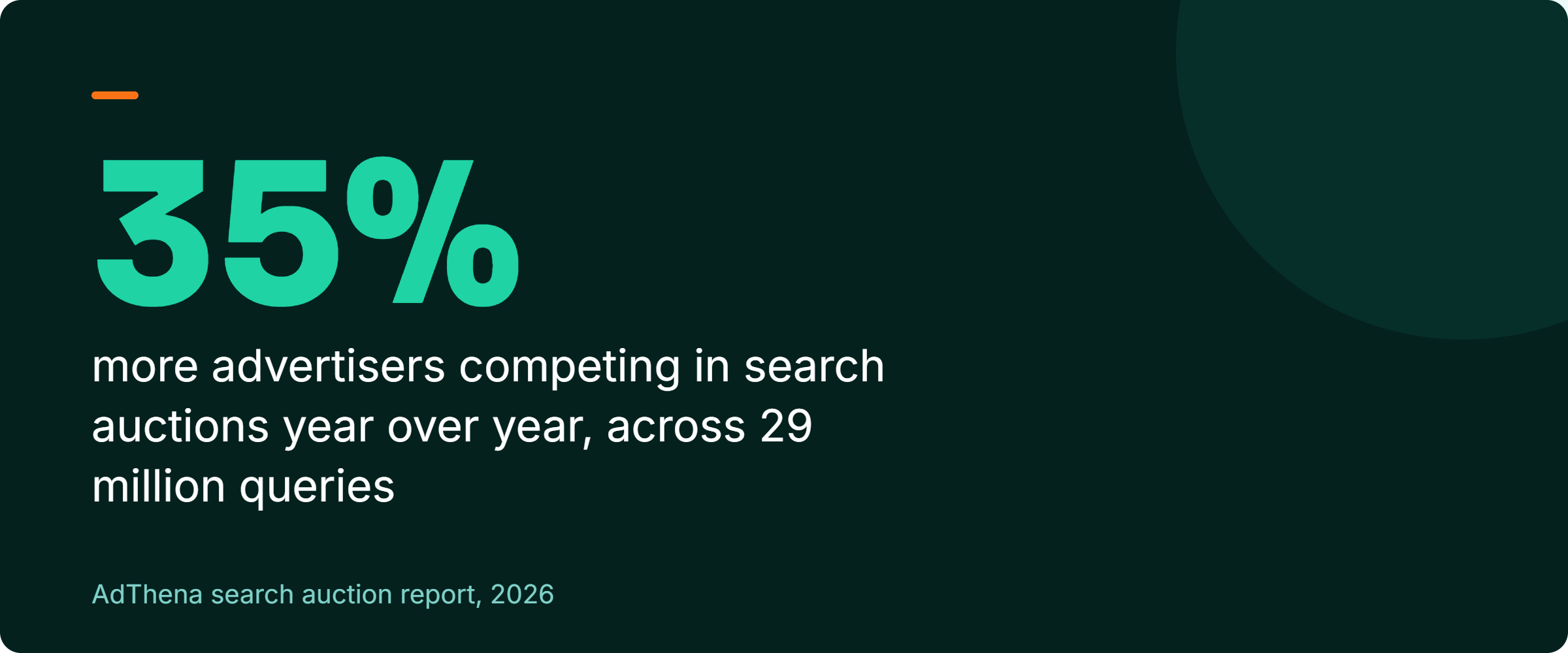
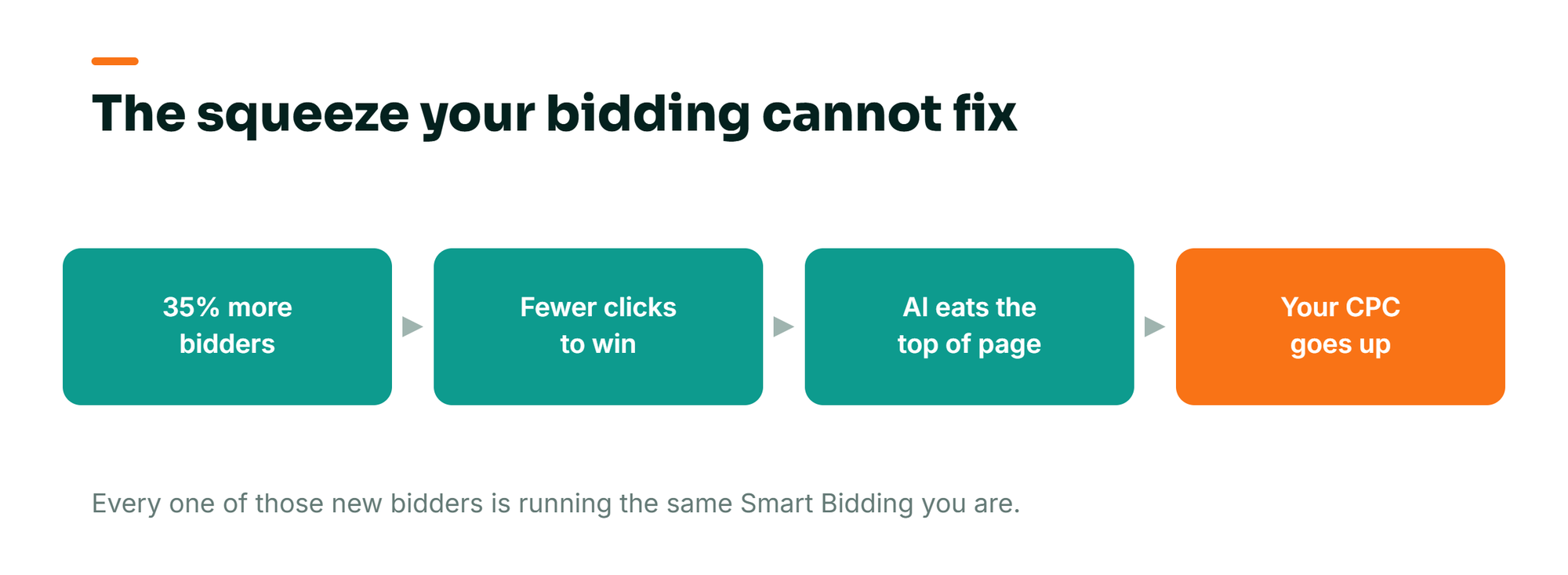
Picture an auction house with a fixed number of items and, suddenly, a third more bidders in the room. Every paddle in the air pushes the hammer price up, and no amount of clever bidding gets you the item cheaper. That is your keyword auction right now. AdThena's report covering 29 million queries found the number of advertisers competing in search auctions up 35 percent year over year.
Why the flood? AI creative tools dropped the barrier to entry through the floor. Building an ad used to take a copywriter, a designer, and someone who knew the platform. Now a solo operator generates a full campaign in an afternoon. More people can run ads. More people do, and they all crowd into the same commercial keywords you have been bidding on for years.
There are fewer clicks to go around. SparkToro's 2026 zero-click study found that fewer than one in three Google searches still sends a click to any website at all, an 8 percent drop from 2025. AI Overviews, the answer boxes Google now stacks at the top of the results, answer the question on the page and the searcher never leaves. Digiday reports 37 percent of marketers have already watched their informational search traffic decline.
More bidders, fewer clicks, AI eating the top of the page. That is the plain economics of why your bill keeps climbing while your results sit flat. It is a math problem you cannot bid your way out of, because bidding is the one lever every one of those 35 percent more advertisers is pulling right alongside you.
Why smarter bidding feels like progress and isn't
Owners reach for the bidding controls because that is the knob the platform hands them. Google's dashboard is built around bids, budgets, and Smart Bidding. When costs rise, that is where your attention goes. It feels productive. You adjust a target, you watch the numbers, you tell yourself you're managing the problem.
But every advertiser in that auction has the same automated bidding, often the identical Smart Bidding strategy Google nudges everyone toward. When the whole room uses the same tool to compete for the same clicks, the tool stops being an edge and becomes table stakes. I have written before about how Google made bidding smarter without making your budget safer, and this is the same trap at auction scale. Automation optimizes your position inside the auction. It does not change how crowded the auction is.
Wood breaks the whole problem into three levers, and the split is the most useful thing in his analysis. There is Brand, upstream of the click, where most of the inflation actually originates. There is Reach, the auction itself, which is where you have the least pull left because everyone is fighting there. And there is Experience, the post-click layer, which is the one part of this you fully control. Over-index on Reach, keep pouring money into the most crowded auction, and you starve the two levers that could actually protect your margin.
What the data says about where your advantage actually is
Wood does not hedge on where the durable advantage sits.
The teams that protect their margins through this transition won't be the ones with better targeting or bidding strategies. They'll be the ones who've built enough visibility and authority outside the auction to win it when it matters.
Ben Wood, Hallam, in Search Engine Land, July 2026
Read that twice, because it inverts how most owners budget. The advantage is not inside the ad account. It is the demand you bring to the auction. When a customer already knows your name, searches for you directly, and clicks, that click is cheap and it converts, because they arrived half-sold. The cheapest click is the one you never had to fight a bidding war to win. That is the Brand lever, and it is why I keep telling owners that brand has become the new backlink. Demand you build compounds. Bids you place evaporate the moment you stop paying.
I am not saying "quit Google Ads." Wood says the opposite, and so do I. Search still works. The move is to stop over-indexing on the most crowded auctions, the red-ocean keywords where 35 percent more advertisers are all bleeding out together, and put weight where you have an edge. That includes cheaper auctions. Wood notes Microsoft and Bing CPCs typically run 20 to 40 percent lower than Google's for the same intent. Fewer bidders in that room, same customers, up to 40 percent off the click.
The third lever, Experience, is the one nobody talks about because it isn't a bid setting. Your landing page is one of the three inputs to Quality Score, Google's rating of how relevant and useful your ad and page are. A higher Quality Score literally lowers what you pay per click for the same position. A slow, vague, or off-message landing page quietly taxes every click in the account, and it is entirely inside your control. My own site went from a PageSpeed score of 59 to 97 in one rebuild, with the headline showing in 2.1 seconds instead of 10.6.
What to do this week, in order
Start with the one number Google's dashboard never leads with. Pull your true cost per lead, not your cost per click. Total ad spend divided by real, qualified leads. WordStream's 2026 benchmark puts the cross-industry average cost per lead at $66.69, with an average conversion rate of 8.18 percent and an average click-through rate of 6.64 percent. Those are your yardsticks. If your cost per lead is climbing faster than $66.69 suggests it should, the auction is taxing you harder than the market average. That tells you exactly how urgent the next four steps are.
Second, check whether your landing page is dragging your Quality Score. In Google Ads, look at the Quality Score column and its "landing page experience" component on your top-spend keywords. Anything rated "below average" is costing you money on every single click. This is a delegate-or-do-it-yourself job: either you fix the page's speed, message match, and relevance, or you hand your agency one direct question, which I'll give you in a moment.
Third, weigh the cheaper auction before you add another dollar to Google Search. Set up a small test campaign on Microsoft Ads targeting your top three commercial keywords. If Wood's 20-to-40-percent-lower CPC holds for your market, you just found cheaper leads with no change to your offer. Do not move your whole budget. Test, measure cost per lead, then decide.
Fourth, audit where your Google spend is actually going. A crowded account bleeds money in ways bidding never reveals, and I've documented how the average account leaks around 25 cents on every dollar through broad match spillover, junk search terms, and untracked conversions. Reclaiming that waste funds the brand and experience work without asking you for a bigger budget.
Fifth, put real weight behind demand that arrives pre-sold. That is branded search, being the name a customer types on purpose, and being the business AI Overviews and assistants recommend by name. This is the slow lever, and it is the one that pays for years. The exact question to ask your agency: "Show me our branded search volume trend and our cost per lead on branded versus non-branded terms." If they cannot produce it, they are managing your bids and ignoring the thing that actually sets your bids.
What to measure, and the numbers built to fool you
Watch cost per lead and cost per acquisition, tracked monthly, split into branded and non-branded. That split is the whole story. If your branded cost per lead is a fraction of your non-branded, every dollar that grows branded demand is buying you cheaper leads for months to come. That is the trend that tells you whether the durable fix is working.
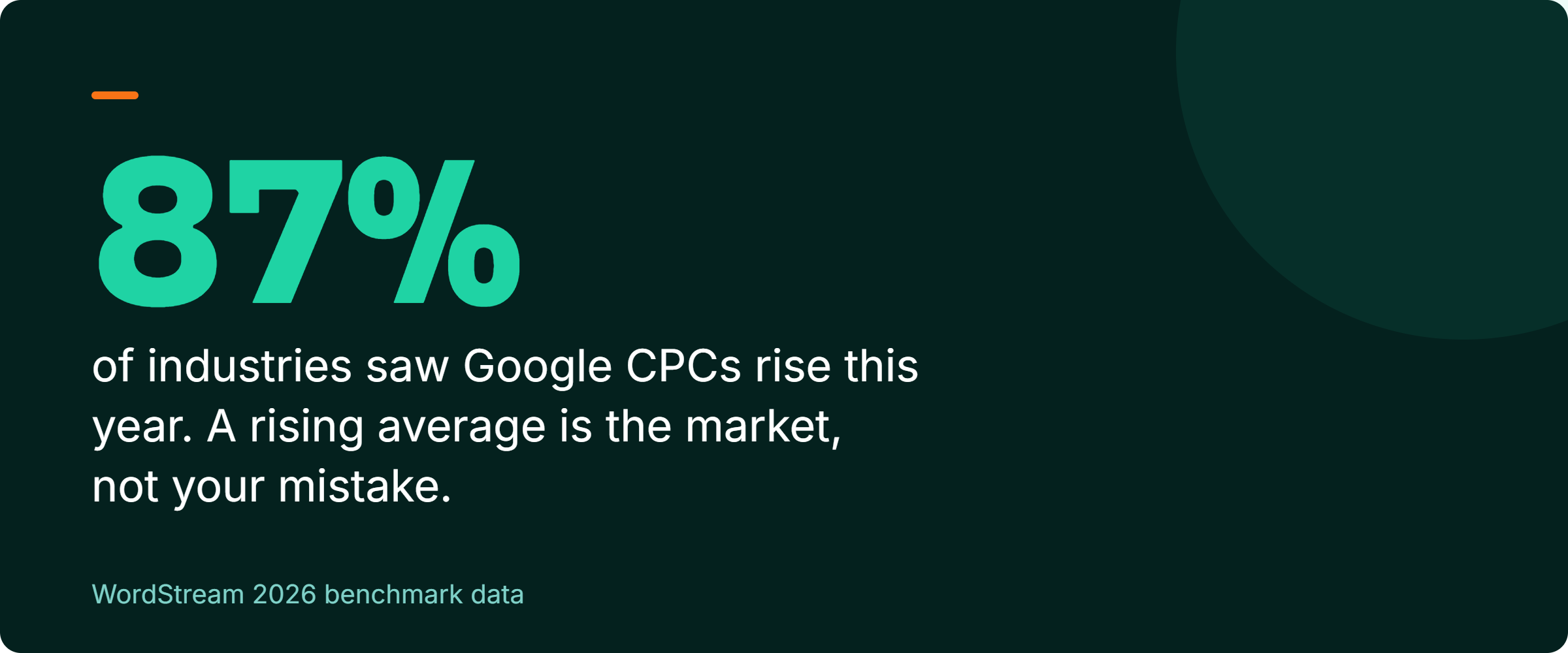
Average CPC is the vanity metric of paid search. It can fall while your cost per lead rises, because a flood of cheap, low-intent clicks that never convert will drag the average down and make a worsening account look like it's improving. Impression share is another one. A bigger slice of a shrinking, more expensive auction is not a win. WordStream found CPCs rose in 87 percent of industries this year. A rising average CPC is not a sign you're doing anything wrong, and a flat one is not a sign you're doing anything right. Judge the account by leads and by what each lead costs you, never by the click.
If impressions fall while CPC climbs and every campaign still reads Eligible, the auction may not be the cause. Check whether Google has placed the account under Limited Ad Serving, a throttle on which auctions you may enter. A bid change will not lift it.
Give the durable levers time. Bidding changes show up in days. Brand demand and a rebuilt landing page compound over months, the same way the London ADHD clinic I worked with filled its calendar. We did not win that by out-bidding rival clinics. We built enough visibility and authority that demand outran their capacity for three straight months, and they ended up hiring more specialists and outsourcing the overflow. That is what winning the auction from outside the auction looks like. It does not show up in your CPC column. It shows up in your bank.
Frequently Asked Questions
Why does my Google Ads bill keep rising when I haven't changed anything?
Because the cost is set before your bidding even enters the picture. AdThena found 35 percent more advertisers in search auctions year over year, driven by AI tools that made ads cheap to produce. SparkToro found fewer than one in three searches now sends any click at all. More bidders competing for fewer clicks pushes the price up on its own. Stackmatix and Digiday measured Google Search CPCs rising 14 to 18 percent year over year, up to 25 percent on your most commercial keywords. Your account didn't change; the auction around it did.
Should I just quit Google Ads if it keeps getting more expensive?
No, and anyone telling you to is overselling it. Ben Wood of Hallam is explicit that this is not about abandoning search. The move is to stop pouring more money into the most crowded auctions and redirect some of it. Test cheaper channels like Microsoft Ads, where CPCs typically run 20 to 40 percent lower. Fix the landing page that's dragging your Quality Score, and build branded demand so more of your clicks arrive pre-sold. Google Search still works. Over-relying on the most expensive corner of it is the mistake.
Will Smart Bidding lower my cost per click?
Not meaningfully, because nearly every advertiser in your auction is using the same automated bidding. When everyone pulls the identical lever, it stops being an advantage and becomes the baseline. Smart Bidding optimizes your position inside the auction. It cannot change how many bidders are in the room or how few clicks are left to win. The levers that actually lower your effective cost are branded demand, which brings cheaper pre-sold clicks, and a stronger landing page, which raises your Quality Score and cuts what you pay per click.
Go pull one number before you touch another bid: your cost per lead on branded search versus non-branded. The gap between those two figures is the real price of every customer who didn't already know your name. Most owners have never looked at it, and most agencies never volunteer it, because that gap makes bid management look like the small lever it is. The cheapest click you'll ever buy is the one from someone who came looking for you.
Want a straight read on where your spend is leaking and which of the three levers, brand, reach, or experience, is starving in your account? Book a call at https://cal.com/johntalaguit/ai-visibility-call and we'll walk through your actual numbers together.