Google's 2026 Cleanup Is Flagging Honest Local Businesses

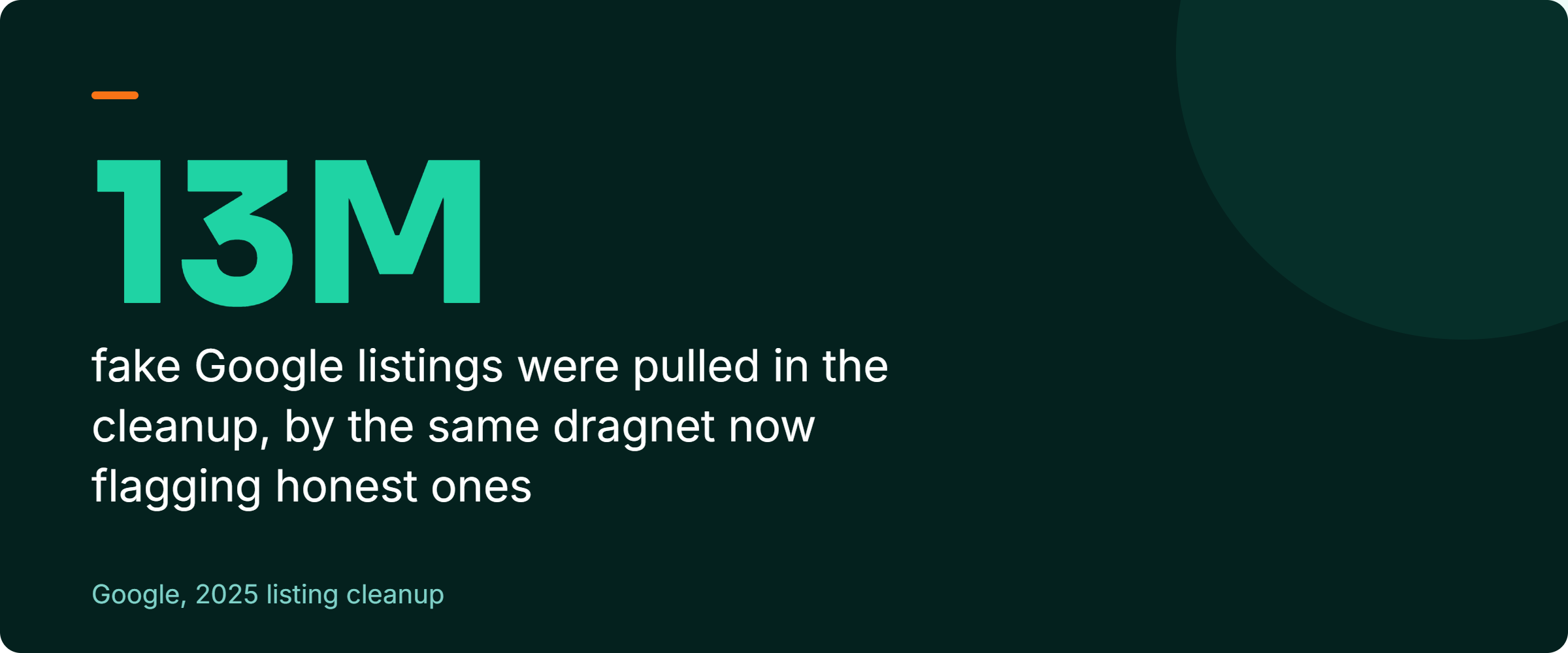
Google spent 2025 tearing down fake listings at a scale that would have sounded made up two years ago, and the businesses cleaning up after that are not all scammers. Some of them are the plumber down the street whose profile got auto-tagged with a service he never offered. Others are the dentist whose listing name still carries a keyword someone added in 2019, or the cafe whose hours got "corrected" by a competitor at 2 a.m. The cleanup is good for honest local businesses on the whole, because the noise around you is finally being removed. But the same automated system pulling down 13 million fakes does not stop to check whether the listing it just flagged belongs to a real business that broke no rule.
The position I want you to walk away with is simple. The era of treating your Google Business Profile as a thing you set up once and forget is over, and it is over specifically because the enforcement is automated. Your only real protection now is to be a verified, actively managed profile that catches problems before they go live. The alternative is an unmonitored one that finds out it was suspended when the phone stops ringing. That is not a vendor scare pitch. It is a direct response to how Google has changed the way it polices Maps.
The automated dragnet is the real problem, not the fakes
Look at what Google reported it did in a single year. In a first-party post on The Keyword (blog.google, April 16, 2026), the company said it blocked or removed over 292 million policy-violating reviews in 2025. It also removed over 13 million fake Business Profiles and blocked 79 million inaccurate or unverified edits to profiles. And it placed posting restrictions on more than 782,000 policy-violating accounts. Those are enforcement numbers, and the way to read them is not "Google is winning." Read them as a measure of how aggressive and automatic the filter has become, because no human team reviews 79 million edits by hand.
"We placed posting restrictions on more than 782,000 policy-violating accounts and removed over 13 million fake Business Profiles, further defending genuine businesses on Maps."
Google, blog.google, April 16, 2026
The phrase "defending genuine businesses" is the goal, and most of the time the system hits the target. The trouble is what happens at the edges. A system tuned to catch 13 million fakes is going to misread a certain number of real listings as suspicious, and when it does, the consequence is not a polite warning. It is a suspended profile. You vanish from Maps and from the local results that appear above the regular search listings. For a business that gets most of its calls from "plumber near me," disappearing from Maps for a week is not an inconvenience. It is a week of payroll you cover out of pocket while you file appeals.
The cost of ignoring this is asymmetric, and that is the part owners underestimate. Ignoring your profile feels free right up until the day it costs you everything at once. A profile that has been slowly accumulating problems, an odd service here, a stray keyword there, an edit you never noticed, is a profile carrying risk it never had to carry. The fix is cheap. The suspension is not.
Honest owners get caught because the profile changed while they weren't looking
Most suspensions of legitimate businesses do not come from something the owner did on purpose. They come from drift, the slow accumulation of small things that no longer match reality, and each one is a flag an automated reviewer can trip over.
Start with the business name, because it is the most common trap. Years ago, stuffing a keyword into your listing name was a cheap ranking trick. A roofer might have set the name to "Smith Roofing Best Roof Repair Phoenix" and watched it help. That name is still on the listing. Today it is a textbook policy violation, and the same automated enforcement clearing out fakes treats a keyword-stuffed name as a signal of a low-quality or spammy listing. You did not change anything. The rules changed underneath you, and the name that helped you in 2019 is now a liability with your signage and your business license telling a different story.
Then there is the Services section. This is where practitioners are seeing a newer problem, and I want to be precise about it because Google has not documented it. It has been reported by people who manage these profiles for a living that Google sometimes auto-populates the Services list with categories it infers you offer, and those inferred services are not always accurate. Picture an electrician whose profile suddenly lists "generator installation" because the category seemed related. If he does not install generators, that is now a mismatch between what the profile claims and what the business actually does, and mismatches are exactly what the filter is built to notice. He never typed it. He just never looked.
The third source is other people. Google Maps lets the public suggest edits to your hours, your address, your category. Most are harmless. Some are not. A competitor can suggest your hours are wrong, or that you are permanently closed, and if no one is watching the profile, that edit can go live before you ever see it. This is the scenario that turns a healthy listing toxic overnight, and the owner usually finds out the way everyone finds out, when the calls stop. If your rankings look fine but the phone went quiet, a malicious or mistaken edit is one of the first things to rule out.
None of these require bad intent on your part. That is the point. The "set it and forget it" profile is dangerous now even if you did everything right. The profile is a living document that other forces, Google's automation and the general public, can edit while you are busy running the business.
The data says reviews still decide, and they decide faster than before
Cleaning up your profile keeps you visible. What you do with that visibility is where the customer actually chooses you, and the 2026 numbers on how people pick a local business are blunt. The BrightLocal Local Consumer Review Survey 2026, which polled 1,002 US adults, found that 97% of consumers read reviews for local businesses. If your reviews are thin or stale, you are losing people before they ever call.
"Even in a world where people are more aware and more frustrated by the scourge of fake reviews, 97% of consumers still lean on reviews to guide their purchase decisions."
Myles Anderson, CEO, BrightLocal
The bar that those reviews have to clear is rising fast. In the same survey, 31% of consumers said they will only use a business rated 4.5 stars or higher, up from 17% the year before. Fully 68% require at least 4 stars. A 3.8 average disqualifies you with that 68% of the market. Recency matters even more than the average now. 74% of consumers said they only care about reviews from the last 3 months. A wall of glowing five-star reviews from 2023 reads as a business that may not be busy anymore. Volume is its own gate too, with 47% saying they will not use a business that has fewer than 20 reviews. For a new local business, the first twenty reviews are the most important marketing asset it can build. If you want the full argument on why a steady drip beats a high lifetime average, I made the case for why recent reviews now beat your average star rating.
Where people look for those reviews is shifting at the same time, and this is the development most owners have not absorbed. Google as a review source dropped from 83% in 2025 to 71% in 2026. Leaning on Google alone is a thinner strategy than it was a year ago. The reason is the new arrival at the top of the list. 45% of consumers used AI tools for local recommendations in 2026, up from just 6% in 2025, making AI the third most popular recommendation source in a single year. That is not a trend creeping in. That is a tenfold jump. The chatbots are now reading your profile and your reviews and summarizing them for someone who will never click through to verify. A clean, accurate, well-reviewed profile is what those tools repeat back. A messy one is what they get wrong.
Spend thirty minutes Monday and close the gaps
You do not need an agency for this. You need half an hour and the willingness to actually look. The audit runs in the order I would do it.
Confirm your name matches your signage and license, with no extra keywords. Open your profile and read the business name as a stranger would. It should be the name on your door and your license, and only that. If it says "Best" or "Affordable" or a city name tacked on, remove the extras. That stuffed name is the single most common reason a legitimate listing gets treated as low quality.
Open the Services section and delete anything you do not actually do. Read every service listed. If something is there that you do not offer, whether you added it years ago or Google inferred it, take it off. The profile should describe the business that exists, because every claim that does not match reality is a flag waiting to be tripped.
Confirm your address is one you can receive mail at, or hide it. Google may re-verify by mailing a postcard to the listed address. It has to be real and reachable. If you are a service-area business that works at customers' locations and does not see clients at your own, hide the address and set your service area instead. A storefront address on a business that has no storefront is a contradiction the system can catch.
Find your duplicate listings and merge them. Search your business name and phone number on Maps and look for second or third versions of yourself, often left over from an old location, a franchise import, or an auto-generated entry. Duplicates split your reviews and confuse both customers and Google. Merge them down to one profile and keep all your history and reviews in a single place.
Confirm the profile is verified and turn on email notifications. Verification is what separates an owner who gets a heads-up from one who gets a surprise. Google announced a change in 2026 that makes this matter more than it used to.
"Starting this month, we're rolling out proactive email alerts so verified and active owners have a way to easily review important edits to their Business Profiles before they go live."
Google, blog.google, April 16, 2026
Read that carefully, because the benefit is gated on two words, "verified and active." If you are verified and your notification email is on, you get to review an important edit before it goes public, which is your defense against the competitor's 2 a.m. change. If you are not, the edit can take effect and you find out later. Google also said its AI system, Gemini, now helps catch fake edits, which works in your favor, but you still want to be the human in the loop who sees the alert.
Watch the right numbers, and ignore the ones that flatter you
After the audit, the job is monitoring, and monitoring is mostly about looking at the things that predict a problem instead of the things that feel good. Check your email for Google's edit alerts, because that is now your early warning system, and a single ignored alert is how a bad edit slips through. Once a week, glance at your profile the way a customer would and confirm the hours, the address, the phone number, and the services still read correctly. Once a month, search your name and number on Maps again to catch any new duplicate before it puts down roots.
Watch your review pace, not just your review total. Since 74% of people only care about reviews from the last three months, the question that matters is whether you have new reviews this month. A hundred from over the years is not the test. A steady trickle of recent reviews is worth more than a big pile of old ones, and the pile will not save you if it is all dated.
The most seductive vanity metric in local search is your total review count and your all-time average star rating, because both only ever go up and both make you feel finished. A 4.7 average built over five years can hide the fact that you have not earned a review since spring, and to a customer reading only the last three months, you look quiet. Profile views and "discovery" impressions are the same kind of comfort. A high view count that produces no calls and no direction requests is a number that looks like traffic. The gap between being seen and being chosen is its own conversation. The metrics that actually predict revenue are calls, direction requests, and recent reviews. The cumulative totals that can only climb predict very little. Google now offers AI help for replying to reviews through Gemini. Whether you let it speak for you is a real choice with tradeoffs. I worked through it in detail in my piece on whether to let Google's AI write your review replies.
Frequently Asked Questions
Will Google really suspend my profile for a keyword in my business name I added years ago?
It can, because the enforcement is automated and it does not know or care when the keyword was added. A name like "Smith Roofing Best Roof Repair Phoenix" violates Google's naming policy today regardless of whether it helped you in the past. The automated system that removed over 13 million fake profiles in 2025 treats a stuffed name as a low-quality signal. Fix it now by editing the name to match your signage and license exactly, with no extra words, before it gets flagged.
What does it actually mean to be a "verified and active" owner, and why does it matter in 2026?
Verified means you have proven to Google that you own the business, usually through a code sent by mail, phone, or video. Active means you log in, you manage the profile, and you have notifications turned on. Google said in its April 16, 2026 post that it is rolling out proactive email alerts so verified and active owners can review important edits before they go live. If you are not both, you lose that early warning and an edit can take effect before you ever see it.
Should I worry more about my star rating or my recent reviews?
Recent reviews, in most cases. The BrightLocal 2026 survey found that 74% of consumers only care about reviews from the last three months. A high lifetime average built on old reviews does less for you than it used to. The same survey found 31% will only use a business rated 4.5 or higher, and your average still has to clear that rising bar. The practical move is to keep a steady stream of new reviews coming in. Do not rest on a number that stopped growing.
The cleanup is genuinely good for you, and I would not want to talk you out of being glad the fakes are going. But the lesson owners are taking from it is backwards. They hear "Google is removing bad listings" and relax. The right response is to assume the dragnet will eventually swing past your door and make sure that when it does, your profile is clean, verified, and watched. The businesses that get hurt in 2026 will not be the ones that did something wrong. They will be the ones that never looked.