Your 4.9 Is Losing to a 4.6 That Keeps Moving

You have a 4.9 and you earned it. It shows at the top of your profile like a trophy. Every time a competitor with a 4.6 outranks you in the map pack, you stare at it and think it makes no sense. My rating is higher, my customers are happier, why is Google sending the calls to them? The mistake buried in that thought is treating the lifetime average as the review signal that wins rankings. It is not. The day you decided 4.9 was good enough to stop asking is the day your real review signal started decaying, while the trophy stayed unchanged and lulled you.
Your lifetime average star rating no longer moves local rankings the way you believe it does, because what Google rewards now is recency and the cluster of signals proving you are open and active. A 4.9 built three years ago and left to coast loses to a 4.6 that keeps gathering fresh, steady reviews. The average is a vanity number. The pulse is the ranking number. This piece shows why the present beats the past in Google's math and what the people who measure this for a living have found. It also covers exactly what to keep breathing so that the trophy stops costing you calls.
An average is a memorial, and Google is staffing today's appointment
An average tells a search engine how people felt about you on balance across all of time. It cannot tell whether you are any good right now. A restaurant can hold a 4.9 from its glory years while it declined, changed owners, lost its chef, and let the room go tired, and the average will not know a thing. The average is a memorial. Google's whole job in local search is to send a person to a business that will serve them well today, not in 2022. A signal that captures the present, whether you are still active, still gathering reviews, still being tended, is simply more useful to the system than one that captures the distant past.
That is the logic, and the cost of missing it is concrete. Picture two businesses. Business A has a 4.9 across 180 reviews, the most recent from sixteen months ago, hours untouched in over a year, no reply posted since 2024. On paper a beautiful profile. In practice a frozen one. Business B has a 4.6 across 95 reviews, six of them from the last month. Every review is answered within a day or two, the hours are correct down to the holiday hours, and a fresh review from yesterday shows at the top. To the owner of Business A, A looks better. To Google, B looks better, because B is demonstrably operating, attended, and current, and A is a museum exhibit. When a searcher needs someone this week, Google sends them to the business it can prove is alive, and the 0.3 difference in average does not come close to overriding that. The 4.9 did not lose because it was fake or bad. It lost because it stopped, and stillness is the penalty. The same quiet-phone gap I described in a separate piece on a ranking that looks fine while the calls disappear often traces back to exactly this kind of frozen profile.
Owners chase the decimal because it looks like a grade
The average is seductive for an honest reason. It is the one review number that is large, visible, and feels like a report card, and we are wired to chase the grade. Owners pour energy into protecting the decimal, sometimes by gating out unhappy customers. That is against Google's rules. As I have argued in a related piece on why buyers decide before they ever reach your site, it is also a fast way to get your reviews frozen entirely. Meanwhile the signal that actually moves rankings, the steady drip of recent reviews, gets neglected the moment the average looks good enough.
The owner thinks we are at 4.9, we can ease off. That easing off is the whole mistake. The tap was never optional. The day you stop gathering reviews is the day your most important review signal begins to decay, even though the average stays unchanged, telling you everything is fine. The good news hiding inside this is that it is one of the most fixable problems in local SEO. You do not need a higher average. You do not need to win anyone back. You need to turn the tap on and keep it running, which is cheaper and faster than almost anything else you could do to a listing.
The people who measure local ranking say recency, not the average, is doing the work
The most respected recurring study in this corner of the industry is Whitespark's Local Search Ranking Factors, and the 2026 edition continues a trend the survey has shown for several cycles. Review signals as a category keep climbing in importance, and within that category the emphasis has shifted away from the raw star average toward signals of activity and freshness.
Darren Shaw, who runs Whitespark and has spent years inside this data, keeps arriving at the same conclusion.
Active reputation management, not the star average on its own, is what predicts performance.
Whitespark's review research keeps confirming that line. Not the rating. The management of the reputation, the ongoing work of gathering and responding and staying current. A high average you stopped tending is a static asset. An active review program is a living signal, and the living signal is the one that correlates with results.
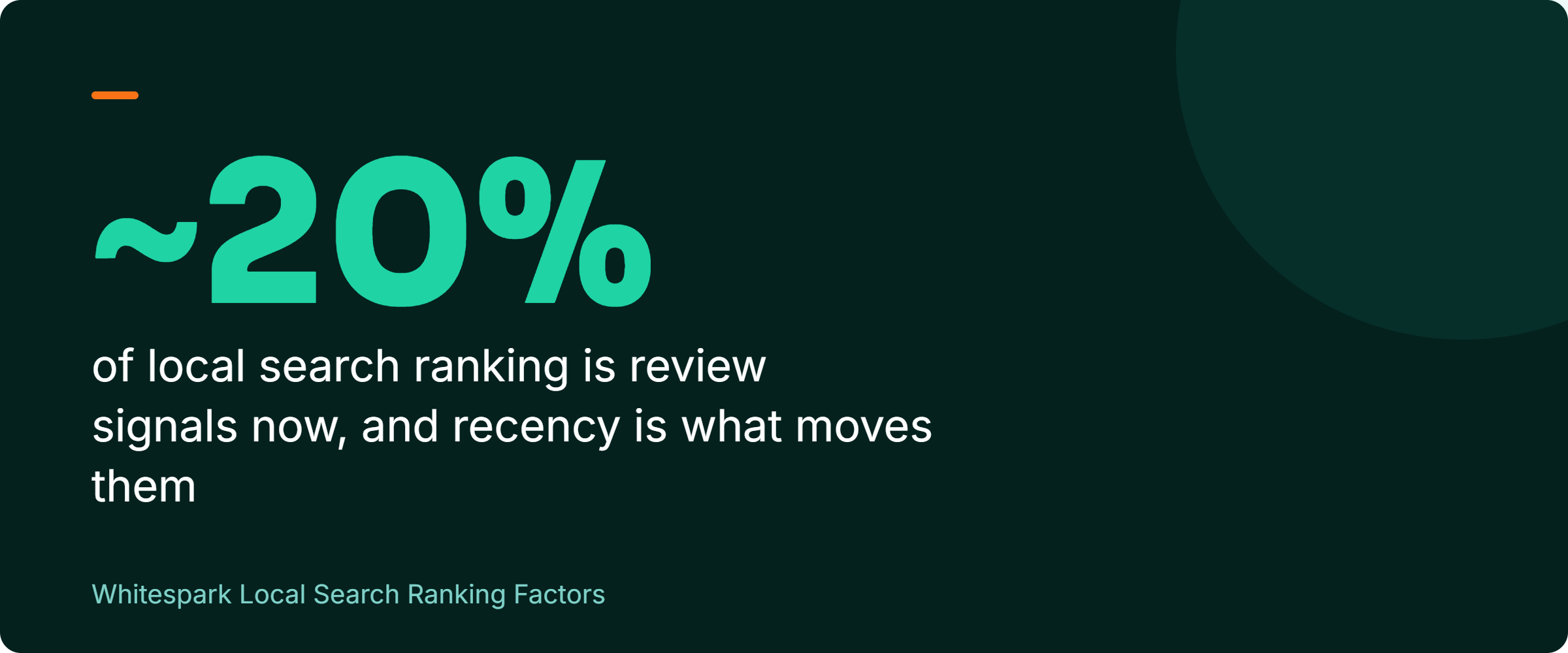
On the weight of reviews overall, the local-search factor research has moved review importance from somewhere around 16 percent in 2023 toward roughly 20 percent more recently. Those figures are approximate, drawn from local-search ranking factor studies, and they move from edition to edition. Trust the direction more than the decimal. The direction is up, and within that rising weight, recency and activity are doing more of the lifting than the average ever did. Recency itself is a small cluster of signals. How fresh is your most recent review? Do new ones arrive in a steady rhythm, or in a single spike? Do your hours, open status and attributes stay accurate and maintained? Does the owner reply promptly and like a human? Put those together and you get the open-and-active picture Google now rewards. None of it is your average. All of it is your pulse.
Turn the tap back on and keep four habits running
The mental switch is this. Stop treating reviews as a score you protect and start treating them as a heartbeat you maintain. A heartbeat needs to keep going. It does not need to be perfect. The work, in the order an owner can do it, hand to a staffer, or assign to an agency.
First, build a monthly drip. Decide on a small, sustainable number of new reviews you will gather every month. Build one simple habit to hit it: a follow-up text the day after service, a line in your email, a take-home card. The number does not need to be big. It needs to be steady, every month, without fail, because steady beats spiky and steady beats a one-time blitz that fades. A sudden burst followed by silence is also the exact shape the spam filters watch for. The steady drip protects you twice.
Second, keep your operating signals current. Set a recurring reminder to check your hours, including special and holiday hours, and your attributes. Fifteen minutes a month that feeds the open-and-active signal directly. Wrong hours do not just send a customer to a locked door. They tell Google your profile is unattended, and unattended profiles get pushed down.
Third, respond to reviews within a day or two, the good and the bad, with a short, warm, specific reply. This is activity Google can see and the next customer can read, and it is the cheapest reputation insurance there is. The owner who replies looks present. The owner who never replies looks gone.
Fourth, let the average breathe. Stop guarding the decimal, ask everyone, take the threes and fours as part of an honest, textured profile, and reply to the critical ones well. A review base with realistic spread looks more trustworthy to both the algorithm and the human than a wall of suspiciously perfect fives. Those threes and fours keep you clear of the manipulation filters that punish unnaturally clean ratings. If you have unanswered reviews from the last ninety days, clear them this week, then commit to the day-or-two cadence going forward.
Watch the date of your last review, not the size of your average
The metric to put on your wall is the date of your most recent review. If it is more than a month or two old, your most important review signal is decaying right now, regardless of how proud the average makes you. Track the rhythm too, a few new reviews arriving every week or month, because a steady cadence is the thing that reads as a living business. Track your reply rate and reply speed, since those are activity signals both Google and the next reader can see. And track whether your hours and special hours are actually current, because that quietly feeds the same open-and-active picture.
The vanity traps are obvious once you name them. The lifetime average is the loudest, a number that can stay at 4.9 while every signal underneath it goes flat. Total review count is the second, because a large count earned years ago and left to coast is a frozen asset, not a live one. Even a recent spike is a trap if it is a one-time campaign, because it inflates your count for a moment and then leaves a flat line that looks worse than steady growth. None of this means ratings are meaningless. A real customer still reads your stars before they call. A 3.1 average will lose you business no amount of recency can save. Quality of service still has to be there. Take two businesses that are both genuinely good. The one with the live, recent, well-tended profile wins the ranking even if its average runs a few tenths lower.
Frequently Asked Questions
Does a lower star average actually rank better than a higher one?
Not on its own, and that is the wrong way to frame it. A 4.6 does not beat a 4.9 because it is lower. It beats it when it is paired with recent reviews, a steady arrival rhythm, current hours, and active owner responses, while the 4.9 has gone quiet. Whitespark's Local Search Ranking Factors and Darren Shaw's November 6, 2025 commentary point to active reputation management as the predictor of performance, not the raw average. Earn a solid honest average through good work, then keep it breathing, and you get the best of both.
How many reviews per month do I actually need?
There is no universal number, and chasing a big one is the wrong instinct. What matters is that the figure is steady and sustainable for your business, because a reliable few every month beats a giant batch followed by silence. A spike followed by a flat line reads as a campaign to the spam filters and leaves your profile looking stalled afterward. Pick a number you can hit every month without fail, attach it to one simple habit like a follow-up text, and protect the consistency over the size.
If recency matters most, should I stop worrying about my rating?
No. Ratings still do real work with human readers, who scan your stars before they call, and a genuinely low average like a 3.1 will cost you business that recency cannot offset. The point is narrower. Stop chasing the decimal at the expense of the pulse, especially by gating out unhappy customers, which is against the rules and risks freezing your reviews. Earn an honest, textured average through good service, let the threes and fours come in, and keep the steady, recent activity running underneath it.
The trophy on your profile was never the thing winning you rankings. The steady, recent, well-tended activity underneath it was, and the moment you mistook the number for the work, the number started lying to you. Keep the heartbeat going and the 4.6 that keeps moving will quietly outrun the 4.9 that stopped. The unsettling part is that the prouder you are of that average, the more likely you are to stop doing the only thing that was ever winning you the calls.