Why a Big Google Ads Launch Usually Burns Your Cash

Some owners tell me they want to "go big" on Google Ads out of the gate, drop five figures in month one and grab the market before a competitor does. I already know how that story ends. The instinct feels like ambition. It is actually the most expensive way to buy information you could have bought cheap.
On launch day your Google Ads account is at the worst return on investment it will ever have, and it will never be this bad again. No Quality Score. No conversion history. No learning. Pour your biggest affordable budget into that exact window and you pay full retail price to teach Google what works. A small careful pilot would have taught you the same thing for a fraction of the money. The move is not to spend big first. It is to earn the right to scale.
Your account is at its weakest the day you turn it on
Google decides what you pay per click partly on Quality Score, its internal rating of how relevant your ad and landing page are to a search. New account, no history, no proven relevance. Google charges you the tourist rate. Your cost per click starts high and your conversion rate starts low. The system has not yet figured out which searches, which times of day, and which audiences actually turn into a booked call or a sale for your specific business.
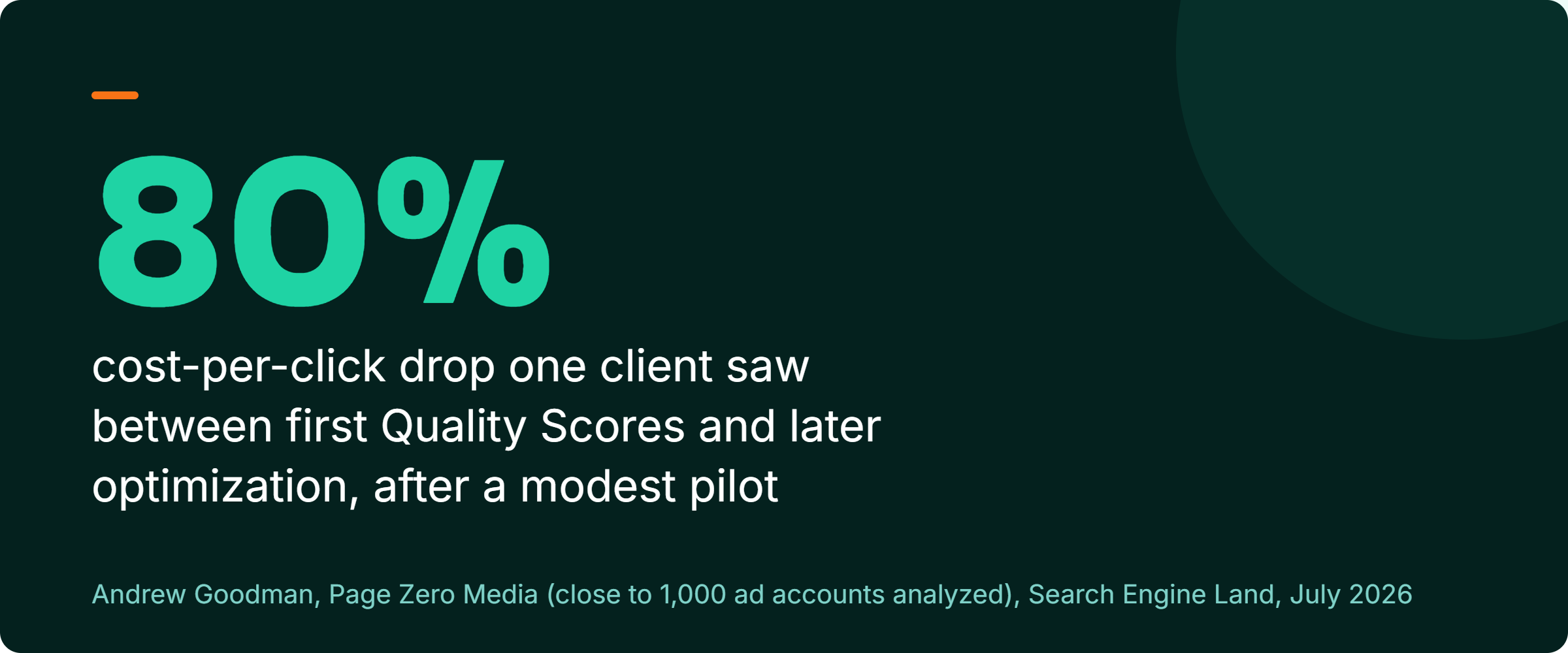
I have watched this play out across ten years of managing Google Ads for clients, and the pattern is consistent. Andrew Goodman of Page Zero Media wrote the book "Winning Results With Google AdWords," and has analyzed close to 1,000 ad accounts. He put a number on it in his July 10, 2026 piece in Search Engine Land. One of his clients saw cost per click drop roughly 80 percent between the point where Quality Scores were first established and later optimization. And that came after a modest pilot, with no splashy launch. Read that again. The same traffic eventually cost him about a fifth of what it did at the start.
Now do the arithmetic on a big launch. Say you dump $15,000 into month one. Most of that money is spent inside the worst-priced, least-informed window your account will ever see. You are not buying customers at that stage. You are buying data, and you are buying it at the highest markup Google will ever charge you. Goodman says it cleaner than I can: "Investing a deluge of funds into the worst ROI environment your budget is ever likely to see defies logic."
Why "spend more to grow faster" feels right and pays wrong
The reason smart owners fall for this is that spending looks like doing. A big budget feels decisive. It scratches the itch to move fast. And Google's own interface quietly encourages it, nudging you toward higher budgets and treating spend as if it were a performance metric. Goodman flags exactly that trap: "As a marketing principle, it's safe to assume that the amount you spend on ads shouldn't be confused with 'performance' (despite Google's opinion)."
Goodman lays out four stories people tell themselves to justify frontloading, and I hear every one of them from owners. The land grab: get in first before rivals bid the auction up. The learning excuse: we will gather data faster if we spend faster. The pre-revenue data-buy: with no sales yet, we will just buy our way to signal. And the vendor minimum: the agency or platform says you need a big floor to "give it a chance." Each one sounds reasonable at the table. Each one ends with your cash gone before anyone knows which searches actually book work.
There is a personality tell here too, and Goodman names it. "Street-smart, owner-operated companies typically start with careful ad budgets. It's deep-pocketed intellectuals who are more likely to talk about how much they're capable of spending." Goodman cites the extreme version: a funded startup that burned through most of $250 million, much of it on ads, while for three years nobody tracked new accounts that led to revenue. I have watched milder cases of the same type up close. Three years. That is not a marketing plan. That is setting money on fire and calling it a strategy.
Contrast that with how the disciplined operators start. Uber's seed round was $1.25 million at a $4 million valuation. Start small, prove it, then raise and scale into what is already working. The companies you admire did not begin by spending the most. They began by proving the thing worked at a size where a wrong guess did not sink them.
What the benchmark data actually says about your first dollar
Look at the current numbers and you can see where a launch budget really goes. The 10th edition WordStream study covers a data window of April 2025 through March 2026, and Brooke Osmundson reported it in Search Engine Journal on June 16, 2026. It puts the all-industry average cost per click at $5.42 and average click-through rate at 6.64 percent. Average conversion rate is 8.18 percent, and average cost per lead is $66.69. Translate that into a decision. At those averages, a lead costs you roughly sixty-seven dollars once the account is running normally. In your untuned launch window, with a fresh Quality Score and no conversion learning, you are paying well above that for the same lead, and often getting no lead at all.
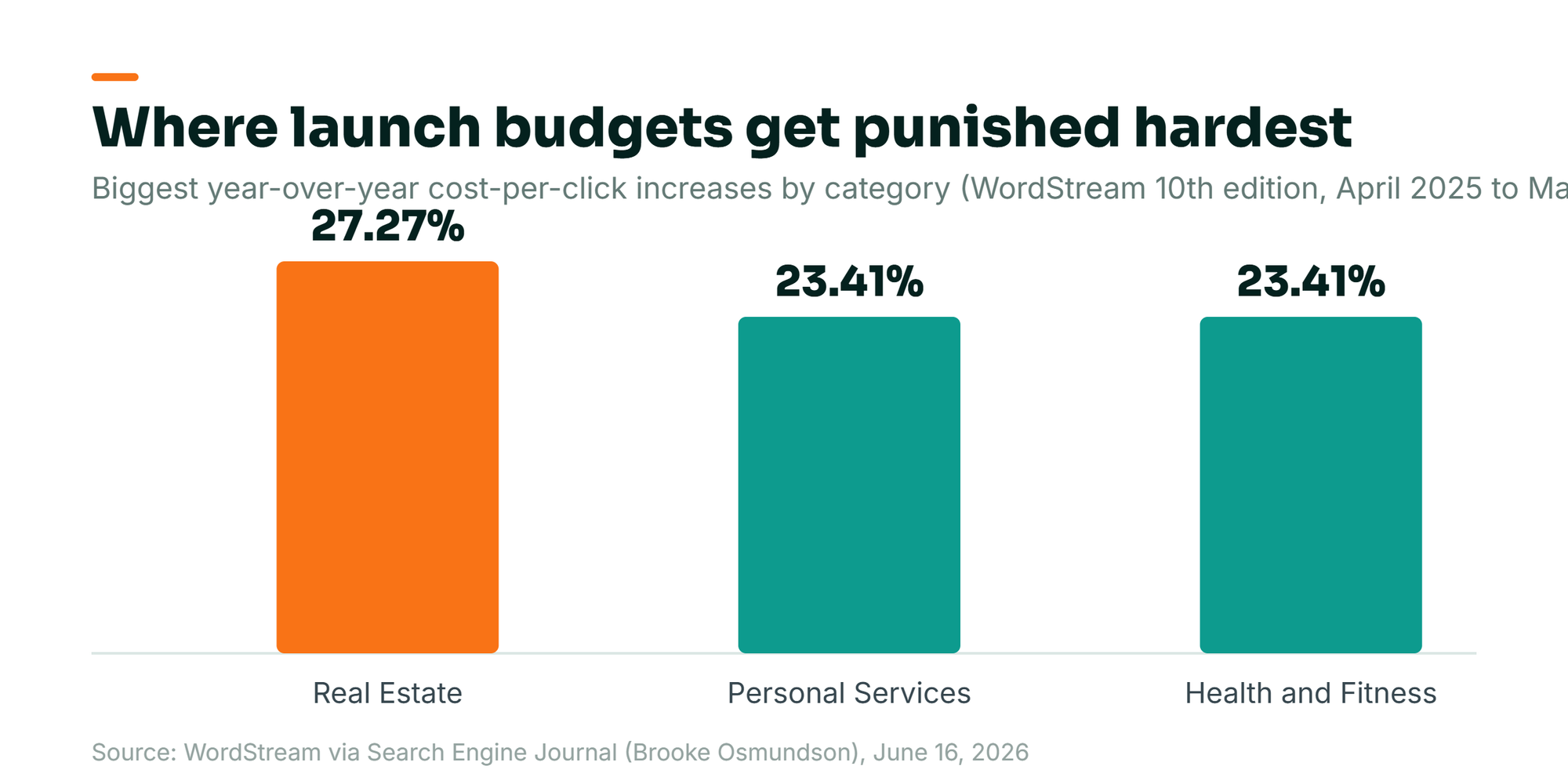
Costs are climbing, too, which makes the launch window even more punishing in certain categories. The same study shows the biggest year-over-year cost-per-click jumps in Real Estate at 27.27 percent, Personal Services at 23.41 percent, and Health and Fitness at 23.41 percent. If you run a clinic, a home-services shop, or a real estate business, your clicks got a quarter more expensive in a year. Starting big in a rising-cost auction while your account is at its least efficient is the worst of both problems stacked on top of each other.
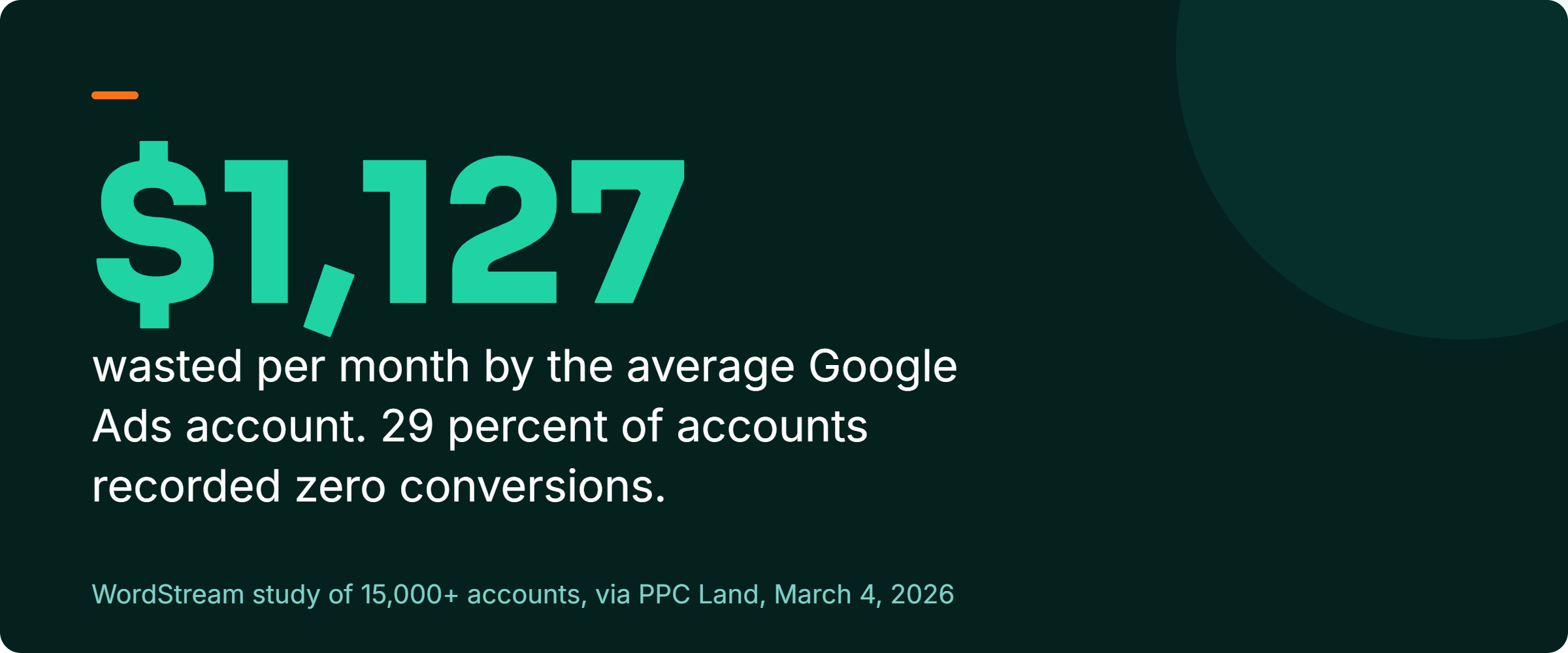
Then there is the waste number, and this is the one I want you to remember. The WordStream study of more than 15,000 accounts, reported by PPC Land on March 4, 2026, found the average account wastes $1,127 a month, and 29 percent of accounts recorded zero conversions. Nearly one in three advertisers paid Google every month and got not a single lead or sale back. Most of that waste hides in exactly the untuned conditions a big launch creates: broad targeting, unproven keywords, no negative keyword list, no conversion signal to optimize against. If you want to see how that leak looks inside a live account, I broke down the mechanics in a walkthrough of how to find and cut wasted spend in a Google Ads account. Bigger launch budgets do not shrink that leak. They widen it.
Osmundson adds a warning I would insist on myself: "Benchmark reports are exactly that: benchmarks. They're not scorecards, and they don't account for your specific brand, audience, goals, or tech stack." Use those averages to sanity-check a launch budget, not to justify one. The point of the numbers is not a target to hit. It is a reminder that your first dollar buys less than your fiftieth.
A phased launch protects your cash while the account learns
What I do instead is smaller and slower, and you can either run it yourself or hand to whoever manages your account. Goodman borrows two frames worth keeping in your head while you read this: Jim Collins' "fire bullets, then cannonballs," and Nassim Taleb's "skin in the game." Small cheap shots first to find the range, then commit real weight only where you have already hit.
First, set a pilot budget you would not miss. For most local and service businesses I work with, that is a few hundred to a low four figures a month. It is enough to gather signal, and small enough that a wrong guess costs you a dinner out and not a payroll cycle. The goal of the pilot is not sales. It is to find which searches actually book calls.
Second, before you spend a dollar, make sure conversion tracking is real and correct. This is the step almost everyone skips, and it is the one that decides whether the whole exercise means anything. If a booked call or a submitted form does not fire a conversion Google can see, the system cannot learn and you are flying blind at full price. When I audit a stalled account, broken or missing tracking is the first thing I check. I walk through the common failure points in this guide to fixing conversion tracking that is quietly lying to you. Fix this first or every number downstream is suspect.
Third, start on tight, high-intent keywords and a real negative keyword list. Bid on the searches where someone is clearly ready to buy or book, not the vague top-of-funnel terms that eat budget and convert at close to zero. Add negatives so you stop paying for the searches that will never turn into work. This is where a small budget stretches. You are funding a test of the searches that make you money, not Google's exploration of everything.
Fourth, let it run long enough to earn a Quality Score and a conversion history, then read the account, not your gut. Give it a few weeks. Watch which keywords produced actual booked calls, which ad copy pulled clicks that converted, and where the cost per lead settled against that $66.69 benchmark. This is the window where Goodman's 80 percent cost-per-click drop starts to show up, because Google finally has the relevance signal it charges you extra to gather.
Fifth, scale into what is already working, not into hope. Now you pour the cannonball, and only into the specific keywords, ads, and audiences that proved themselves in the pilot. If you delegate this to an agency, the exact question to ask is: "Show me the keywords and campaigns that produced booked revenue in the pilot before we increase the budget." If they cannot answer that, do not let them scale. One more caution as you turn up spend: raising budget often hands more control to Google's automated bidding. That has its own failure modes, which I laid out in a piece on the risk of letting smart bidding run your budget. Scale deliberately, with a hand on the wheel.
There is one exception. Some categories genuinely need more runway to gather enough data to be meaningful, low-volume niches, long sales cycles, expensive-click industries where a tiny budget never accumulates a readable sample. If that is you, the answer is a larger pilot, not a blind blowout. Bigger sample, same discipline. You still earn the right to scale. You just need a slightly heavier bullet before the cannonball.
Measure booked revenue, not the vanity numbers Google shows you first
The trap in the first ninety days is measuring the wrong thing and feeling good about it. Impressions, clicks, and click-through rate are the numbers Google surfaces most eagerly, and they are the ones that look healthiest during a big launch, precisely because you paid to inflate them. None of them pay your rent. A high click-through rate on searches that never book a call is just an expensive way to feel busy.
Track cost per booked lead first, meaning an actual inquiry you could sell to, measured against that $66.69 benchmark as a rough sanity line. Next comes conversion rate on your money keywords. Watch for that 8.18 percent average to tell you whether a keyword is pulling its weight or bleeding you. Last, track the trend of your cost per click over the first several weeks. A falling cost per click is the visible proof that your Quality Score is maturing and your account is starting to earn the better pricing Goodman documented.
The remember-this line from Goodman is the whole discipline in three words: "Earn the right to scale." Spending is not a strategy and a big budget is not a plan. Prove the thing works small, then feed the winners. That order protects your cash during the exact window when your money is least efficient. It separates the owner who builds a machine that prints leads from the one who becomes another entry in that 29 percent who spent all year and got zero conversions back.
Frequently Asked Questions
How much should I start with on Google Ads?
Start with a pilot budget you would not miss if it produced zero leads. In my experience with local and service businesses, that means a few hundred to a low four figures a month. The pilot's job is to find which searches actually book calls before you spend real money. Once you know your winning keywords and your cost per booked lead against the roughly $66.69 all-industry average, you scale into what already works. Some low-volume or expensive-click categories need a larger pilot to gather enough data, but that is a bigger careful test, not a blind blowout.
Why are my clicks so expensive at the start?
On day one Google has no Quality Score, no conversion history, and no learning about your account. It charges you the highest rate you will ever pay. Quality Score is Google's internal rating of how relevant your ad and landing page are to a search, and a fresh account has not earned a good one yet. As the account matures, prices fall. Andrew Goodman documented one client's cost per click dropping roughly 80 percent between establishing Quality Scores and later optimization. Starting small lets that learning happen without paying full retail on a huge budget.
When is it safe to increase my budget?
When you can point to specific keywords, ads, and audiences that produced actual booked revenue in your pilot, not before. Let the account run a few weeks to earn a Quality Score and a conversion history. Then read the real numbers: cost per booked lead, conversion rate on your money keywords, and a falling cost per click. Scale only into the winners, and do it gradually, since raising budget often hands more control to Google's automated bidding. If your agency cannot show you which campaigns produced revenue in the pilot, do not let them turn the budget up.
The next time a launch feels underwhelming because the budget looks small, remember what the big budget actually buys on day one. It does not buy customers. It buys Google's learning curve at the highest price you will ever pay for it. Your boldest marketing month is Google's best month, not yours. If you want a second set of eyes on where your account is leaking before you scale anything, grab a call with me and we will look at it together.