Burying Bad Press Is Dead. AI Reads Sources, Not Rankings.

Ten years ago, one bad article about your business was a ranking problem. You pushed it down with fresher content, and in time customers stopped seeing it. That fix is finished. AI search cares what it can cite. Page one rankings do not decide that. A resolved complaint from a decade ago can quietly become the way ChatGPT and Google's AI Overviews describe your company today.
This piece defends one position. Suppression is dead as a standalone strategy, and the businesses that keep paying agencies to bury old stories are paying for a service that AI search routes straight around. The move that works now is monitoring what AI says about you and out-publishing the old story with better, more current sources, not hiding it. I will get to the limits of this and to how firmly I hold it, but the direction is not close.
A resolved complaint from a decade ago is now your AI bio
Anthony Will, the CEO of the reputation firm Reputation Resolutions, laid this out in Search Engine Land on July 14, 2026. His account comes from client work, not a lab. He describes a Midwest grocery chain that had run well for more than twenty years. Back in the mid-2010s, one location had a customer service incident that drew negative press. The business fixed it fast. The article faded from search, the story went quiet, and everyone moved on.
Then, in Will's words, the story got new visibility "seemingly overnight." AI Overviews began pulling that old article back into answers about the company. A single resolved incident from roughly a decade earlier started shaping how AI systems described a business whose reputation had long since recovered. Nobody re-published the story. No new complaint appeared. The AI simply found a source it trusted and repeated it.
Weigh what kind of evidence this is. Will's grocery chain is one practitioner's documented case, not a peer-reviewed study, and his article carries no percentages at all. Take it as a field report from someone who cleans up reputations for a living. In my own work across 300-plus businesses since 2008, the mechanism he describes matches what I keep seeing. AI answer engines do not rank sources the way a results page does. They select and quote them.
Picture your own business. Say you run a physiotherapy clinic that had one rough news cycle in 2017, maybe a billing dispute or a former employee who went to a local reporter. You settled it, changed your process, and the piece slipped off the second page of Google years ago. A prospective patient now opens ChatGPT and types, "Is [your clinic] any good?" The AI answers with a tidy summary that mentions the old dispute as fact and never once notes that it was resolved. The patient never scrolls a results page. They never see your five years of clean reviews. They just read the AI's verdict and book somewhere else.
Why the old suppression playbook stopped protecting you
The traditional reputation fix was built entirely around rankings. You flooded the first page with fresh positive content, optimized your profiles and social accounts, and sometimes built small microsites to push the negative story to page three, where almost nobody looks. It worked because human searchers rarely go past the first page. Demoting a story was nearly as good as deleting it.
AI search breaks that logic at the root. As Will puts it, media coverage carries strong authority signals, and an AI answer engine will treat a news article as a reliable source even when that article no longer ranks prominently. His line is the one to remember: the old story "doesn't need to dominate search rankings anymore. It only needs to remain a trusted source." Push it to page five and you have changed its rank. You have not changed whether the model considers it citable.
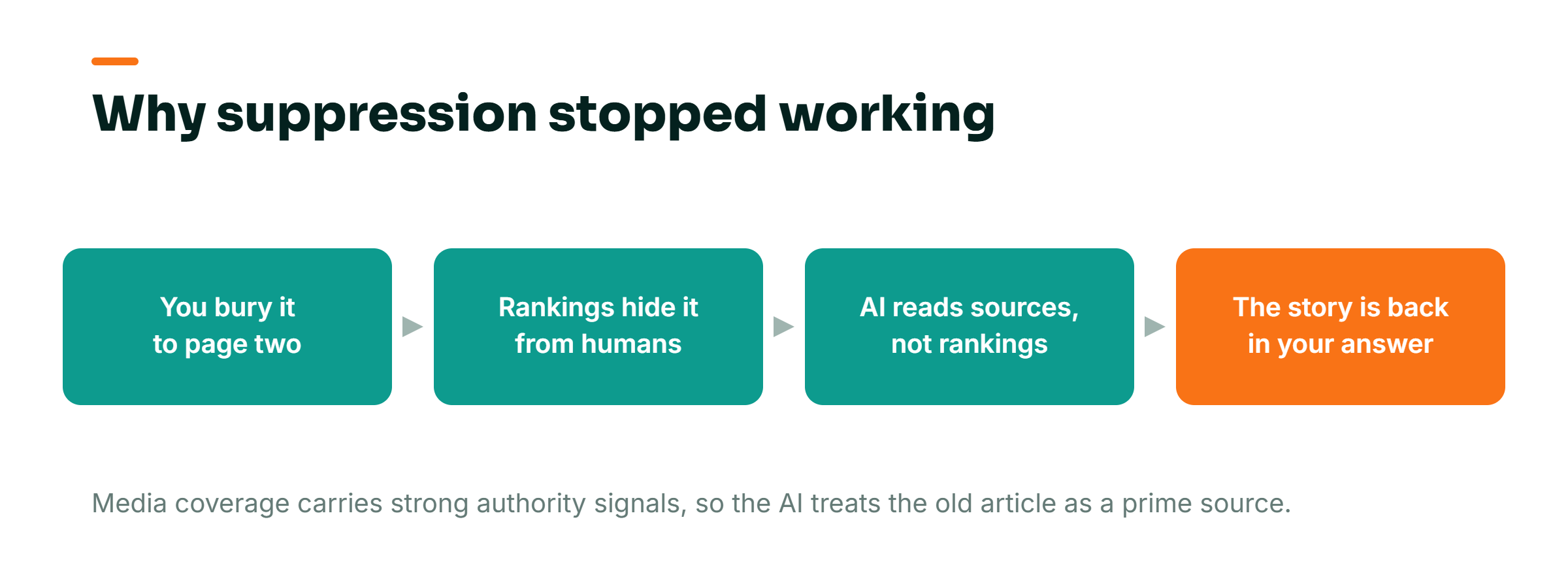
This is why owners get it wrong. They are still buying a rankings solution for a sourcing problem. An agency shows them a nice screenshot of page one full of positive links and calls the job done. Meanwhile the model is three layers down, reading the one article that agency was hired to bury. The report looks like a win. The AI answer is unchanged.
Low trust in AI does not protect you, it sends buyers to the source
This is the point where people tell me the AI story does not matter because customers do not trust AI anyway. The data says the opposite of what they think it means. A YouGov survey across 19 markets, reported by Search Engine Journal in July 2026, found that only 28 percent of U.S. searchers trust information from an AI assistant, against 70 percent who trust a search engine. Low trust in the AI feels reassuring until you ask what a distrustful person does next.
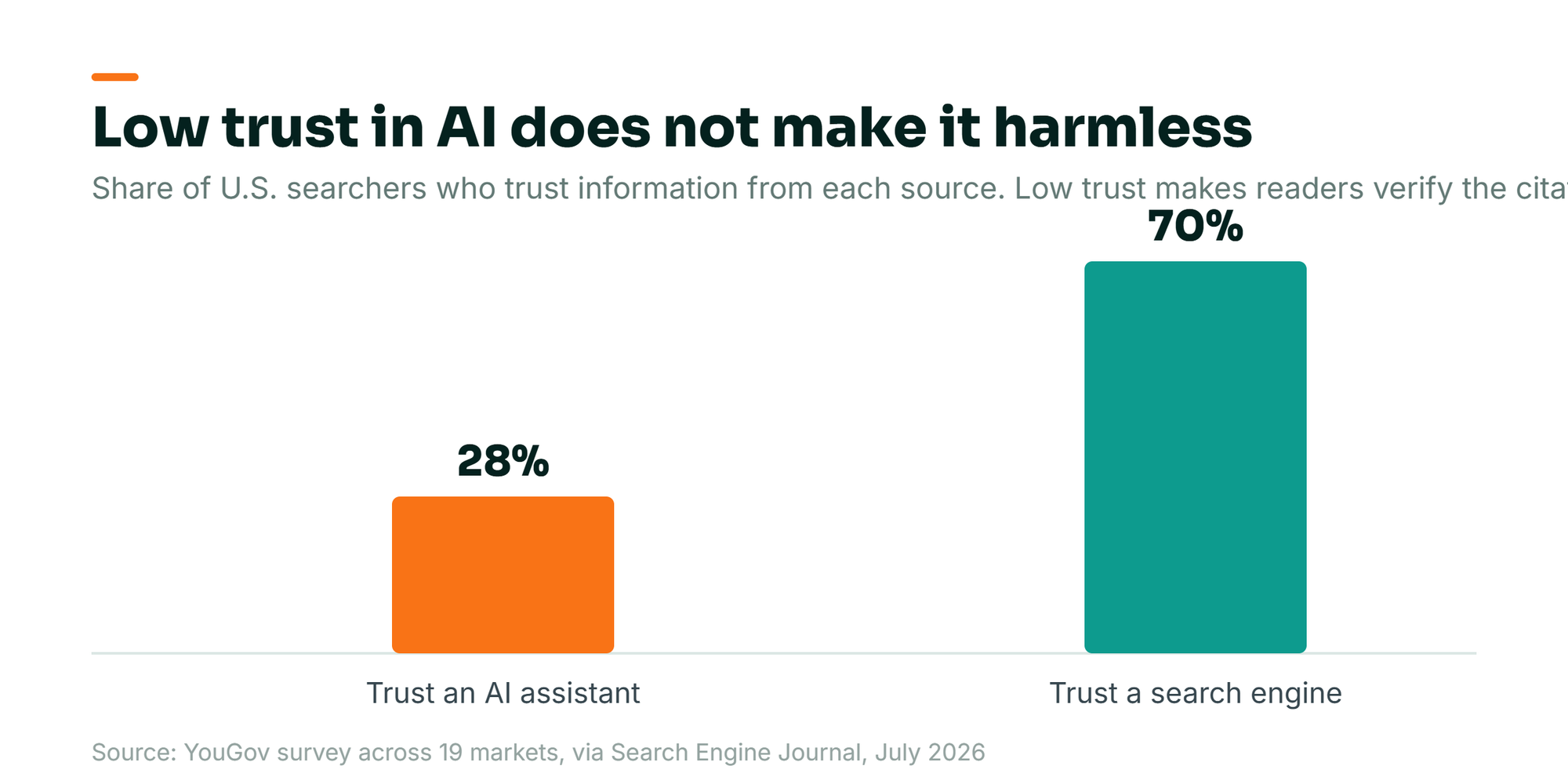
They verify. In the same YouGov survey, 22 percent of people who use AI search click through to the links the AI supplies. Only 17 percent stop at the AI answer itself. The click-through rate rises to 33 percent among daily AI users. Read that against the reputation problem. When the AI repeats your old negative story, a large share of readers do not take it on faith. They click the citation and open the original 2017 article. Low trust in AI does not protect you. It sends buyers straight to the source you thought was buried.
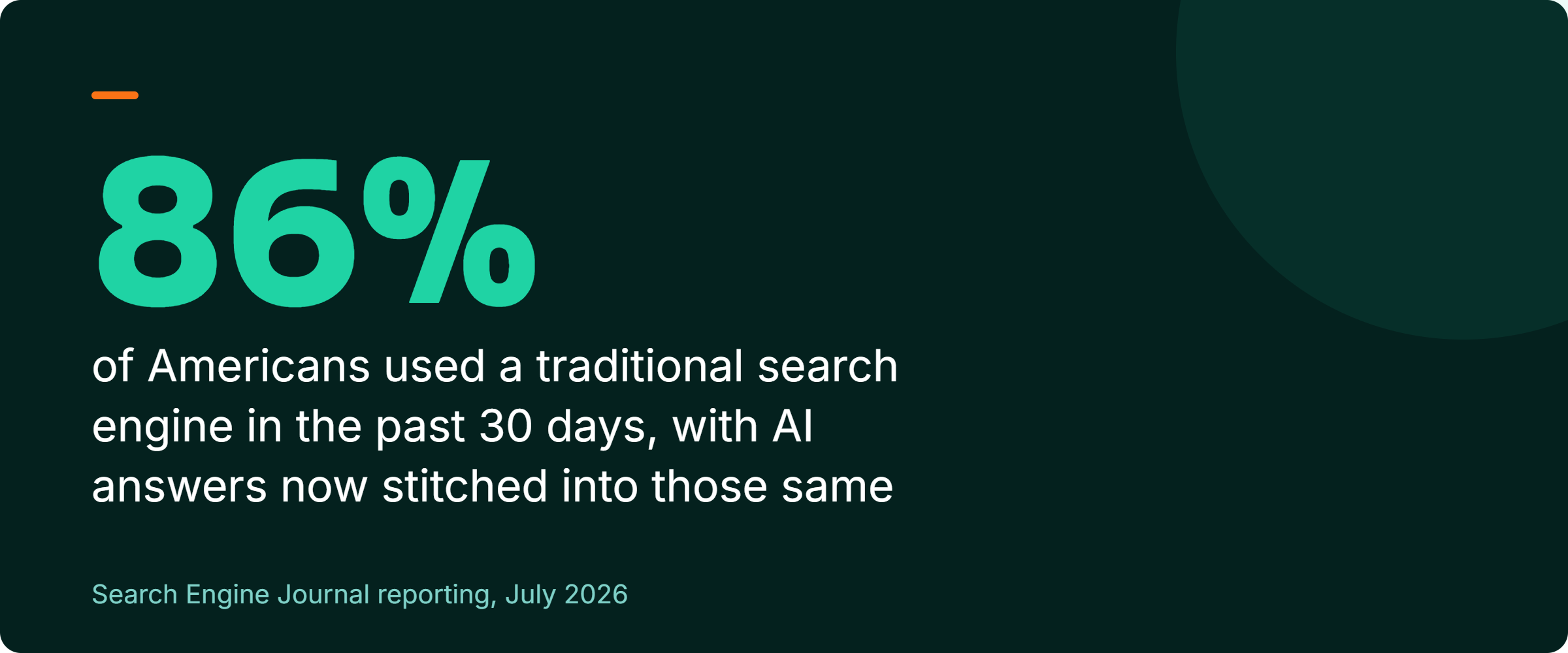
The reach behind that is not niche either. The same reporting notes that 86 percent of Americans used a traditional search engine in the past 30 days, and AI answers are now stitched into those same searches through Overviews. The audience seeing an AI summary of your business is most of your market. Some will hope the AI-driven clicks are junk traffic that will not convert. A Google study reported by Search Engine Journal on July 1, 2026 found that clicks lost to AI Overviews were not lower quality. It saw no measurable difference in bounce rate, time on site, or return-to-search. The people arriving through AI behave like real prospects, which cuts both ways: real prospects who read a stale negative, and real prospects you can win if the AI cites something current instead.
Out-publish the story, do not bury it
The fix is about supply. Right now the most citable thing about your business might be a single old article. Your job is to give the AI better, fresher, more authoritative sources to reach for. Then the model has a reason to describe you the way you actually operate today. Will recommends the same direction. You can start every step below this week.
First, monitor what AI says about you. You cannot fix a citation you have never seen. Spend a couple of hours each month typing real buyer questions about your brand into ChatGPT, Google's AI mode, Perplexity, and Gemini, and write down every source they cite. Will names tools like Otterly.ai, Mangools, and Ahrefs Brand Radar that track citations, visibility, and sentiment across AI platforms if you want to automate it. I walked through a simple manual version of this check in how to check whether AI is actually recommending your business. Do this yourself or hand a junior team member a fixed list of queries and a spreadsheet. It is the single highest-value hour on this list because it turns an invisible problem into a visible one.
Second, publish citation-worthy proof that outranks the old story as a source. For his grocery chain, Will's team published original case studies and expert insights on reputable, longstanding media outlets, the kind of sources an AI already trusts. That is the point. Skip the marketing fluff. You are creating material more current and more authoritative than the negative, the kind the model prefers. Real results, real numbers, real named people. I go deeper on the mechanics of this in why you should publish the proof before AI fills the gap for you. If you outsource it, the instruction to your agency is exact: "Get verifiable, dated proof of our current record onto sources AI trusts," not "write us five blog posts."
A second case comes from Seer Interactive, which saw published proof push out an old complaint about its own brand. Wil Reynolds at Seer watched one negative theme, "high account manager turnover," show up 67 times in branded AI outputs. Seer published its real retention data. Perplexity cited it, and after just two citations the language models stopped repeating the complaint. The new evidence was specific and checkable.
Third, diversify your credible sources. One thought-leadership piece on one outlet is fragile. Anthony Will's advice is to spread expert insight across several respected publications. That gives the AI a range of current, authoritative material to draw from instead of one old article standing alone. For a local clinic that can mean a bylined column in an industry publication, a quote in a regional trade outlet, and an original data note on your own site, all dated this year.
Fourth, respond faster when something new hits. Will's point is that the time to address a controversy is before it gets widely cited, because once an AI has been repeating a source for months, you are fighting its established habit. Speed is cheaper than cleanup. Assign one person to own the monitoring and to flag anything new inside a week.
Fifth, ask the publisher directly. When a story is genuinely outdated or factually wrong, you can request a correction, an update, or removal from the outlet. Will points to removenews.ai, which automates that outreach ask and is free, and notes that traditional reputation tools like Semrush and Surfer still have their place. This is slow and often gets a no. Treat it as one lever, not the plan.
What to measure, and the number that will fool you
Measure the thing that actually moves buyers: what AI answers say about you, and which sources they cite. Once a month, run your fixed query list and record whether the AI still surfaces the old negative and whether anything you published has shown up as a new cited source. That is the scoreboard. Everything else is a proxy.
The vanity metric that will fool you is your Google ranking for the positive content. Watching a fresh article climb to position two feels like progress, and under the old playbook it was, but as I have argued here, rank is not what the AI reads. You can own the top of the results page and still lose the AI answer. If you only track rankings, you will report a win to yourself while the citation problem stays untouched.
The second trap is checking once and relaxing. AI answers shift as models re-crawl and re-weight sources. A clean answer in July can go negative again in September with no new event behind it. Being mentioned favorably one time is not a state you reach and hold. One spot-check cannot show you the trend. I made that case in full in why being mentioned by AI is not the same as being believed. Set a monthly reminder and keep the log. The trend line is the asset, not any single reading.
The limit I promised is source selection, and nobody can promise you control over it. AI platforms change how they choose and weight which sources to cite, without notice or explanation. A strategy that surfaces your proof this quarter can be reshuffled next quarter by a model update you never hear about. Everything above carries that uncertainty. It also argues for a deep, current supply of trustworthy sources over a bet on one lever. A broad, fresh base survives more reweightings than a single perfect page ever could.
Frequently Asked Questions
Can I just get the old negative article deleted?
Sometimes, but do not build your plan on it. You can ask the publisher for a correction, an update, or removal, and a free tool called removenews.ai automates that outreach request. In practice outlets often decline, especially for accurate reporting, and even a removed page can linger in an AI model's memory until it re-crawls. Treat removal as one lever worth pulling, then put your real effort into publishing better, more current sources for the AI to cite instead.
Does this matter if customers do not even trust AI answers?
It matters more, not less. A YouGov survey across 19 markets, reported by Search Engine Journal in July 2026, found only 28 percent of U.S. searchers trust AI assistant information, against 70 percent for search engines. But low trust makes people verify: 22 percent of AI users click through to the sources the AI supplies, rising to 33 percent among daily users. When AI repeats your old story, those readers click the citation and read the original. Distrust of AI sends buyers straight to the source you hoped was buried.
How often should I check what AI says about my business?
Once a month is a sensible floor for most small businesses. Type a fixed list of real buyer questions about your brand into ChatGPT, Google's AI mode, Perplexity, and Gemini, and record both the answer and the sources cited. AI answers shift as models re-crawl and re-weight sources. A clean result one month can turn negative the next with no new event behind it. A single check tells you very little. The monthly trend line is what you actually manage.
AI can surface something about your business that was once true, was resolved years ago, and gets repeated today with none of that context. The article you paid to bury in 2016 was never really gone. It was waiting for a system that reads the sources themselves. The $150 AI visibility audit puts your customers' questions to ChatGPT, Gemini, Perplexity and Google AI Mode and records what each one says and who it names. To check the old story itself, book a quiet AI visibility call with me and we will run your queries together.