People Don't Trust AI Answers Yet. Be the Receipt.

Your customer's first question about your business is getting answered before they ever meet you. A machine handles it, sometimes at the top of Google, sometimes inside ChatGPT, and you never see the exchange happen. Most owners read that as a robbery. They are half right. The panic keeps skipping one detail: almost nobody believes the machine yet, and most people keep checking its work.
Your job in 2026 is to be the source the AI quotes and the page the buyer clicks to confirm it. Win both and you win the sale twice, once in the answer, once on your site. A YouGov survey reported by Search Engine Journal in July 2026 puts hard numbers under that, and they are far kinder to you than anything you have read about zero-click search.
The Shrinking Click Is Real, and It Has a Price
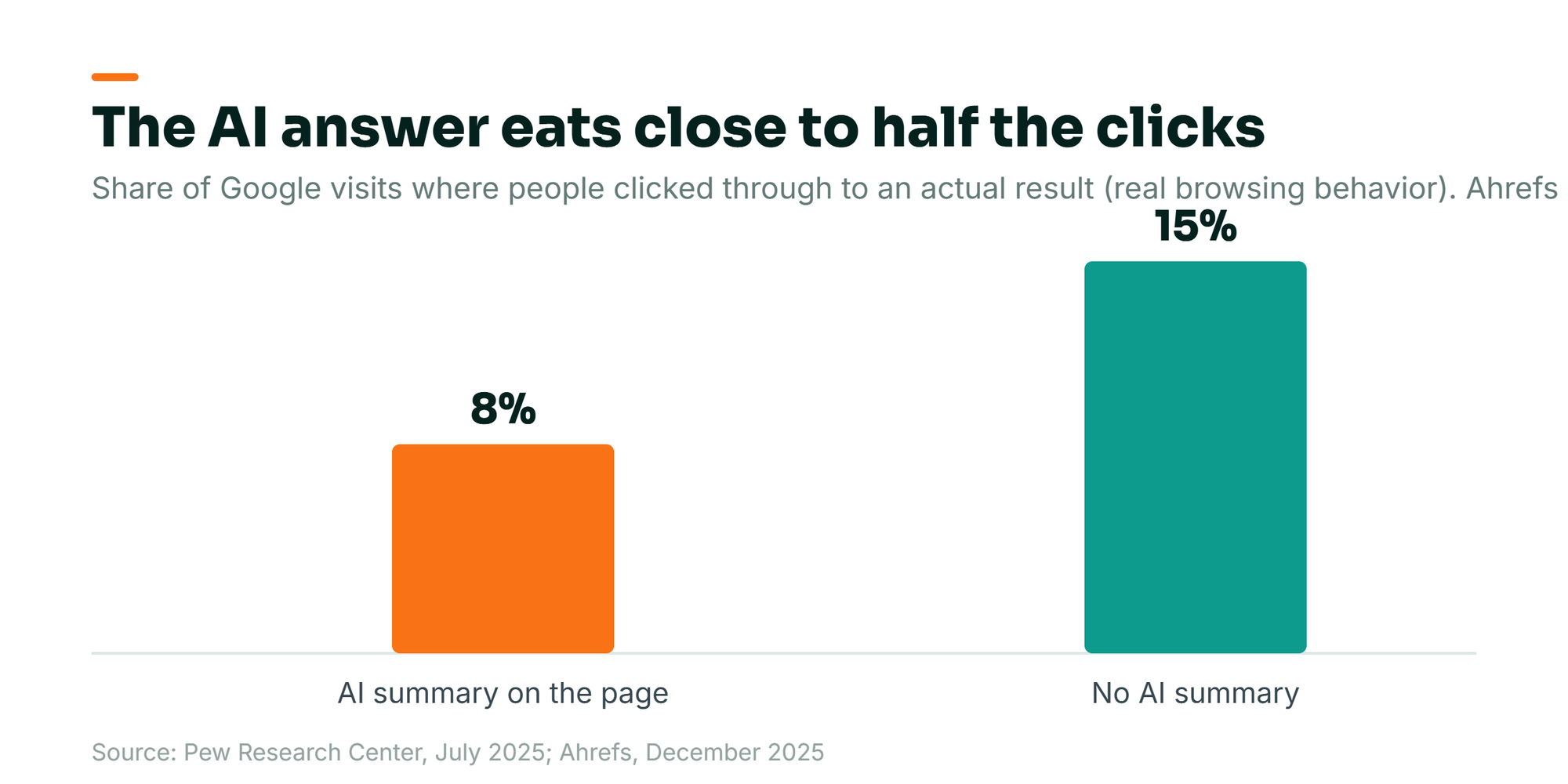
Pew Research Center watched what people actually do when Google answers for them, and the numbers are blunt. With an AI summary at the top of the page, people clicked through to an actual result on just 8% of visits. Without one, 15%. That is close to half the clicks gone, and it comes from Pew's July 2025 study of real browsing behavior, not a vendor's press release.
Ahrefs sharpened the point. By their December 2025 update, an AI Overview was cutting the click-through rate on the number-one organic result by roughly 58%. Earlier in the year that same figure was 34.5%. The trend is moving against you, not calming down. This is the reality underneath the idea that your buyers decide before they ever reach your website. The AI answer is the new first impression, and you are not in the room when it forms.
Put that in money. Say organic search sends you 100 booked jobs a month, and half of your best queries now trigger an AI answer above the links. You are not losing a little traffic off the edges. You are watching the top-ranked pages you spent years earning quietly hand back a third to over half of the clicks that used to fill your calendar. Ignoring that is expensive. Overreacting to it is worse, and it is exactly where most owners go.
Owners React by Doing One of Two Wrong Things
Panic comes in two flavors, and both send you a bill. The first is denial: the AI answer is a fad, search still works, carry on as usual. Tell that to the page that just lost half its clicks. The second is surrender. An owner reads one breathless post about AI killing search, guts the content and SEO budget that still feeds the business, and pours it into some scheme to "get into ChatGPT." I have been doing this for 17 years, since 2008, and I have watched the search-is-dead sermon get preached three separate times. The denial camp gets slowly starved. The surrender camp defunds the channel that pays the bills to chase one that barely registers yet.
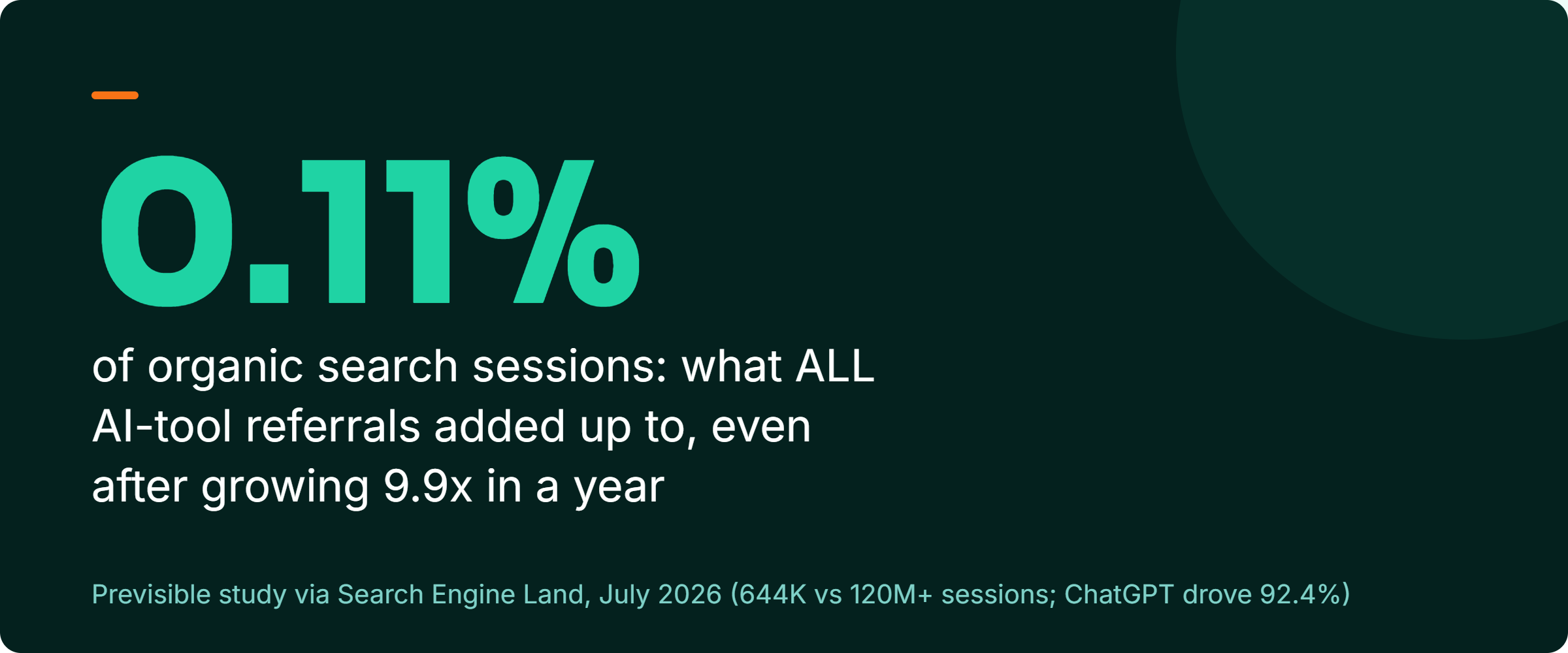
Surrender is a mistake, and the numbers say why. A Previsible study reported in Search Engine Land in July 2026 tracked real referral traffic from AI tools across a large set of sites. Monthly sessions from those tools grew almost tenfold, 9.9 times, to about 644,000 by May 2026. Impressive, until you meet the denominator: that was 0.11% of the organic sessions in the very same dataset, which cleared 120 million. ChatGPT alone drove 92.4% of the trackable AI referrals. This isn't even a broad front. It is one tool, sending a rounding error of your traffic, growing quickly.
The right move is to fund both channels. AI traffic is worth winning because it is small and early, the way any channel is cheapest before everyone piles in. Hardly anyone has claimed it yet. In a Q1 2026 study reported by Search Engine Journal in May 2026, Victorious found that 159 of 177 brands, 89.8%, had zero mentions across 107,011 AI responses. You just do not pay for that ground by starving the search work that still books the calendar. Both camps read this as a traffic problem. The trust numbers below say otherwise, and that is where your opening is.
Only 28% of Americans Trust the AI Answer
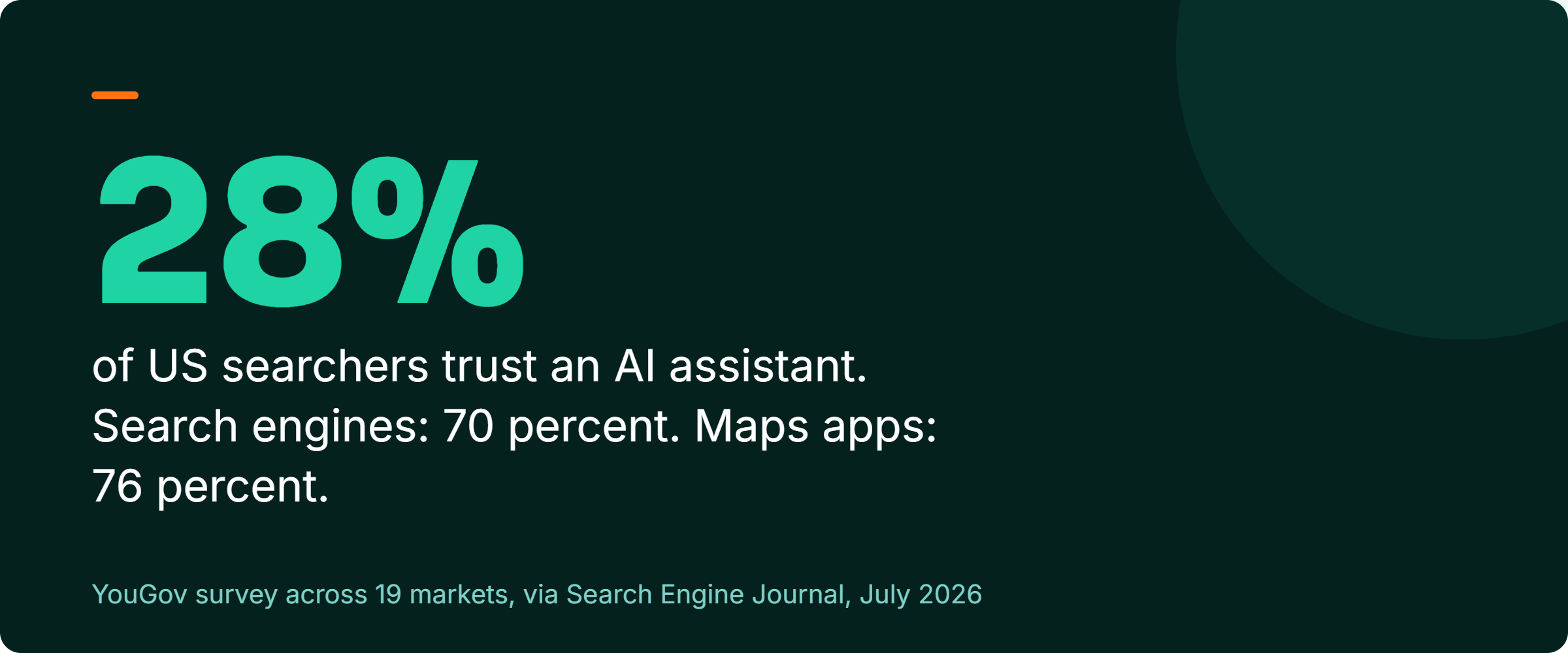
That figure is not a typo, and it is the most useful thing you will read this quarter. In that YouGov survey reported by Search Engine Journal, 28% of US searchers said they trust the information an AI assistant gives them. For a regular search engine the number is 70%. For a maps app it is 76%. People trust the blue dot that has marched them into the wrong parking lot more than twice as much as they trust the AI summary. Think about that for a second.
The spread across countries tells the same story. US adoption of AI search came in at 48%, the lowest of all 19 markets in the study. India, Indonesia, and the UAE were close to 89%. Great Britain, which matters if you sell into it, scored 54%. And 86% of people had used a plain search engine in the previous 30 days. The AI answer is loud. Its grip on trust is still weak.
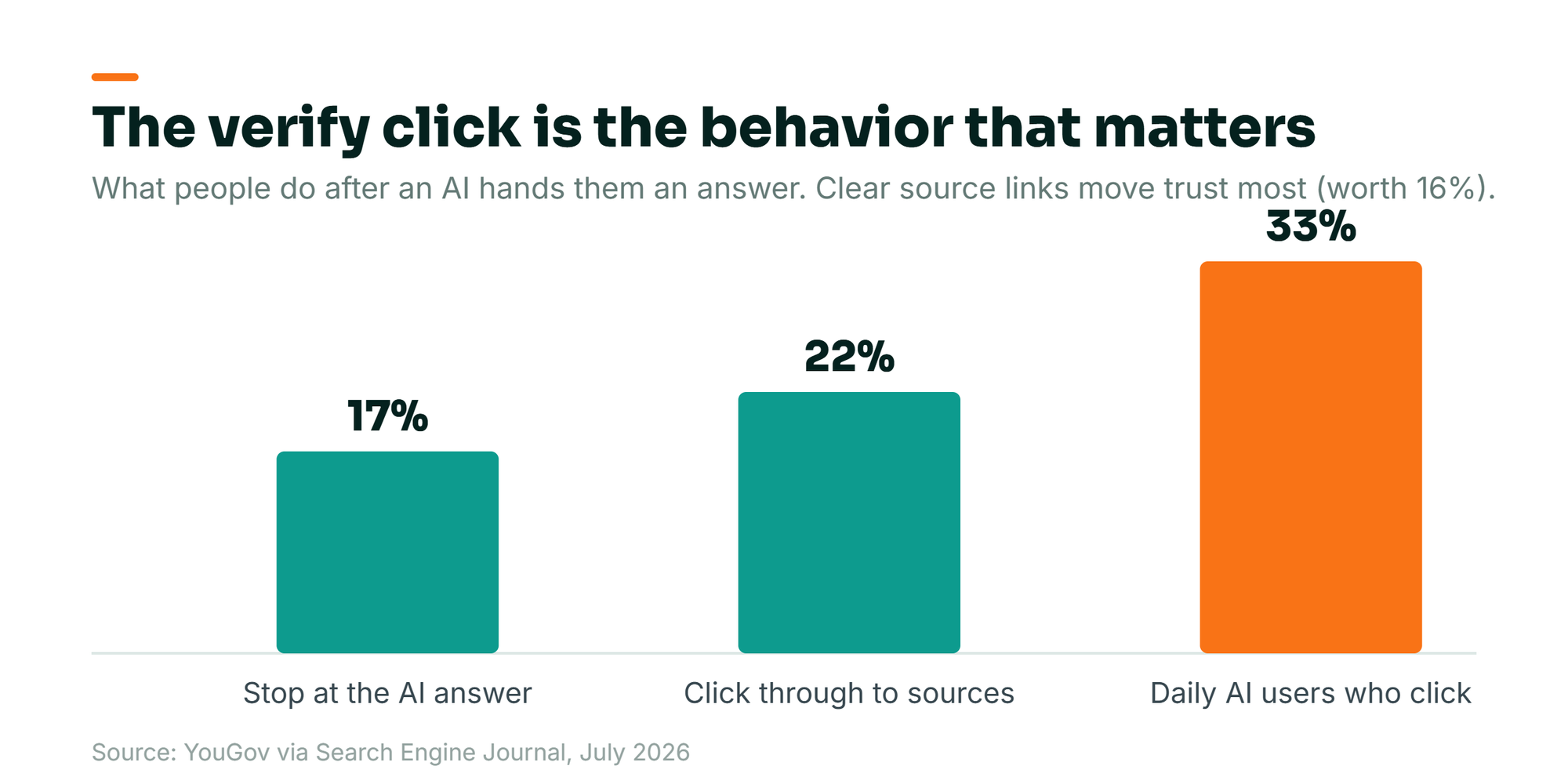
The behavior underneath backs it up. After an AI hands someone an answer, 22% still click through to the underlying links, and only 17% stop searching altogether. Among daily AI users, the people supposedly furthest down this road, the click-through rate climbs to 33% while the stop-searching rate holds flat at 17%. Read that twice. The heaviest users click to verify more, not less. The survey also found what moves trust most: a clear source link, worth 16%, and being the official source, worth 15%.
Mark Fantino, YouGov America's senior vice president, wrote of AI assistants in the report's foreword, "They want to just answer you." Then came the catch, as he framed it: AI might save people steps, but people still want receipts. Read "receipts" the way a buyer does: source links, an official site, a fact they can check with their own eyes before they hand over money.
The AI search market in the U.S. isn't expanding outward. It's compounding inward, among a smaller group of people who were always going to be your early adopters anyway.
Greg Jarboe wrote that in his July 2026 Search Engine Journal piece on the YouGov study. AI search is getting more intense among the people already using it. It is not taking over your whole customer base this year. That buys you time, but only if you spend it on the right thing.
This is a different argument from the one you have heard about zero-click search. That story is usually told from a publisher's chair, where a lost click is lost ad money. If you run a clinic, a law firm, or a plumbing company, the zero-click panic is really a publisher's problem, not yours, because you were never selling page views. You sell a booking. Your booking lives inside the trust gap, and it does not behave like a media company's traffic.
Become the Receipt Your Customer Clicks to Check
Picture a patient with a slipped disc opening ChatGPT and asking for the best physio near them. The AI names three clinics, yours among them. The patient does not book off that list. They open a tab for each clinic and start checking: real reviews, actual credentials, whether this place even treats disc injuries or just sore shoulders. Whoever's page answers those questions fastest, in plain language, with a real therapist's name on it, gets the call. The AI built the shortlist. Your page closes it.
AI can't recommend what it can't understand.
Sam Richardson, VP of growth at Intero Digital, said that in Search Engine Land in July 2026, and it is the hinge of the whole fix. The model has to be able to read your facts, and the human has to be able to confirm them. Same job, two audiences. On your actual pages that looks like this, in the order I would do it.
Put a real name and face on the work. A named author with a short, credentialed bio, who they are and why they know this, gives both the model and the buyer someone accountable. "Reviewed by Lisa Chen, physiotherapist, 12 years treating disc injuries" is a receipt. "Our team of experts" is not.
Stamp the page with a visible date. Not the day you first published in 2021, the day you last checked the facts. Recency is a signal a human scans for in a heartbeat and a machine reads cleanly. A price or a policy with no date attached reads as stale to buyer and machine alike.
Back every claim with a one-line source. If you say you resolve 90% of cases without surgery, say where that number comes from and over what period. "Based on 240 patients treated in 2025" turns a marketing line into a checkable fact. The buyer exhales. The model gets something it can quote.
Keep the facts a buyer checks in plain text. Your hours, service area, credentials, and prices belong in readable HTML, not baked into an image, buried in a PDF, or loaded by a script that only fires after a click. If a fact lives only inside a downloadable brochure, assume the AI never read it and the rushed buyer never found it.
Replace "contact us for pricing" with a real number. Vague pricing gives the AI no figure to summarize and the buyer no reason to trust you. The AI quotes the competitor who was specific instead. "Initial assessment $95, standard treatment $70" is a fact a machine repeats and a human believes. "Call for a quote" is only a fact about your reluctance.
Underneath all five, add structured data. It tells the machine which line is a price, which is your hours and which is a credential. None of this is exotic. If your team can put a name, a date, a source, and a price on a page, you have done most of the work already.
Publish Your Proof Where AI Already Looks
The five fixes turn your own page into the receipt. The AI does not read your page alone, though. It weighs your site against every other source that mentions you, and the facts that would reassure a buyer most are often never published anywhere. Amanda Natividad of SparkToro named where that proof gets stuck.
Make a list this week: client results with real numbers, retention or repeat-rate data, response times, certifications, named references. A fact that only comes up on sales calls is invisible to the AI. Pick the five facts that would most reassure a nervous buyer and write each one as a sentence with a number in it. Those sentences go on your own page first, with a name, a date and a source attached.
Then publish each one somewhere beyond your own domain. A case study with hard outcomes on a partner's site. An honest answer in a relevant industry forum thread. A data point in an interview or a guest piece. A detailed, specific reply to a real review. Checkable facts on sources the AI already reads can change what it says about you. Seer Interactive published its own retention data, and AI answers stopped repeating an old complaint about staff turnover. I walk through that case in the fix for old bad press that AI keeps repeating.
If you delegate this, give your team or agency one standing instruction. Every month, publish three verifiable facts about us in three places we do not own, and show me where each one was published. How the people you pay respond tells you whether they understand 2026.
Measure the Verify Click, Not the Vanity Mention
The wrong scoreboard will lie to you for months. First, track whether AI tools actually cite you, checked more than once, because a single lucky answer is not a pattern. Ask the questions your buyers ask, from a couple of devices, across a few weeks, and log both how often you appear and whether the facts it repeats about you are right. Second, your branded and direct traffic, the people who saw you named in an AI answer and came to verify by typing your name into the address bar. That is the verify click showing up in your analytics even when the referrer field is blank. Third, the only number that pays rent: calls, forms, and bookings from people who found you through an AI answer. Capture it by asking every new lead how they heard about you and writing the answer down.
The first trap is treating a one-time mention in ChatGPT as a win. That mention is a coin toss you happened to win that morning. Being named is not the same as being believed, and the same answer can name your competitor tomorrow. Chasing raw AI referral volume is the second trap. The Previsible numbers already told you it is a rounding error this year. Grade the work by AI session count alone and you will quit something that is feeding your pipeline through branded searches and direct visits. The worst trap is celebrating a mention while the AI is repeating a wrong price or a closed location. A confident wrong answer costs you the one buyer who trusted it enough to act.
Give any of this two to three months before you judge it. Trust and citations move slower than an ad campaign does. An answer that ignores you in July can name you in September once the facts on your page are clean. The buyer who verifies you in September was never going to convert in July anyway.
Frequently Asked Questions
Should I stop investing in Google SEO and move everything to AI search?
No. A Previsible study reported in Search Engine Land in July 2026 found AI tools sent about 0.11% of the sessions that organic search did, even after growing nearly tenfold. Search still books your calendar, and AI is the new, small channel you win by being citable. Fund both, and never gut the one paying your bills to chase the one that barely registers yet.
How do I know if AI is even mentioning my business?
Ask it the way your customers do. Type the real questions a buyer would use, like best plumber in your city, into ChatGPT and Google's AI answers, from a couple of devices, more than once over a few weeks. One check tells you very little because the answers vary from day to day. Log how often you appear, and just as important, whether the details it gives about you are correct.
What is the most important thing to fix on my website first?
Put your real, checkable facts in plain text on the page: a named person, a last-updated date, honest pricing, your hours, and your service area. Sam Richardson of Intero Digital put it plainly in July 2026, that AI can't recommend what it can't understand. If the machine cannot read your facts and the buyer cannot confirm them, the rest of your work will not move the needle.
Everyone told you AI would take the click. It is taking some of them. The ones it leaves behind are the most valuable clicks you have ever gotten. The person arriving has already been told you might be the answer and is now checking whether that is true. That is not traffic. That is a warm buyer with a specific doubt, standing on your doorstep, asking you to prove it. The businesses that win the next two years are not the ones shouting loudest inside the AI answer. They are the ones whose page survives the second look.
If you want a straight read on whether yours does, I work through that with owners one on one. That includes whether AI is citing you at all and whether the page it sends people to actually settles the doubt. You can book a quiet call with me here, and we will look at your real pages together.