AI Visibility Not Working? 7 Reasons and the Fix for Each

You have heard "AI visibility" a hundred times by now. Maybe you added some FAQs, cleaned up a page, asked ChatGPT about your business once, and felt good for an afternoon. And the assistants still do not mention you. A customer asks Gemini or Perplexity who to hire, and your name never comes up.
This is not a niche worry anymore. ChatGPT is up to around 800 million weekly users (OpenAI, October 2025), Google's Gemini passed 750 million monthly users (Alphabet, February 2026), and people are clearly using these tools to decide who to hire. BrightLocal found that 45 percent of consumers used AI for local business recommendations in 2026, up from just 6 percent a year earlier (BrightLocal Local Consumer Review Survey, 2026). When nearly half your potential customers are asking a machine who to call, being left out of that answer is lost revenue, not a vanity problem.
AI visibility is not one thing you fix, it is a stack of separate things, and "it is not working" almost always means two or three of them are broken at the same time. That is why random tweaks do nothing. You patch one layer while the real problem sits one layer down, untouched.
So let me give you the actual list. Here are the seven reasons your AI visibility is not working across the assistants, and the specific fix for each. Work them in order. If you want the full picture of how all of this fits together first, I mapped it in my complete guide to AI search visibility. This post is the troubleshooting checklist.
One note before we start. If your problem is specifically Google's AI Overview, the AI summary at the top of a Google search, that one has its own quirks, and I broke it down separately in why your AI Overview is not showing your business. Everything below is the broader, cross-platform version: ChatGPT, Gemini, Perplexity, and Google's AI Mode all at once.
1. You are not findable anywhere the AI looks
The assistants do not know things by magic. They pull from the open web, from search results, from sources they have indexed. If your business has a thin web footprint and ranks for almost nothing, there is simply not enough of you out there to find and quote.
And do not assume ranking number one rescues you. Ahrefs studied AI citations against Google results and found that 88 percent of the URLs the assistants cite do not rank in Google's top 10 for that query at all (Ahrefs, 2025). The models are not just reading the first page of Google and reading it back. They reach across the web for whoever has clearly answered the specific thing. If you are answering nothing clearly, anywhere, you are not in reach.
There is also a blunt, self-inflicted version of this one that catches more sites than you would think: you blocked the AI crawlers. Each assistant reads the web with its own bot, OpenAI's GPTBot and OAI-SearchBot, Anthropic's ClaudeBot, PerplexityBot, and so on. If your robots.txt quietly disallows them, or a security plugin does it for you, the assistants literally cannot read your site (Search Engine Land, 2026). Before any clever strategy, open your robots.txt and confirm you are not slamming the door on the very tools you are trying to show up in.
The fix: build real presence, and make sure you are reachable. Let the AI bots crawl you, rank for the questions your customers ask, publish pages that answer specific buying questions plainly, and make sure your business actually exists, clearly and consistently, across the places these models read.
2. Your content has no clean answer to lift
Say the AI can find you. Now the problem is shape. These systems pull a clear, quotable fact out of a page. If your answer is buried in brand fluff and never stated plainly, there is nothing to lift, so the AI grabs the competitor who said it simply.
The fix: state the answer plainly, right under a heading that matches the question, in a sentence a machine can quote whole. Lead with the answer, then explain. And this will save you from a popular waste of money: structured data (schema) is not the magic citation lever it gets sold as. When Ahrefs tested nearly 1,900 pages that added schema against thousands that did not, the effect on AI citations was about 2 percent either way, statistical noise, and on Google's AI Overviews it was slightly negative (Ahrefs, 2026). Google itself says no special schema is required for its AI features. Keep schema for normal SEO hygiene, but do not believe anyone who tells you a pile of markup will fix your AI invisibility. Clear, well-organized writing does the heavy lifting. Do not make a reader or a model dig for your answer.
3. Your brand is too quiet to be trusted
This is the one nobody likes. An assistant recommends names it sees other trusted sources talk about. If your brand is barely mentioned anywhere, the model has no reason to feel confident putting you forward, even if you technically match.
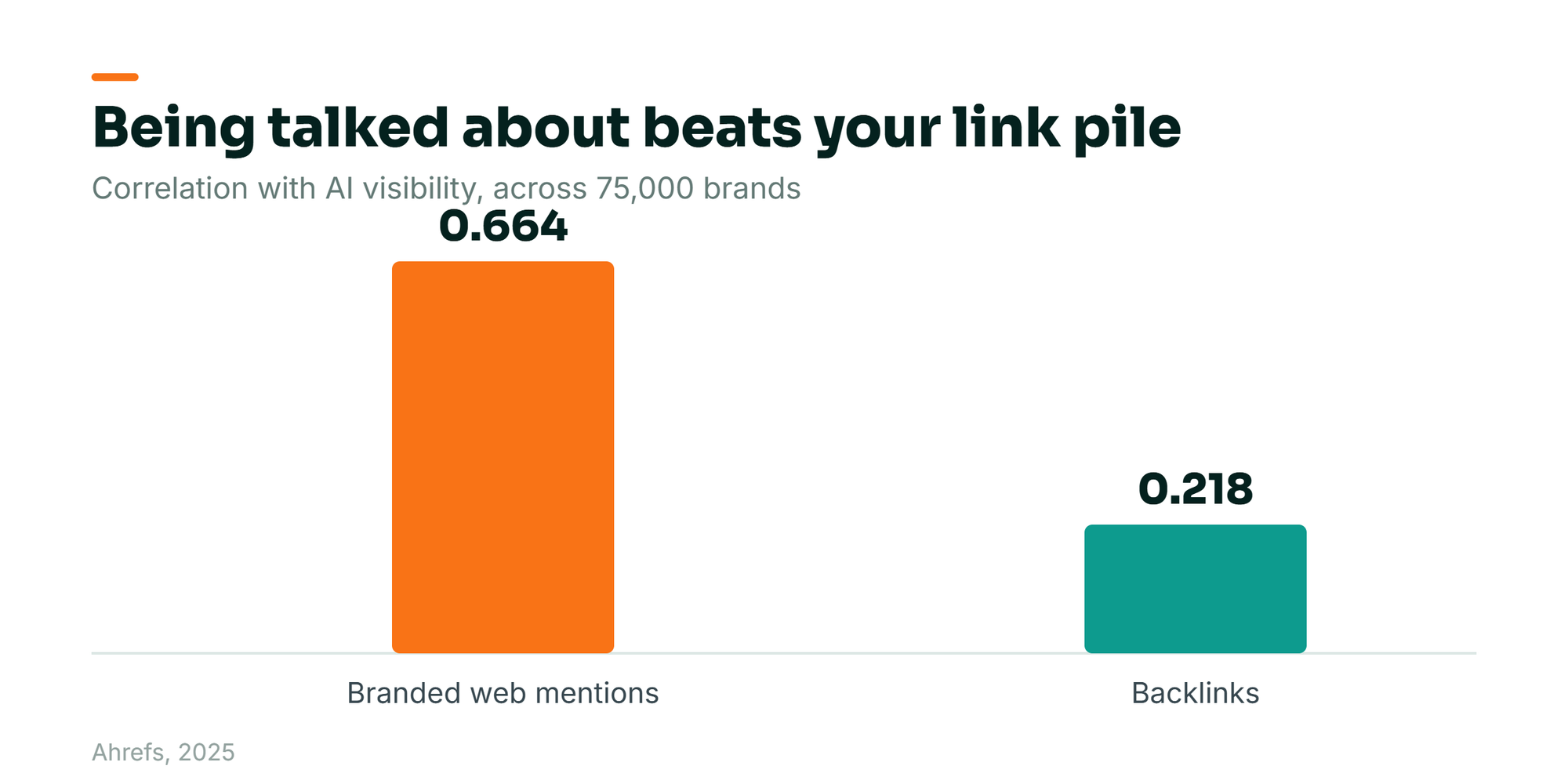
We now have a number for how much this matters. Ahrefs analyzed 75,000 brands and found that branded web mentions correlated with AI visibility at 0.664, while raw backlink counts came in at just 0.218 (Ahrefs, 2025). How often the web talks about you mattered roughly three times more than how many links you have piled up. Being mentioned is the new currency.
The fix: get talked about. Earn mentions, build a real reputation, show up where your industry shows up. This is slow, and anyone selling you an overnight version of it is lying.
4. Your business information is inconsistent
The models build a picture of who you are from data scattered across the web. If your name, address, phone number, hours, and categories say different things in different places, you become a blurry, low-confidence entity. A confused source is a skipped source.
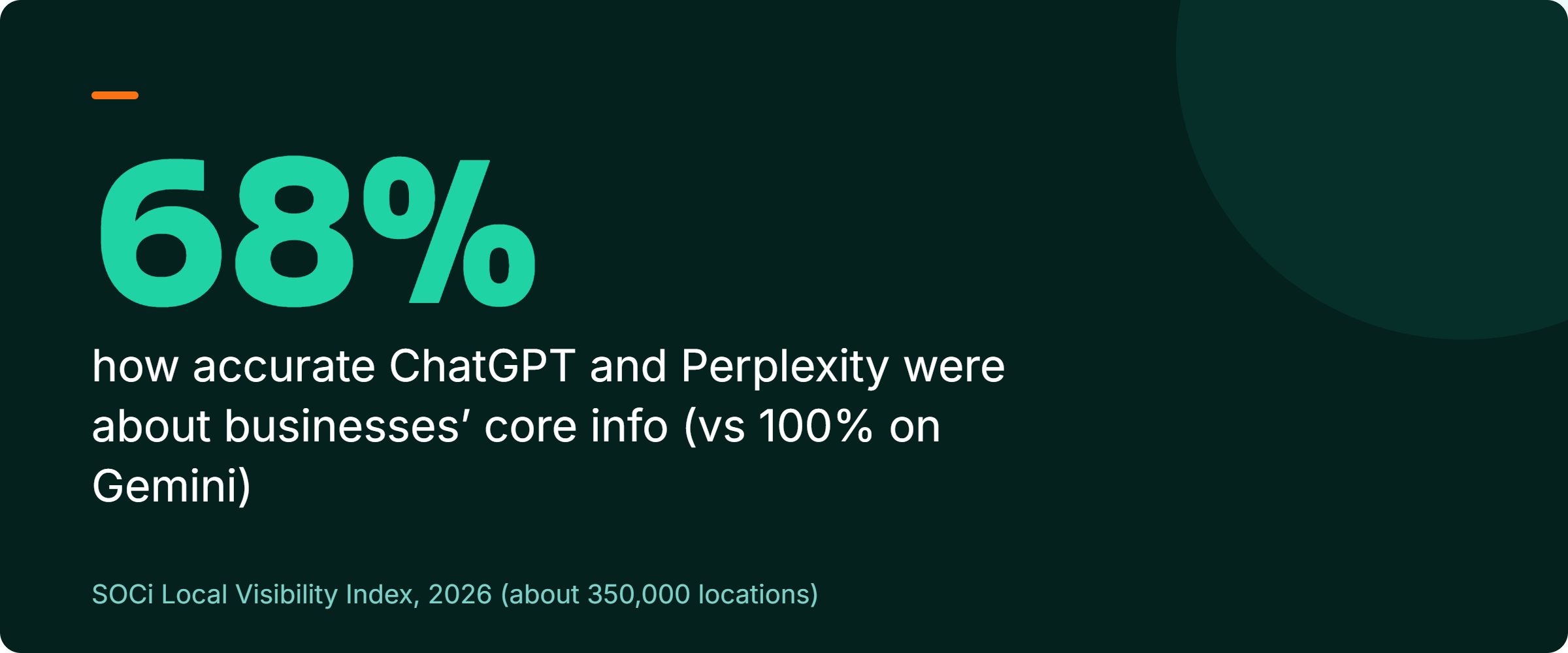
This is not a small effect. SOCi audited roughly 350,000 business locations and found that core profile information was only about 68 percent accurate on ChatGPT and Perplexity, against 100 percent on Gemini (SOCi Local Visibility Index, 2026). They named data accuracy across your site, Google, Yelp, and Facebook as the single biggest factor in whether a location shows up in AI recommendations, and concluded that AI visibility is "3 to 30 times harder" to earn than ranking well in traditional local search. Clean data is not busywork. It is the floor.
The fix: make your core business facts identical everywhere. Same name, same address, same phone, same categories, across your site, your Google Business Profile, your social profiles, and every directory. Consistency is what turns you into something the AI can confidently name.
5. You are missing from the sources AIs lean on
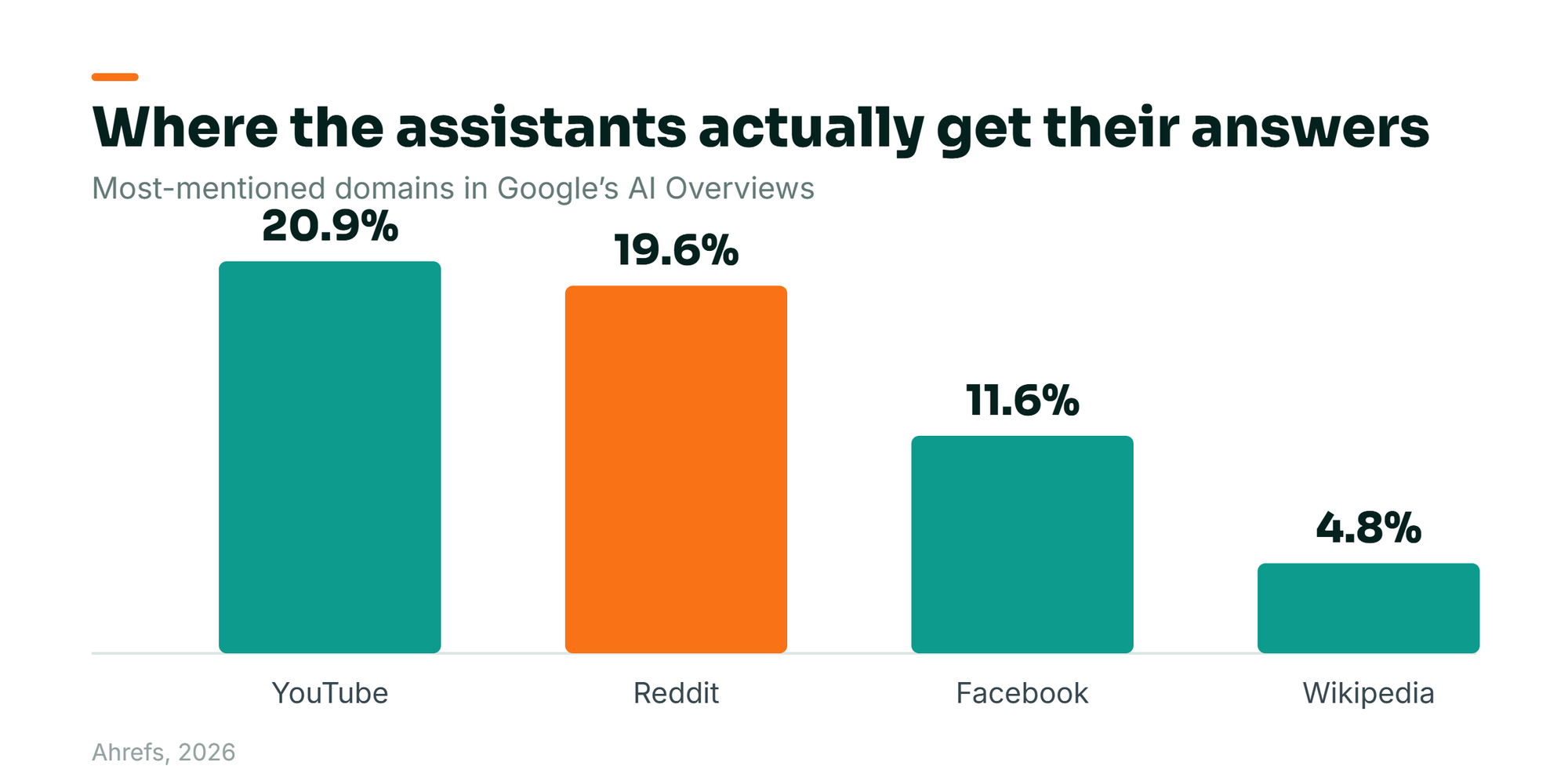
Here is one most owners never think about. Assistants love third-party sources, often more than they love your own website. When you look at what they actually cite, the same names dominate: Reddit, YouTube, Wikipedia, review sites, and "best of" listicles. Reddit alone is the single most-cited domain on Perplexity and sits near the top across Google's AI features (Profound and Semrush, 2025). Listicles are their own force here: one analysis of 25,000 cited URLs found that 63 percent of AI citations pointed to list-style pages, especially ranked "best of" lists (Evertune, reported by Search Engine Land, May 2026). When someone asks for a recommendation, the model often reaches for those before it reaches for you. If you are absent from all of them, you are absent from the answer.
Do not over-rotate on this if you run a local business. The Reddit obsession is mostly a product and software-brand story. When BrightLocal looked at what ChatGPT actually cites for local-business questions, plain old business websites were about 58 percent of the sources and forums like Reddit barely showed up at all (BrightLocal). For a plumber or a dental clinic, your own site, your Google Business Profile, your reviews, and local directories matter far more than any subreddit. Match the channel to your business instead of chasing whatever is trending in marketing threads.
The fix: get into the conversations that fit you. Earn legitimate listings, real reviews, and honest mentions in the roundups, directories, and communities your buyers actually read. You usually will not outrank Reddit, and you do not need to, you just need to be present where it matters, which I get into in why you should stop trying to outrank Reddit.
6. You are aiming at questions that never name a business
Not every question produces a business recommendation. Some get a definition. Some get a list of national brands. If you keep testing queries that simply do not surface companies like yours, the silence is not about you.
The fix: target the buying-intent questions where the assistant genuinely names providers. Build clear, specific answers for those, not for broad informational queries that were never going to mention anyone. The "how much does X cost" and "best X for someone like me" questions are where recommendations actually live.
7. You are measuring it wrong
Before you conclude any of this is broken, check how you are checking. AI answers shift by user, location, device, and moment, and they shift between assistants too. BrightEdge found that ChatGPT and Gemini agreed on only about two of their top five recommended brands for the same question (BrightEdge, 2026). Ahrefs found that only about 14 percent of the most-cited sources are shared across ChatGPT, Perplexity, and Google's AI (Ahrefs, 2025). The engines reward different things: Gemini leans on your website and Google Business Profile, ChatGPT leans on Wikipedia, Reddit, and Bing, and Perplexity rewards clean comparison-style pages. You can be a star in one assistant and a ghost in another, on the very same query, which is exactly why checking only your favorite one tells you almost nothing.
The fix: measure a hit rate, not a single look. Ask the buying questions many times, across all the assistants, and track how often you show up. That number is the truth. One screenshot is noise.
Picture your own business
Say you run a med spa. You ask ChatGPT "best med spa near me" and get nothing, so you panic. But work the list. You barely rank for anything (reason 1), your treatment pages read like a brochure with no plain pricing or specifics (reason 2), you have a handful of reviews while competitors have hundreds (reason 3), your address is listed three different ways across the web (reason 4), and you are nowhere in the local "best med spa" Reddit threads the model keeps quoting (reason 5). No single fix saves you there. It is five broken links in one chain, and that is completely normal.
About 17 years in search and more than 300 businesses have shown me this pattern almost every time. It is never one reason. It is a few stacked together, which is exactly why guessing does not work. You have to diagnose, not tweak. If you want the deeper argument for why these problems stack and never come alone, I wrote it up in you do not have one AI visibility problem, you have several.
Frequently Asked Questions
How do I fix my AI visibility?
Stop guessing and work the chain in order. First make sure you are findable and ranking somewhere, then make your answers clean and quotable, then build the brand mentions and consistent business data that make an AI confident naming you, then get present on the third-party sources assistants lean on, like reviews, directories, and community threads. Most "it is not working" cases are two or three of these broken at once, so fixing one in isolation rarely moves anything.
Why does ChatGPT recommend my competitor and not me?
Usually because the model trusts and finds them more easily than you. They probably rank better, state their answers more clearly, carry more reviews and mentions, and show up in the directories and roundups the assistant pulls from. It is rarely a single advantage. It is a pile of small ones that add up to the model feeling safer recommending them. The fix is to close those gaps, not to copy their words.
How long does it take to fix AI visibility?
It depends entirely on which links are broken. Restructuring a page so the answer is clean and quotable can show results in a few weeks. Cleaning up inconsistent business data is fast to do but takes time to propagate. Building the brand reputation and third-party presence that earn trust takes months. Anyone handing you a guaranteed timeline has not actually looked at your specific situation.
If you have worked through this list and you still cannot tell which links are breaking for you, that is exactly what I sort out with owners every week. You can book a free AI visibility call and we will look at your real searches, find the two or three reasons actually costing you, and put them in the order worth fixing. No pitch deck, just the real deal.