How to Show Up in Google AI Overviews (and Why Your Business Isn't)


You typed your service and your town into Google and watched the AI answer build itself at the top of the page. A competitor got named and you did not. It is easy to conclude that something is broken, or that the whole thing is rigged.
Google's own documentation asks for no special markup to appear in an AI Overview. A business that gets skipped is skipped at one specific point: the search it tested, its ranking, a page with no quotable answer, or a thin record on other sites.
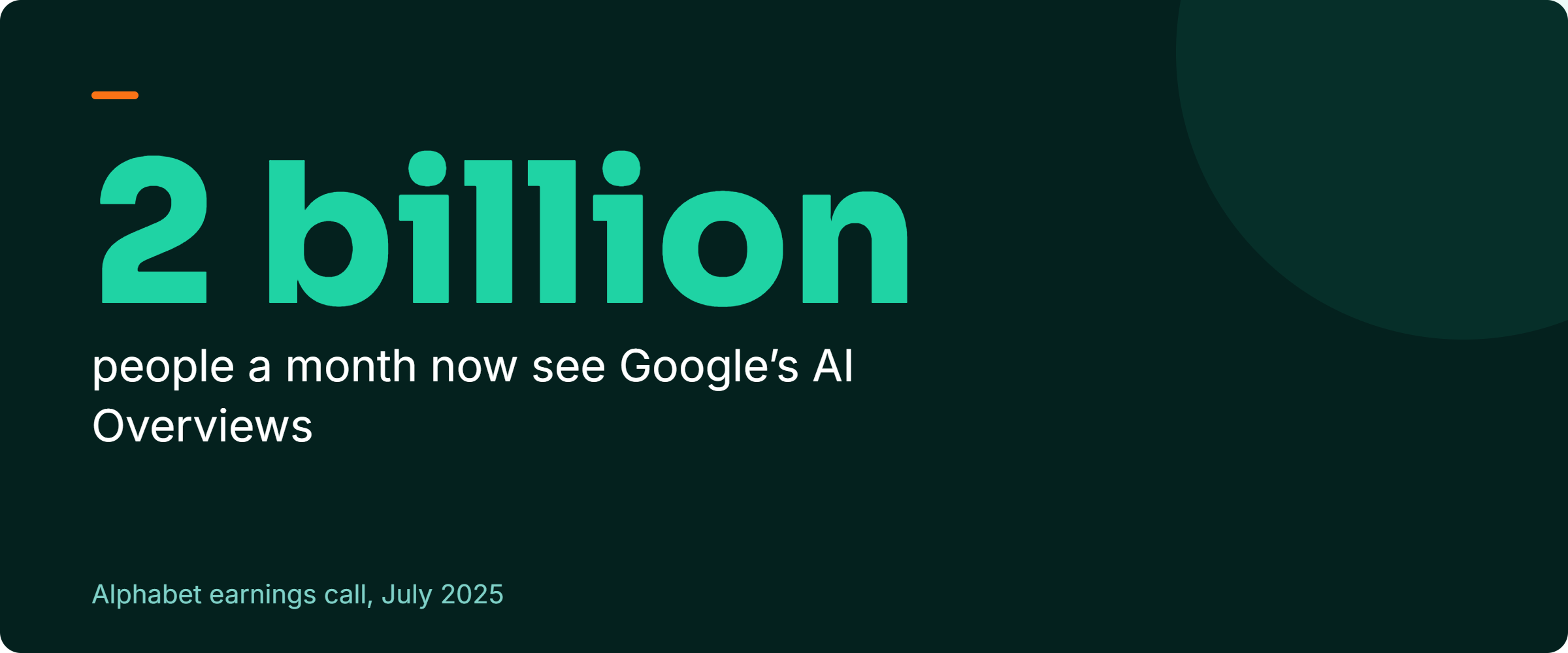
On Google's own numbers, AI Overviews reach more than 2 billion people a month (Alphabet earnings call, July 2025). Pew Research found that when an AI summary appears, people click a normal search result 8 percent of the time, against 15 percent when there is no summary (Pew Research Center, July 2025). Google has disputed Pew's click numbers and the exact percentages will keep moving. A customer who reads the summary may still never scroll down to your listing.
If ChatGPT, Gemini and Perplexity are leaving you out too, my complete guide to AI search visibility covers every engine, layer by layer.
How to show up in Google AI Overviews
Google sets the bar in its Search Central page "AI features and your website", last updated December 10, 2025. A page needs to be "indexed and eligible to be shown in Google Search with a snippet" to appear as a supporting link in AI Overviews or AI Mode. The same page adds: "There are no additional technical requirements."
That is the whole technical list. Being eligible does not decide who gets named, and the businesses I see skipped are rarely missing a setting.
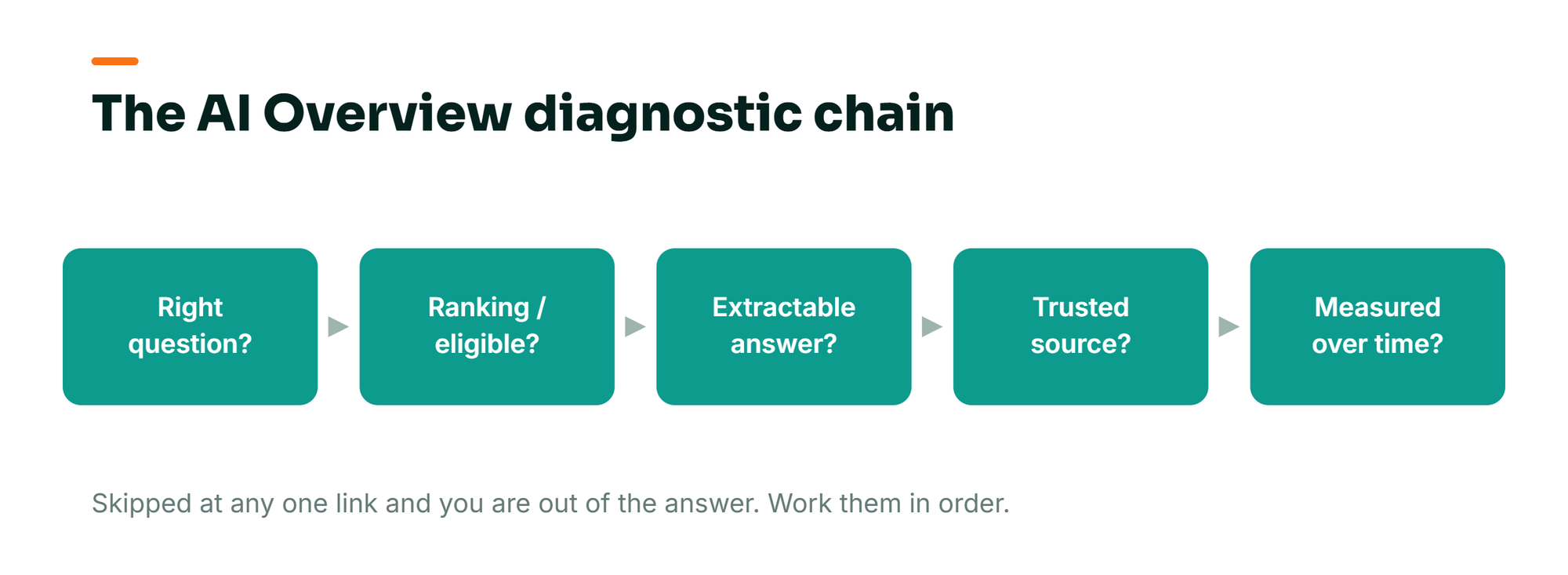
Start with the search itself. Test one that produces an AI Overview, because cost, choice and fit questions trigger one far more often than a plain local search. Once your search shows one, showing up comes down to this order:
- Rank for the question and the questions around it. AI Overviews draw on pages Google already surfaces, including pages that answer one slice of the question.
- Put a quotable answer at the top of the section. One plain sentence under a heading that matches what the customer typed.
- Build a record Google can trust. Reviews, mentions and consistent business details on sites you do not own.
- Measure across many searches. One look from one phone tells you very little.
My own site has a PageSpeed score of 100 and a domain rating of 0. Section 3 below shows what that earned in clicks.
First, make sure you are even looking at the right thing
Google can put several features at the top of a search, and an AI Overview is only one of them. On many local searches it is not the feature that names businesses.
You may have even seen Google say it outright: "An AI Overview is not available for this search." That line is not a verdict on your business. It means the question did not trigger an AI answer for anyone, your competitors included. The case worth worrying about is when the AI Overview does show up and names other businesses instead of yours.
Whitespark's May 2025 study of 540 local queries across three US cities split them by intent. On a straight local search like "plumbers in Phoenix," an AI Overview showed up about 15 percent of the time and the map-style local pack 93 percent of the time. An informational question like "how much does a plumber charge" produced an AI Overview on 92 percent of searches. Hybrid questions like "cost of dental implants in Phoenix" hit 97 percent.
Whitespark's own blended figure, in its report "The Prevalence of AI Overviews in Local Search," is 68 percent of local searches with an AI Overview against 39 percent for the local pack. That is the number I quote in the local signals AI reads. The three split figures above average to the same 68 percent. The blend shows how common AI Overviews are in local search. The split shows which searches they appear on.
| Kind of local search | Example | Searches with an AI Overview |
|---|---|---|
| Local intent | “plumbers in Phoenix” | About 15% (local pack 93%) |
| Informational | “how much does a plumber charge” | 92% |
| Hybrid | “cost of dental implants in Phoenix” | 97% |
| Blended figure (Whitespark report) | Local searches overall | 68% (local pack 39%) |
Sources: Whitespark, 540 local queries across three US cities, May 2025 (split rows); Whitespark, "The Prevalence of AI Overviews in Local Search" (blended row).
The bare "near me" searches owners like to test usually produce the local pack, with no AI Overview on the page. The AI Overview owns the earlier, question-shaped searches a customer runs before they are ready to call. If you are looking at a local pack and wondering why the AI did not name you, there was no AI answer on that page to be named in.
An AI Overview that does fire will not always name a business. Some questions get a plain definition. Some get a list of national brands. Across all Google searches, Pew Research Center found AI Overviews on 18 percent in March 2025, and on 60 percent of searches that started with a question word.
Aim at the questions that produce business-naming answers in your field. Those are usually hybrid, money-adjacent questions. Think "how much does X cost in my city" or "is X worth it for someone like me" from a customer ready to spend. Chasing a query that never names anyone wastes the effort.
Confirm an AI Overview appeared on your search, and that it named businesses, before you work on anything else. When it named other businesses and not yours, the cause is in one of the sections below.
1. You are not in the organic running yet
This is the most common one, and the least fun to hear. AI Overviews build their answer from pages already surfacing in Google's results. If you do not rank anywhere near the front for the question your customer asked, your page is not in the pile the AI picks from.
Ranking on page one used to come close to a guarantee of getting cited. When Ahrefs studied where AI Overviews pull their citations from, 76 percent of cited pages ranked in the top 10 organic results for the same query in mid-2025. By early 2026 that overlap had dropped to 38 percent. The other citations come from pages ranking lower, or not ranking for that exact query at all.
The drop comes from how the answer is built. Google splits your customer's question into a fan of smaller sub-questions and pulls a source for each piece, a technique it calls query fan-out. The AI can cite a page that answers one slice of the question well, even if that page does not rank first for the whole thing.
The wrong response to fan-out is a hundred thin pages for a hundred tiny keywords. Build one deep page that answers the whole cluster of questions a customer asks around a topic, and treat AI visibility as part of regular SEO. A page that ranks for the question and its sub-questions is the page an AI Overview can reach for.
2. Your content is not extractable
Say you do rank, right there on the front page, and the AI still skips you. At that point the problem is the shape of the page. An AI Overview lifts a clean, quotable sentence or two out of a page. Pew found the median AI summary is just 67 words and that 88 percent of them cite three or more sources (Pew, July 2025). The machine assembles a short answer from several tidy snippets. A page that answers in a glossy, roundabout, brand-voice way gives it no clean sentence to lift.
I see this constantly. A business has a genuinely good page, but the actual answer is buried three paragraphs deep, wrapped in fluff, never stated plainly. The AI gives up and grabs the competitor who put the answer in the first line under a clear heading.
Make the answer impossible to miss. Put the direct answer in the first hundred words or so of the section, under a heading that matches the question your customer typed. Write it as a plain factual sentence a machine can lift whole, then explain underneath. CXL looked at 100 Google AI Overview citations and found 55 percent came from the first 30 percent of the cited page. Which formats get pulled and which get skipped is covered in the content AI actually cites.
3. Google does not trust your site enough yet
Sometimes you rank, your content is clean, and you still get skipped. An AI Overview leans toward sources Google trusts, and that trust is built on sites you do not own.
My own site is the example I know best. The on-page side is done: 115 posts, each with a question-led FAQ and FAQPage schema, and a PageSpeed score of 100. The record on other sites is thin and the domain rating is 0. In the 90 days to September 1, Search Console logged 1,230 impressions and 17 clicks. Clean formatting made those pages easy to read. It could not supply the trust, which has to come from other sites.
Ahrefs put a number on the same pattern across 75,000 brands. Branded web mentions correlated with AI Overview visibility at 0.664, while the raw backlink count came in at 0.218 (Ahrefs, May 2025). How often the wider web talks about you mattered about three times more than your link pile.
A young, thin or quiet domain has not built that trust yet. The gap closes over months, and no page edit closes it in an afternoon.
Build the slow trust signals. Get mentioned by credible sources, earn detailed reviews, keep your business details identical everywhere, and publish enough useful depth that you stop looking like a stranger. Anyone who promises a shortcut here is selling something.
4. You are checking it wrong
Before you panic, make sure you actually have a problem. AI answers are not fixed. They change by location, by device, by who is logged in, and from one moment to the next. You can search your business at 9am and get left out, search again at 2pm and get named. One look is one data point.
I have watched owners convince themselves they are invisible based on a single search from their own phone, while they were getting cited for the same question across half their market. Measure it across many tries and count how often you show up.
To check Google itself, type ten real customer questions into Google, worded as questions, in a private window with the location set to the city you serve. Note which businesses each AI Overview names, and run the same questions again on different days. For your own pages, Search Console now has an AI performance report under Performance. It counts impressions from Google's AI features for your site and reports no clicks. It does not show who was named in your place. The same test across ChatGPT, Gemini, Perplexity and Google AI Mode is in how to check if AI is actually recommending your business.
Ignore the AI snake oil while you do this
A whole industry now sells owners "AI Overview tricks." Google's own guidance on AI features, reported by Search Engine Journal in June 2026, was blunt about what does not earn a citation. The list covers special llms.txt files, chopping content into machine-readable chunks, and rewriting pages in an "AI-friendly" robotic style. Google's line is that getting into AI answers is still good SEO: clear, honest, well-structured content from a source it trusts.
If someone charges you for an llms.txt file or an "AI optimization" plugin and promises AI Overview placement, keep your money. Placement comes from the steps at the top of this page.
A dental clinic, worked through the checks
Say you run a dental clinic. You search "best dentist near me," you are not in the AI answer, and the instinct is to blame the whole machine. Work the checks instead. On that exact search Google most likely showed a local pack, with no AI answer to be left out of. Now search for the cost of dental implants in your city, or whether a same-day crown is worth it. Those are the questions that fire an AI Overview, and one clean, trusted page can get you named there.
I have worked in search for about 17 years, and most of the businesses I see left out of AI Overviews already clear Google's eligibility line. Their pages are indexed and can show a snippet. They drop out later, on the search they tested or on the record other sites hold about them.
The search comes first, then the ranking, the quotable answer, the trust and the measurement. A rewritten page does little for a search that never shows an AI Overview. A quotable answer does little for a site Google does not trust yet.
Free download
The AI Overview Diagnostic Checklist
The checks from this post as a printable PDF you can run against your own business today.
- The pre-check: does your search even trigger an AI Overview
- The fixes in the order to run them
- The real trigger-rate numbers from Whitespark’s 540-search study
Frequently Asked Questions
Why is my business not showing up in Google's AI Overview?
Often because the search you ran did not produce an AI Overview at all. Straight local searches like "plumbers in Phoenix" mostly show the local pack, and Whitespark found an AI Overview on about 15 percent of them. When an AI Overview does appear and names other businesses, the usual cause is ranking, a page with no clean sentence to quote, or a site Google does not trust yet. Work those in order.
How long does it take to show up in an AI Overview once I fix things?
It depends on which step was broken. If you already rank and only needed to restructure a page so that the answer is quotable, you can start showing up within a few weeks. If the problem is trust, expect months of building reviews and mentions before the answer changes. A guaranteed timeline is a guess.
Can I pay Google to put my business in the AI Overview?
No. AI Overviews are part of the organic answer, and there is no button to buy your way into them. You earn the spot the way you earn a strong organic ranking: be eligible, be the clear answer, and be a source Google trusts. Paid ads can appear around the AI answer, but they do not put you inside it.
If you want to know who AI names in your place, the $150 AI visibility audit puts ten of your customers' questions to ChatGPT, Gemini, Perplexity and Google AI Mode, three times each. You get every business named instead of you. Or book a free AI visibility call and we will look at your real searches and find the step where you drop out.