How to Improve Your AI Visibility: A Step-by-Step Checklist

Most advice on AI visibility leaves you more confused than when you started. It throws ten buzzwords at you and never tells you what to actually do on Monday morning. So let me give you the opposite of that. A plain checklist, in the order that works, that you can hand to yourself or your team and start working through today.
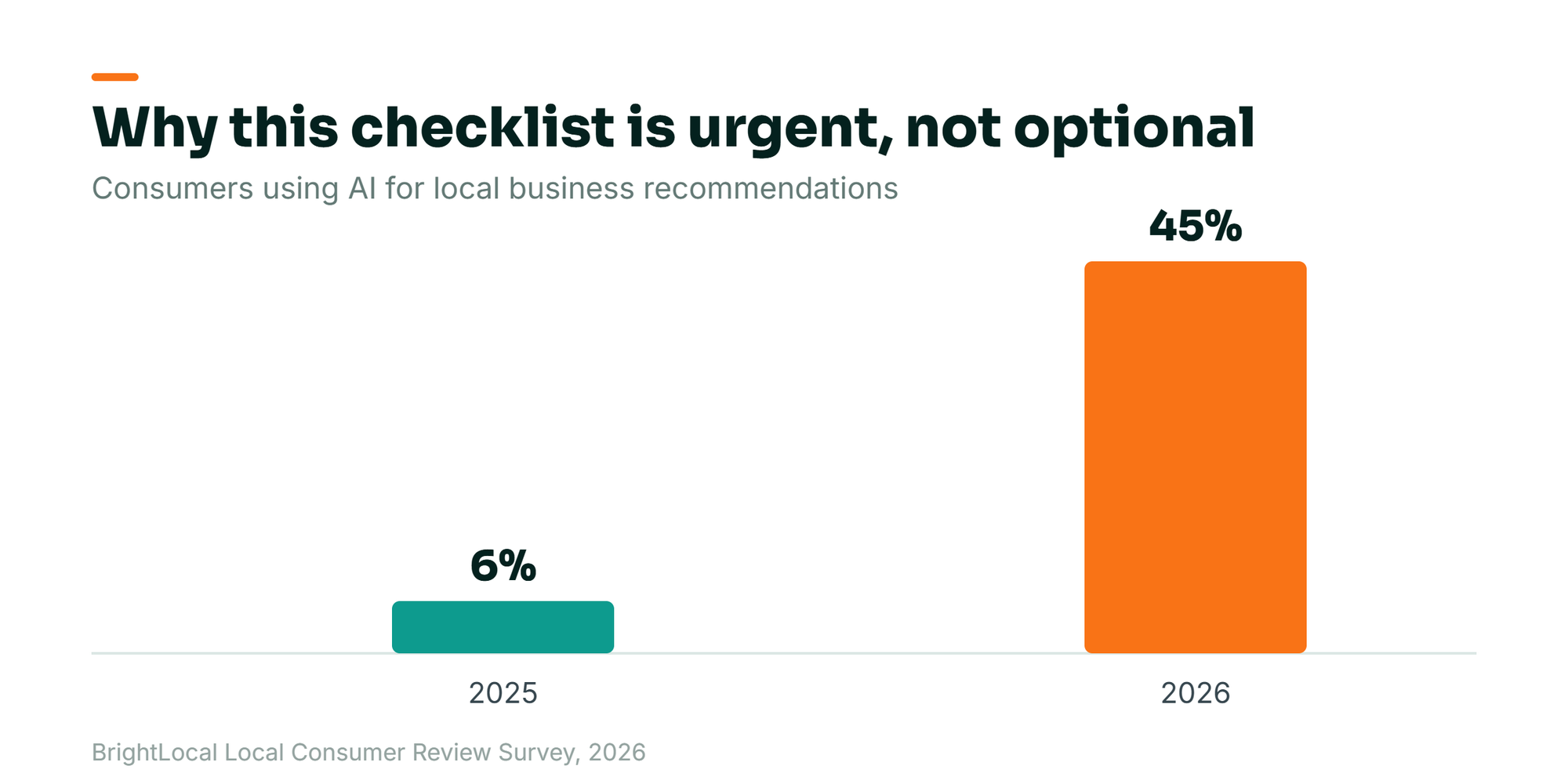
And the time to start is now, not next year. The share of consumers using AI for local business recommendations jumped from 6 percent in 2025 to 45 percent in 2026 (BrightLocal Local Consumer Review Survey, 2026). That is not a trend creeping toward you. That is already most of a buying audience asking a machine who to trust. The businesses that get named in those answers are the ones doing the boring work below, in order, while everyone else argues about it.
This is the build-it-up version. If your AI visibility is actively broken and you want to diagnose what is wrong, I wrote the troubleshooting companion to this in AI visibility not working, here are seven reasons and the fix for each. This post is for the owner who wants to do it right and build real, durable presence. For the full picture of how everything connects, start with my complete guide to AI search visibility. Then come back and work this list.
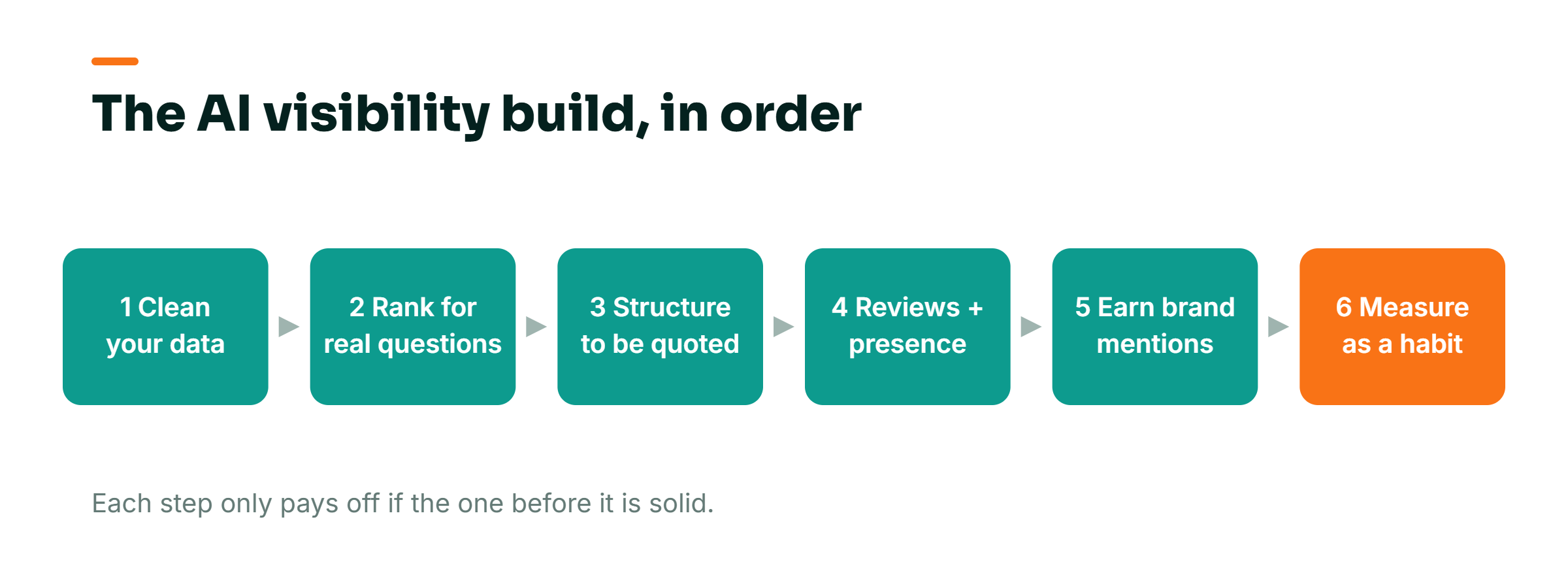
Order matters here. Doing step five before step one is how people waste months. So go top to bottom.
Step 1. Clean up your business data first
Before anything clever, get the boring stuff right. AI assistants build a picture of who you are from your business details scattered across the web. If your name, address, phone number, hours, and categories disagree from one place to the next, you look like a blurry, low-confidence business, and a confused source gets skipped.
This is not a minor detail you can leave for later. When SOCi audited around 350,000 locations, core business information was only about 68 percent accurate on ChatGPT and Perplexity, and they found data consistency was the single biggest factor in whether a business showed up in AI recommendations at all (SOCi Local Visibility Index, 2026). Get this wrong and every step after it is built on sand.
Do this: make your core facts identical everywhere. Same name, same address, same phone, same categories, across your website, your Google Business Profile, and every directory you can find. Then give your Google Business Profile real attention, because for a lot of local searches it has quietly become your homepage as far as the AI is concerned. The single highest-impact move there, per BrightLocal, is picking the most specific primary category you can ("Personal Injury Attorney," not "Lawyer"), then filling in every field, adding real photos, and keeping fresh reviews coming in. This is unglamorous and it is the foundation. Do not skip it.
Step 2. Rank for the real questions your customers ask
AI answers lean heavily on content that already performs in regular search, and beyond that, on whoever has clearly answered a specific question anywhere on the web. If you rank for nothing and answer nothing plainly, you are not in the pile the AI picks from. So you need to be findable for the actual questions people type, not just your brand name.
Do this: list the real questions your buyers ask before they hire you, the specific ones, and make sure you have a strong page answering each. While you are in there, check one quiet technical thing: open your robots.txt and confirm you are not blocking the AI crawlers (GPTBot, OAI-SearchBot, ClaudeBot, PerplexityBot). If the assistants cannot read your site, nothing else on this list matters. Being eligible in normal search is step zero for AI visibility. The two are not separate projects.
Step 3. Structure your content so AI can quote it
Ranking is not enough if the AI cannot cleanly lift your answer. These systems pull a plain, quotable sentence out of a page and often stitch several short sources together. If your answer is buried in brand language, there is nothing to grab.
Do this: state the answer plainly, right under a heading that matches the question, then explain underneath. Lead with the answer. One concrete upgrade that pays off: put a real number and a real outside quote on the pages that matter. The original generative-engine-optimization research out of Princeton found that adding cited statistics and quotations raised a page's visibility in AI answers by roughly 30 to 40 percent. A specific, sourced fact gives the machine something it trusts enough to lift. I go deep on exactly which formats get pulled and which get ignored in the content AI actually cites, and it is worth reading before you rewrite a single page.
Step 4. Build reviews and third-party presence
Assistants love sources that are not your own website. Reviews, directories, community threads like Reddit, and "best of" roundups all feed into who gets recommended, and they often get reached for before your own site does. If you only exist on your own pages, you are missing the places the AI actually trusts.
Do this: earn real reviews steadily, claim legitimate listings, and get mentioned in the roundups and communities your buyers read. You are building a footprint outside your four walls, because that footprint is what the AI reaches for first.
Step 5. Earn brand mentions and authority
This is the slow, compounding one, and it may be the most important. An assistant recommends names it sees other credible sources talking about. Ahrefs looked at 75,000 brands and found that branded web mentions predicted AI visibility about three times more strongly than backlinks did, 0.664 against 0.218 (Ahrefs, 2025). The more your brand shows up in trustworthy places, the safer the model feels putting you forward.
Do this: get quoted, get featured, show up where your industry shows up, and keep publishing genuinely useful depth so you stop looking like a stranger. There is no shortcut here, and anyone selling you one is taking your money. This is the work that separates the businesses that win AI search from the ones that just talk about it.
Step 6. Make measuring a habit, not a one-time check
You cannot improve what you only glance at once. AI answers shift by user, location, device, and moment, so a single search proves nothing either way.
Do this: pick your key buying questions and check them regularly across the assistants, tracking how often you show up, not whether you showed up once. That hit rate is your real scoreboard. The full procedure for running it is in how to check if AI is actually recommending your business.
Picture your own business
Say you run an accounting firm. You could spend a month obsessing over clever content for step three while your address is listed four different ways across the web (step one is broken) and you have eleven reviews to a competitor's three hundred (step four is broken). All that clever writing moves nothing, because the foundation underneath it is cracked. Work the list in order and each step makes the next one actually count.
Two notes so you do not get sold a shortcut. You will see people pushing llms.txt files as the new must-do. Skip it for now. No major AI provider actually reads those files yet, so it is optional at best, not a foundation. And give this real time. Industry guides put it plainly: an established brand can see movement in weeks to a few months, but a brand new business often needs twelve to eighteen months of this work to build the authority the assistants trust. That is not a reason to wait. It is the reason to start today.
Across about 17 years in search and more than 300 businesses, the owners who win at this are almost never the ones with the fanciest tactics. They are the ones who did the boring steps in the right order and kept going while everyone else chased the shiny thing. Steady beats clever here, every time.
Frequently Asked Questions
How do I get my business to show up in AI search results?
Work it in order. First make your business data consistent everywhere, then rank for the real questions your customers ask, then structure your content so an AI can quote it cleanly, then build reviews and third-party presence, then earn brand mentions over time, and finally measure your results regularly. Showing up is the payoff of doing those steps in sequence, not a single setting you switch on.
What is the first thing I should do to improve AI visibility?
Clean up your business information before anything else. Make your name, address, phone, hours, and categories identical across your website, your profiles, and every directory. It is unglamorous, but a business the AI can identify with confidence is a business it will actually name. Industry audits keep finding inconsistent data is the single biggest thing holding businesses out of AI recommendations, so clever content on a shaky foundation is wasted effort.
Do I need to hire someone to improve my AI visibility?
Not necessarily. The early steps, cleaning your data and structuring your content, are things a focused owner or a capable team member can absolutely do. The later steps, building authority and earning the right third-party presence, take more time and judgment, and that is usually where a second set of experienced eyes pays for itself. Start with what you can do yourself and get help where it actually moves the needle.
If you want someone to look at your specific situation and tell you which step on this list will move the needle most for you right now, that is exactly what I do with owners every week. You can book a free AI visibility call and we will map your real starting point and the order worth working in. No pitch deck, just the real deal.