The Keyword Is Finally Dying. Don't Bury Your Budget With It.

The mistake is already happening in thousands of accounts: a business owner reads that Google replaced keywords with an "AI Brief," shrugs, types two vague sentences about what they sell, and hands Gemini the keys to a five-figure monthly budget. That single lazy paragraph is how you lose money in 2026. This article proves one thing. The keyword really is being replaced this time, but the brief that replaces it gives Google more control over your spend, and your only defense is writing guidance tight enough that Google's AI can't waste it.
I've heard "the keyword is dead" for fifteen years. It was wrong every time. What's different now isn't the funeral announcement, it's the mechanism underneath it. You used to guess the words your customer would type. Now you describe your business to a machine and let it decide which conversations you belong in. That shift sounds small. It moves the place where your money leaks from a list you can see to a paragraph you probably wrote in ninety seconds.
Customers stopped talking in two-word phrases, and your keyword list never noticed
Think about how you searched for a contractor last week. You didn't type "kitchen remodel." You typed something closer to "how much does it cost to redo a small kitchen if the plumbing is in the wrong spot." Google's own data tracks this. AI Mode, which Google calls the biggest redesign of the search box in 25 years, has passed one billion monthly users, and the queries people type into it run roughly three times longer than a traditional search.
Three times longer changes the math of a keyword list. A list of 200 exact phrases was always a bet that customers would phrase their need the way you predicted. When the average question triples in length, the number of ways someone can ask for the same thing explodes past anything a human can write down. Frederick Vallaeys, cofounder and CEO of Optmyzr, puts the cause plainly.
"The keyword isn't dying because Google decided to kill it. It's dying because consumers stopped phrasing their needs in a couple of words."
Frederick Vallaeys, cofounder and CEO of Optmyzr
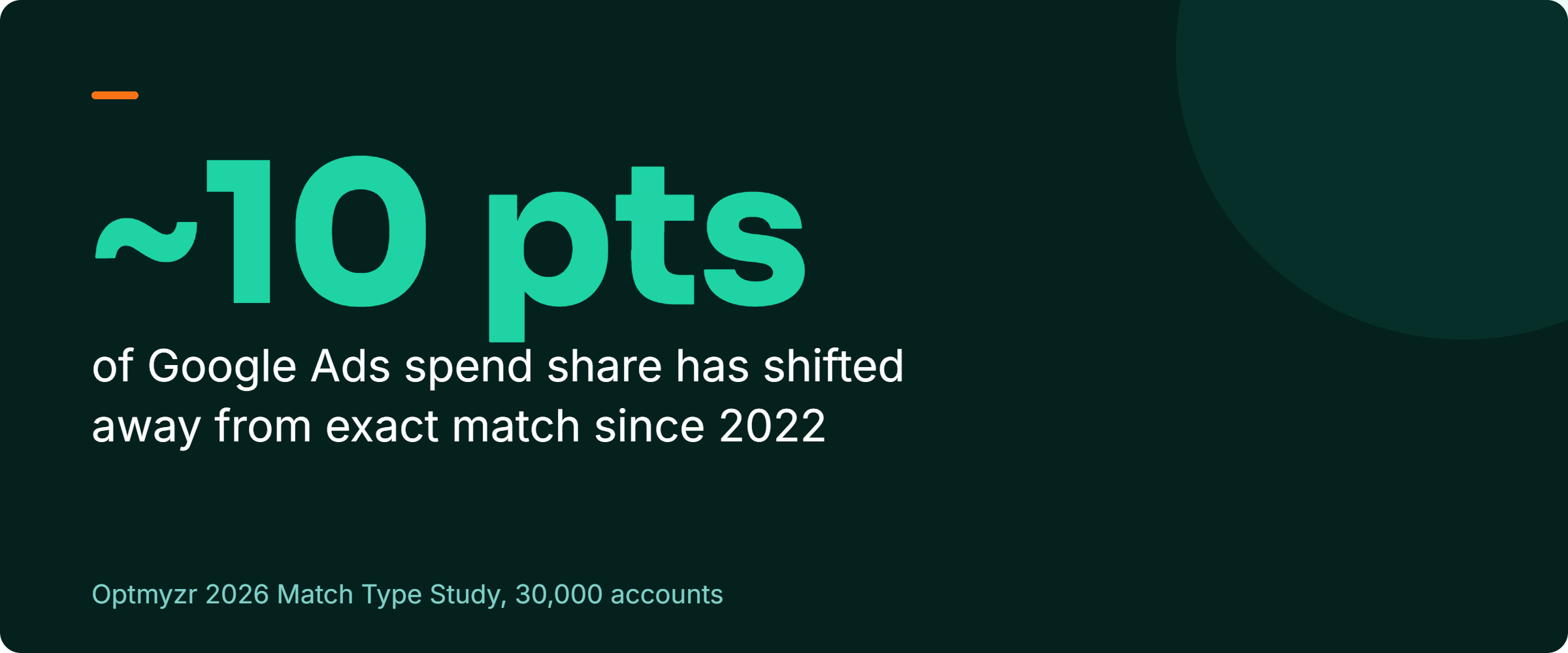
The money is already moving. Optmyzr's 2026 Match Type Study looked at 30,000 Google Ads accounts in February 2026 and found exact match has lost nearly 10 percentage points of spend share since 2022, while broad match has climbed to become the single largest match type by budget. Read that as a sentence about your wallet: the tight, predictable targeting you could audit line by line is no longer where most ad dollars live. The loose, machine-driven targeting is. This is the same drift I wrote about in why Google's AI Max for Search is really broad match wearing a new badge, and the AI Brief is the steering wheel bolted on top of it.
Phrase match didn't disappear. The same study found it still holds the largest share of non-branded spend and leads on conversion rate in both ecommerce and lead generation. So the picture isn't "automation won, targeting is dead." It's messier. The controllable middle still converts best, and the budget is draining away from it anyway.
Owners treat the brief like a checkbox, then wonder where the money went
The trap is a quiet one. When the control was a keyword list, a bad list still looked like work. You had rows. You had match types. You could open the account and see 300 lines of effort, even if half were wrong. A brief looks like a contact form. You fill in a few boxes, describe your business, click save, and it feels finished because there's nothing left to type.
That emptiness is the danger. Vallaeys frames the difference better than any product page does.
"A keyword list is a static artifact. A brief is a negotiation."
Frederick Vallaeys, cofounder and CEO of Optmyzr
A negotiation means the other side fills any silence with its own interpretation. Leave out who you don't want, and Gemini decides. Leave your price stance unstated, and the AI guesses. The AI Brief is a Gemini-powered control layer that steers AI Max: you describe your business in plain language, and Gemini matches that description against the prompts real people type. Vallaeys calls it "targeting prompts with prompts." It accepts positive instructions, negative instructions like "never mention prices," audiences, messaging themes, and intents. Every one of those fields you skip is a decision you've delegated to a system that gets paid when your ad shows.
This is the same structural problem I flagged about how Google made bidding smarter while your budget didn't get the memo. Automation isn't neutral. It optimizes for what you told it to optimize for, and when you tell it almost nothing, it optimizes for spend. A roofer who writes "we do roofing in Texas" has just authorized Google to chase someone searching "how to patch a roof myself," because nothing in that brief said otherwise. The free advice seeker and the $14,000 replacement job look identical to an AI you never bothered to instruct.
The owners who get burned aren't lazy. They're busy, and the interface rewards speed. It takes longer to write a brief that protects you than to write one that satisfies the form. Nobody at Google is going to email you to point that out.
The data says the keyword is going, not that judgment is
It's worth being honest about the history, because the panic merchants are already out in force. Vallaeys, who has every commercial reason to hype the new thing, refuses to.
"People have been calling the keyword dead since at least 2010. Yet here we are in 2026, still using keywords to show ads on Google."
Frederick Vallaeys, cofounder and CEO of Optmyzr
So why believe it this time? Not because Google announced it. Because the customers changed first. The billion people in AI Mode typing three-times-longer questions aren't a marketing campaign, they're a behavior. Writing in Search Engine Land on June 8, 2026, Vallaeys argued that the AI Brief is the first control that actually matches how people now search: with sentences, not fragments. He wasn't selling a feature. He was naming a behavior change he didn't cause.
The thing being replaced is the word, not your judgment about your own business. That's the part the vendor noise gets backwards. A keyword list was a guess about vocabulary. A brief is a description of who you serve, who you don't, and what a good lead looks like. You know those answers better than any algorithm. The shift from one query to many is exactly the pressure now reshaping paid search, and the brief is the response to it. The skill that mattered moved from picking words to writing clear instructions. That's a harder skill, and a more valuable one, because it can't be outsourced to a keyword tool.
One boundary matters before you act on any of this. The AI Brief and AI Max run through AI Max for Search and Performance Max. They do not run on Standard Search campaigns. If your account is still on classic keyword campaigns, none of this has touched you yet, and you have time to prepare instead of react.
Write the brief like a contract, not a tagline
What to actually do, whether you run the account yourself, hand it to a team, or pay an agency. The goal is one thing: leave no field for Gemini to fill with its own interpretation of your money.
First, write your exclusions before your inclusions. Most owners describe what they sell and stop. Flip the order. Start with who you refuse: the DIY crowd, the bargain hunters, the wrong service area, the products you no longer carry. Use the negative instructions the brief explicitly supports, the "never mention prices" type. A dentist should write "exclude people seeking free or low-cost dental clinics" before writing a single word about their crowns. If you do this yourself, open a notes app and list ten kinds of customer you'd hate to pay for. That list is your draft.
Second, name your best customer in concrete terms, not adjectives. "High-quality leads" means nothing to Gemini. "Homeowners over 35 within 20 miles, planning a full bathroom renovation in the next 90 days, not renters and not people pricing a DIY job" means something. The brief takes audiences and intents. Feed it specifics it can match against real prompts.
Third, set your price posture on purpose. If you're premium, say you don't compete on price and don't want price-shoppers. If you lead with affordability, say that instead. Silence here is the single most expensive blank, because price intent is where the cheap clicks and the serious buyers diverge most sharply.
Fourth, give it your messaging themes and the lines you'd never say. The brief accepts both. If "cheapest in town" would embarrass your brand, write that it's off-limits. If "licensed and insured since 1998" is your wedge, hand it over. You're not writing ad copy here, you're handing the AI the rails it stays inside.
Fifth, if you delegate this, ask your agency exactly one question and listen hard to the answer: "Show me the negative instructions and exclusions in our AI Brief, and tell me which customer types we're actively turning away." If they can't show you a list, the brief is vague, and vague is the leak. An agency that wrote "we provide excellent HVAC services to the greater Phoenix area" and called it done is letting Google's AI fill in the rest with your budget. That's the conversation that pays for itself.
None of these steps require you to learn Google Ads. They require you to know your own business and refuse to leave that knowledge off the page. The brief is plain language by design. That's the gift and the trap: plain language feels easy, so people write too little of it.
Watch the spend split, not the impressions, or you'll celebrate the wrong number
Once the brief is live, the wrong thing to watch is reach. AI Max will happily get you more impressions and more clicks, because looser targeting always does. Impressions and clicks are the vanity metrics here. They go up almost by definition when you let the AI roam, and they tell you nothing about whether the roaming found buyers.
Watch three things instead. Watch your cost per qualified lead or your return on ad spend, the money-out-versus-money-in number, weekly for the first month after the brief goes live. Watch the search terms report, the list of actual queries that triggered your ads, and read it like a bill, because that's what it is. If you see "free," "cheap," "DIY," or "how to" showing up, your exclusions are too soft and you go back and tighten the brief. Then watch your conversion rate against where it sat under your old keyword campaigns, since the Optmyzr study found phrase match still leads on conversion rate in ecommerce and lead gen, which means a drop after switching is a signal, not noise.
Give it about 30 days before you judge anything. The AI needs conversion data to learn, and a week of jumpy numbers will tempt you into changes that just reset the clock. But 30 days of rising spend with flat qualified leads is not "the algorithm learning." It's the leak I described in how the average Google Ads account leaks 25 cents on every dollar, wearing a newer outfit. If you're also running Performance Max, where the AI Brief operates too, hold those conversions to the same test and check whether they would've happened without you paying for them.
The measurement discipline is the whole game now. Under keywords, a bad setup showed itself in a messy account you could see. Under a brief, a bad setup shows itself only in the numbers, weeks later, after the money's gone. The owners who win in 2026 aren't the ones who write the cleverest brief. They're the ones who read the search terms report on a Friday and tighten the screws before Monday.
Frequently Asked Questions
Do I still need keywords at all in 2026?
Yes, for now. The AI Brief and AI Max only run on AI Max for Search and Performance Max campaigns, not on Standard Search, so classic keyword campaigns still exist and still work. Optmyzr's 2026 study of 30,000 accounts found phrase match still holds the largest share of non-branded spend and leads on conversion rate in ecommerce and lead gen. The shift is real but it's a transition, not an overnight switch. Plan for the brief, don't panic-delete your keywords.
What's the single biggest mistake when writing an AI Brief?
Writing only what you sell and skipping what you don't want. The brief is a negotiation, and any field you leave blank gets filled by Google's AI in whatever direction tends to spend your budget. Start with exclusions: who you refuse to pay for, what price-shoppers you're turning away, which queries embarrass your brand. A brief that says "we do roofing in Texas" and nothing else is an invitation for the AI to chase free-advice searchers with your money.
How fast will I know if the brief is wasting money?
Check the search terms report within the first week to see the actual queries triggering your ads, but give cost per qualified lead and return on ad spend a full 30 days before you judge them, since the AI needs conversion data to stabilize. The early warning sign is words like "free," "cheap," or "DIY" appearing in your search terms, which means your exclusions are too loose. Rising clicks with flat qualified leads after 30 days is not the algorithm learning. It's the brief leaking, and it's time to tighten.
For fifteen years, "the keyword is dead" was a slogan that sold conference tickets and consulting hours. This time the customers made it true by changing how they ask. The strange part is that the new control is more honest about what marketing always was: not guessing the magic words, but telling someone clearly who you want and who you don't. Google built a system that finally listens to plain language about your business. The open question is whether you'll bother to say anything worth listening to, or hand it two sentences and call it strategy.