The 10% Rule: One Test That Decides If Google Shows Your Page

You are still running the 2019 playbook. See a keyword a competitor ranks for, write a post to match it, hit publish, wait for traffic. That machine is quietly billing you for pages Google was never going to show. Google now scores each page you publish for whether it adds anything the index does not already have. A page that adds no new information can cost real money to produce and never surface in a single result. Before you write a word, the only question that matters is whether your page knows something the top three results do not. If the honest answer is no, you should not publish it.
That is not a mood or a style rule. It is close to how the machinery scores you, and it decides whether the page earns a customer or just becomes a line item.
Google grades every page against the ones already ranking
Start with the scale, because it reframes everything. Google processes more than five trillion searches a year, which is 13.7 billion a day, roughly 158,000 every second (Google, cited in Search Engine Journal, July 2026). No human reviews your post against that flood. A system does, and one of the things it is built to judge is whether your page is new.

Harry Clarkson-Bennett, SEO Director at The Telegraph, laid this out in Search Engine Journal on July 15, 2026. He pointed at a Google patent with an ugly name and a simple idea: "Contextual estimation of link information gain." The patent's own words, quoted in that article, describe the score plainly.
"An information gain score for a given document is indicative of additional information that is included in the given document beyond information contained in other documents that were already presented to the user."
Google patent language, "Contextual estimation of link information gain," quoted in Search Engine Journal, July 2026.
Read that again with your own blog in mind. The score is not "is this page good." It is "does this page add anything the reader has not already seen on the pages ranking above it." Information gain is framed on a scale of 0 to 1. A page that scores 0, one that adds no new information, becomes a candidate to be demoted or dropped from the reader's next set of results. Not penalized in some dramatic way. Just quietly left out, because it repeats what the reader already got. The same thing happens inside your own domain, where two pages answering one question quietly cancel each other out in AI citations.
The cost, in plain money. Say your agency sends you eight posts a month. If four of them are competent restatements of what already ranks, you paid a writer, an editor, and a project manager to manufacture pages that score 0 for information gain. Those pages will never see a customer. That is not a traffic problem you fix later with a tweak. The page was dead before it was published. You cannot optimize your way out of having no point to make.
The 2019 habit is now the thing sinking you
Every owner I have audited who is stuck in this hole got there the same way, and it used to be sound advice. Find the keywords your competitors rank for. Build a page for each one. Cover the topic thoroughly. In 2019 that worked because the index was thin and matching the competition was often enough to get a seat at the table.
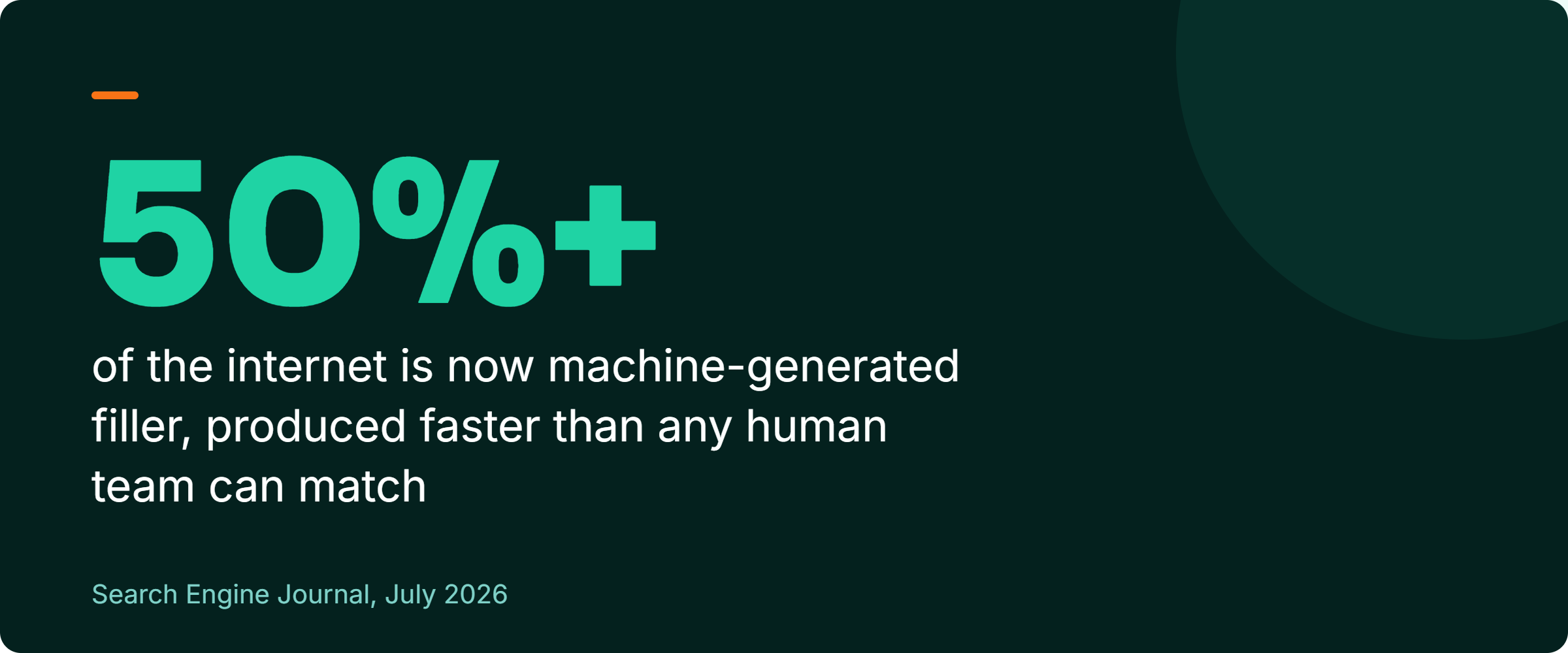
The index is not thin anymore. It is drowning. More than half of the internet is now AI slop, machine-generated filler produced faster than any human team could ever match (Search Engine Journal, July 2026). When you tell a writer or a tool to "cover the topic," you are asking them to reproduce what already exists. A thousand other sites are now doing the exact same thing at machine speed. Your thorough, sensible, on-brief post is competing against an infinite supply of pages that are also thorough, sensible, and on-brief. Thorough stopped being a differentiator the moment thorough became free.
The Google content warehouse leak surfaced a signal called contentEffort, described in that same article as an LLM-based estimate of how much real effort went into an article. Google is spending compute to guess whether a machine could have produced your page in seconds. If it could, that is not a point in your favor. The whole system is being retooled to find the pages that took something a machine cannot fake, and to stop rewarding the ones that did not.
This is where owners get the diagnosis wrong. They see soft traffic and conclude they need more posts, faster. More posts is the disease, not the cure. I have written before about why a busy blog can still mean an empty pipeline. The root cause is almost always a calendar full of topics chosen because a competitor ranked for them, not because you had anything of your own to say about them.
Senior SEOs agree the page has to add something new
You do not have to take my read of a patent. The practitioners closest to this are saying the same thing in blunter language. Clarkson-Bennett's advice, from the same July 2026 piece, is the whole strategy in one sentence.
"Apply what we call information gain in this context to your own content, if you cannot add anything of value to the existing index, then don't bother."
Harry Clarkson-Bennett, SEO Director, The Telegraph, in Search Engine Journal, July 2026.
Do not bother. From a senior SEO at a national newspaper, that is as direct as this industry gets. He puts a number on how little separation you need, and it is smaller than you would guess. As little as a 10% difference in your content, he argues, could be the delineator between marketing success or failure. Ten percent. You do not need to reinvent the subject. You need one honest tenth of the page that is genuinely, verifiably yours.
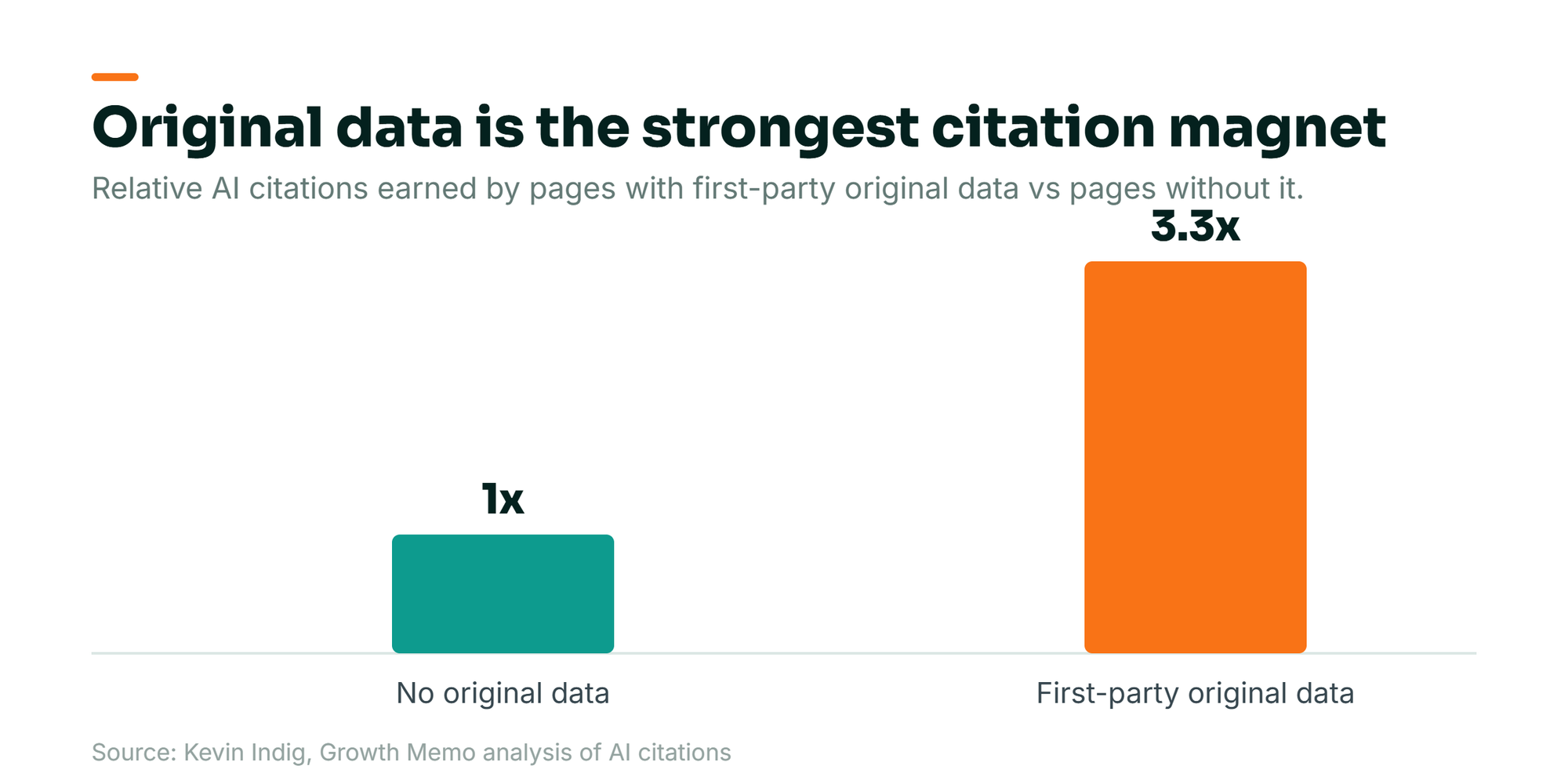
What fills that ten percent? Data nobody else has. Kevin Indig's Growth Memo analysis found that first-party original data is rare in AI citations, and pages that carry it earn roughly 3.3 times more citations than pages that do not. Original data was the single strongest predictor of a page reading as original. Three and a bit times the citations, from data your competitor cannot copy because they did not run your business. That is the return on saying something only you can say.
Duane Forrester, quoted in Search Engine Journal on July 13, 2026, framed the stakes for anyone still publishing summaries of common knowledge.
"If your content can be fully replaced by a summary, it has no moat. The summary becomes the product, and your page becomes the raw material that someone else's system processes and discards."
Duane Forrester, quoted in Search Engine Journal, July 2026.
Raw material that gets processed and discarded. If your page is a restatement of what is already known, an AI answer will absorb the useful part and never send the reader to you. This is already the norm, not a forecast. Rand Fishkin's SparkToro analysis of Similarweb clickstream data found that 68.01% of US Google searches ended without a click in the first four months of 2026. Most searches never send anyone to any website at all. Roughly two of every three searches end on the results page. A page whose only job was to summarize the obvious was competing for a click that increasingly does not exist. The citation gap above is the core of the fuller case I have made for why you should publish your own proof before an AI fills the gap with someone else's.
Run the go/no-go test before you write a word
You do not need to understand patents to act on this. You need a filter you can run in two minutes, before anyone spends a dime writing. This is the one I give clients.
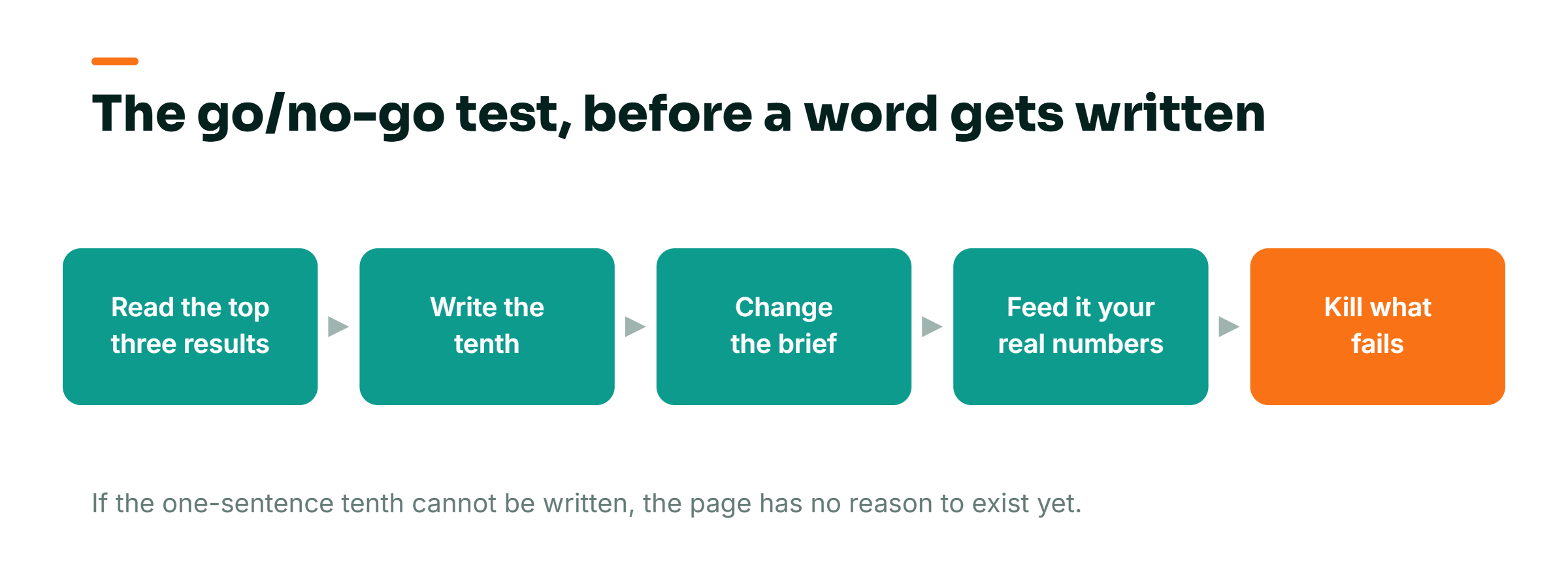
Step one, name the top three results. Before you commission the post, actually search the query and read the three pages already ranking. Not the titles. The pages. Ask the only question that matters: if a customer read those three, what would they still not know that this business can answer? Write that answer in one sentence. If you cannot, stop. The page has no reason to exist yet, and no amount of writing skill will give it one.
Step two, find your tenth. That one sentence is your ten percent, and it has to be something only you have. A real number from your own jobs. A first-hand result you can stand behind. A client story with a specific outcome. A price nobody else publishes. If you are a physio clinic, the difference between a page that gets shown and one that gets dropped is stark. A generic "benefits of physiotherapy" post reads like ten others and scores near zero for new information. A page reporting your own average recovery times across 200 real patients, broken down by injury, is a page no competitor can reproduce, because they do not have your 200 patients. Same topic. One is raw material to be discarded. The other is the source everyone else has to cite.
Step three, decide who does it, and change the brief. If you write in-house, the rule is one sentence long: no post goes live without a fact we know that the top three results do not. If an agency writes for you, ask them a single question at your next call and watch how they answer it. "For each post this month, tell me the one proprietary fact or number that makes it different from what already ranks." An agency running the 2019 playbook will get vague and start talking about keyword volume and word count. A good one will ask you for your data, because they know that is the only part of the page a machine cannot fake.
Step four, feed the machine what it cannot generate. Your invoices, your job records, your before-and-after numbers, your pricing, your close rates, the questions your customers actually ask on calls. These are assets you already own and almost never publish. This is the raw supply of information gain, and it is already in your inbox and your accounting software. One benchmark built from your own numbers will out-earn a stack of topic posts, which is the whole argument behind why a single benchmark beats fifty blog posts in AI search.
Step five, kill the ones that fail. The hardest step for most owners. When a planned post cannot pass step one, do not soften it and publish anyway. Cut it. A page that scores zero for new information does not just fail to help. It spends your budget and adds one more thin page to a domain, and Google forms an impression of your whole site from the pages on it. An empty slot in the calendar beats a page built to be discarded.
Measure whether pages earn, not whether they exist
Watch the wrong number here and you will keep funding the exact pages this test is designed to stop. The trap is counting output. Posts published this quarter. Total word count. Number of keywords "targeted." None of those tell you whether a single page added anything or earned a single customer. They only tell you how much you spent. Grading content by raw traffic alone misleads you as well, in a market where most searches never produce a click.
Measure outcomes instead, and give them time. First, per page, does it get cited or referenced anywhere it did not before: pulled into an AI answer, quoted by another site, sent around by a customer. That is the signal that your ten percent registered as new. Second, over a full quarter, which specific pages generated an actual inquiry, a call, a booking. Tie the outcome to the page, not to the blog as a blob. Third, the ratio that tells you if the test is working at all: of the pages you published, how many carried a proprietary fact, and did those outperform the ones that did not. If your data pages consistently pull ahead, you have your answer, and your content budget just found its floor.
Give it a quarter, not a week. Information gain compounds slowly because it depends on Google and AI systems re-encountering your pages and learning that this domain is where the numbers come from. The owners who lose patience at week three and pad the calendar with filler undo the work that was starting to pay off. This connects to a wider shift I keep pushing clients toward: treating content as a non-commodity asset AI search cannot ignore, instead of a monthly quota of interchangeable posts.
Clarkson-Bennett has a line for the owner worried that this means competing with bigger players on every subject. It does not.
"Stay in your lane, but drive a nicer car."
Harry Clarkson-Bennett, in Search Engine Journal, July 2026.
You do not have to out-publish anyone. You have to be the one page in your lane carrying the real numbers.
Frequently Asked Questions
How do I know if my page adds anything new before I publish it?
Search the exact query and read the three pages already ranking, all the way through. Then write one sentence naming what a customer would still not know after reading those three that your business can answer. If you can write that sentence and back it with your own number, result, story, or price, publish. If the sentence is vague or you cannot write it at all, the page adds no new information and should not go live yet.
Will Google actually drop my page for being too similar to others?
Google scores pages on information gain, described in its own patent as a measure of what a page adds beyond documents the reader has already seen, on a scale of 0 to 1. A page scoring 0 adds no new information. It becomes a candidate to be demoted or dropped from that reader's next set of results. It is not a manual penalty. The page just quietly stops appearing, because it repeats what the reader already got elsewhere.
What counts as proprietary data if I run a small business?
Things you already own and rarely publish. Average results across your own past jobs or clients, your real pricing, your close rates, before-and-after numbers, and the specific questions customers ask you on calls. A physio clinic reporting recovery times from 200 real patients has data no competitor can copy. You do not need a research budget. You need to publish the numbers already in your invoices and job records.
Go look at the last five posts you paid for. For each one, try to write the sentence: this page knows something the top results do not. If you can write it for five out of five, keep doing exactly what you are doing. If you can write it for one, you now know where the rest of the money went. The fix was never to write more. It was to have something to say, and to stay quiet when you don't. If you want a second set of eyes on which of your pages carry a real moat, book an AI visibility call. We will run the test on your archive together and spot the ones being discarded.