Your SEO Metrics Are Lying to You: The Attribution Gap
AI answers now influence buyers your analytics never records. Five cheap, delegate-able instruments that show what search really contributes.

Your analytics dashboard is confidently wrong. It tells you organic search drove a certain number of visits and a certain number of sales, and somewhere in a budget meeting that number decides whether SEO gets funded next quarter. The problem is that an entire layer of search influence, AI answers, zero-click research, and chatbot recommendations, never shows up in that report. You are making revenue decisions with a measurement system built for a search behavior that no longer describes how your customers actually buy.
The same gap misleads owners about their content. Google organic traffic is falling for almost every site and a sliding traffic line looks like a failing blog. Read it that way and you will delete pages that still close deals.
The attribution gap is real, and it is growing
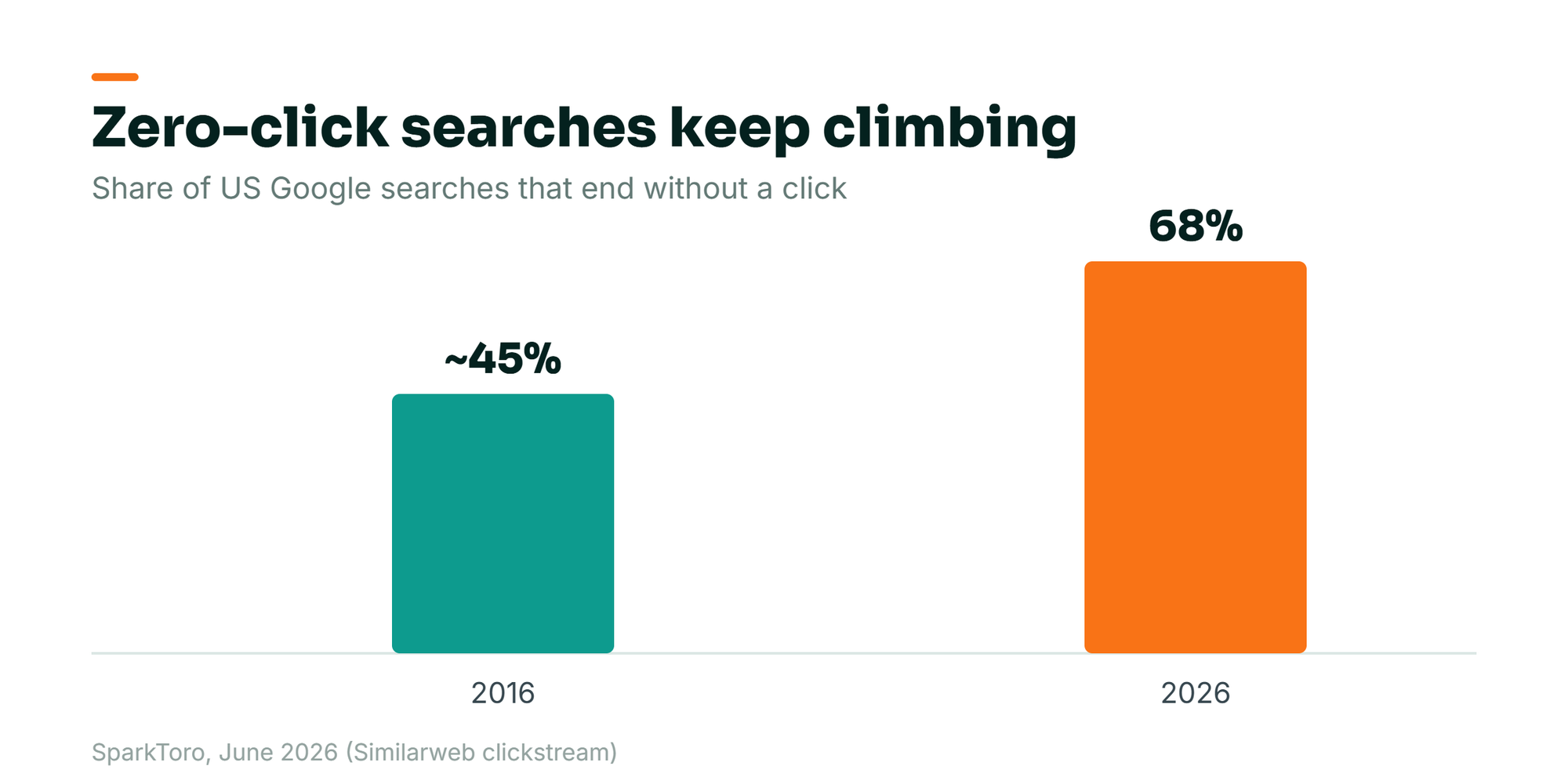
Start with what never reaches your site at all. Rand Fishkin of SparkToro, using Similarweb clickstream data, reported on June 8, 2026 that 68.01% of US Google searches between January and April 2026 ended with no click to any website. SparkToro's figures put that share at roughly 45% in 2016.
Google also sends a smaller share of the clicks that do happen. SparkToro, citing the Ahrefs "ChatGPT vs Google" tracker in June 2026, found that Google's referral share to more than 75,000 tracked domains fell about 8 percentage points from June 2025 to May 2026. That is roughly a 22% drop in a single year.
Pew Research Center studied real US browsing behavior. When an AI summary appeared on a results page, users clicked a traditional result on only about 8% of visits, against 15% when no summary appeared. The research and the influence both happened on Google's page, where your analytics cannot follow.
Now add the traffic that does reach your site but gets filed under the wrong source. When someone asks ChatGPT for a recommendation, gets your brand, and then types your URL or Googles your name, your analytics calls that "Direct" or "Branded Organic." It has no idea an AI made the introduction. Even actual clicks from AI tools often arrive stripped of referrer data, because of how the apps handle links. Analyses by AI analytics vendors such as Loamly estimate that the large majority of AI-driven visits, on the order of 70%, end up in the Direct bucket. There they are indistinguishable from people who already knew you.
What this means for your business: search, in its new AI-mediated form, is influencing more purchase decisions than ever while reporting fewer of them. The channel looks like it is dying in your dashboard at the exact moment it is changing shape. Businesses are cutting search investment based on numbers that systematically undercount it.
Why your reports get it wrong
The mechanism is worth understanding, because once you see it you stop trusting last-click reports on instinct.
Web analytics attributes a sale to the last measurable touchpoint before it. That model was always a simplification, but it was a tolerable one when the buying journey ran through clickable links that passed referrer information. AI search breaks every assumption in that chain. The research phase happens inside a chat window your analytics cannot see. The recommendation happens in generated text with no tracking parameter. The user often does not click at all; they copy a name, close the app, and come back later on another device. Each of those behaviors either creates no record or creates a misleading one.
There is also a structural quirk: AI assistants compress the consideration phase. Semrush's clickstream research found that by the time an AI search user reaches a website, they have usually already compared options and absorbed the value proposition inside the conversation. The visible session is short, late, and looks low-effort in your data, while the heavy lifting happened off the books. Your dashboard sees a one-page visit that converts and calls it Direct. What actually happened was a twenty-minute AI research session you never witnessed.
Meanwhile the metrics that feel rigorous keep pointing backward. Rankings tell you where you appear in a list fewer people scroll. Sessions count clicks in a behavior pattern with fewer clicks. Fishkin titled his widely shared essay "In a Zero-Click World, Traffic is a Terrible Goal." The people search influences most are now the least likely to show up as search visitors. In that setting, optimizing to the visible number actively steers you wrong.
What the data actually shows about invisible search value
The verified numbers tell a consistent story: the AI-touched buyer is scarcer in your reports and richer at the register.
Semrush's study of AI search traffic found that an AI search visitor is on average 4.4 times as valuable as a traditional organic search visitor, measured by conversion outcomes. Their clickstream data showed ChatGPT referrals converting at dramatically higher rates than classic organic visits, and outbound referral traffic from ChatGPT to the wider web grew 206% over 2025.
Adobe Analytics, measuring US retail at enormous scale, found traffic to retail sites from generative AI sources grew 693% year over year during the 2025 holiday season. Those AI-referred visitors converted 31% more than other traffic sources, with revenue per visit up sharply. Early in 2025 AI traffic actually converted worse than average; by the holidays that had fully reversed. The channel matured from curiosity to purchase path within a single year, which is exactly the kind of shift a static measurement setup misses.
The sharpest single example comes from a company measuring its own front door. Patrick Stox of Ahrefs reported on June 16, 2025 that visitors arriving from AI search were just 0.5% of Ahrefs' traffic but drove 12.1% of its signups. That is roughly 23 times the conversion rate of its traditional organic visitors.
Treat the 23x as one company's result on its own site. It proves the pattern exists. For your own forecast, the Semrush and Adobe figures above are the safer benchmarks.
On the zero-click side, Seer Interactive's analysis of 25.1 million organic impressions found click-through rates fell 61% on queries where an AI Overview appears, measured June 2024 through September 2025. Seer's 2026 update records a partial rebound, which changes the size of the drop, not the lesson. But the same study found brands cited inside the AI Overview earned 35% more organic clicks than uncited brands on those queries. Influence did not disappear. It relocated to the citation, where most companies are not measuring anything.
And the experts who study retrieval systems argue measurement has to follow the machinery. Mike King of iPullRank was Search Engine Land's 2025 Search Marketer of the Year. He has documented how Google's AI Mode fans a single question out into many sub-queries and assembles an answer from sources the user never sees listed. A buyer can be won or lost inside that assembly process. No ranking report, and no traffic report, captures it.
Put the pieces together and the attribution gap has a shape. Recorded search visits fall, the Direct bucket swells with AI-referred buyers, and conversion-heavy traffic gets credited to everything except the channel that earned it. If you reduced SEO spend last year because "organic is down," there is a real chance you cut the most productive influence channel you had, based on its least accurate report.
How a non-technical owner can close the gap
You do not need a data science team. You need a few honest instruments and the discipline to read them together.
First, separate AI referral traffic in your analytics. An Ahrefs study of 3,000 sites by Louise Linehan and Xibeijia Guan, published February 6, 2025, found that 63% of websites already receive some AI traffic. Patrick Stox of Ahrefs explained where much of it ends up:
"We report whatever referrer we're told to report. If they don't send us one, then it would go in the 'Direct' bucket."
Have whoever manages your GA4 build a custom channel group that captures visits from chatgpt.com, perplexity.ai, gemini.google.com, claude.ai, and copilot.microsoft.com. The same Ahrefs study found that 98% of AI traffic comes from ChatGPT, Perplexity and Gemini, the first three on that list. ChatGPT now appends a tracking tag (utm_source=chatgpt.com) to many of its outbound links, which makes this easier than it was a year ago. This is an afternoon of work. It will undercount, because referrer stripping still hides much of the traffic. It still turns an invisible channel into a measurable floor and you can watch its conversion rate against the Semrush and Adobe benchmarks.
My own site runs GA4 through Google Tag Manager. The booking finishes on cal.com, where my analytics cannot follow. The event I judge the site by is the click on my booking link. A separate tracker logs whether AI assistants mention or cite the site across repeated runs. Building the AI channel group from the step above is the next job in that setup.
Second, ask every lead how they found you. Add a required "How did you hear about us?" field to your forms, with "ChatGPT or another AI assistant" as an option. It is the cheapest attribution technology ever built. Fairing's LLM Product Discovery Benchmarks for Q2 2025, drawn from answers to that exact question, found that 69.4% of transactions had no identifiable last-click source. For roughly seven in ten sales, analytics cannot say what earned the order. The buyer's own answer is often the only signal you get.
The same benchmark found that customers naming an AI tool rose more than 10x from January to mid-July 2025. About 1 in 7 brands had seen at least one such mention by July 2025. Self-reported attribution is imprecise, but it catches exactly the journeys analytics cannot: the copy-paste visit, the cross-device return, the AI recommendation remembered for a week. Sales teams should log the answer in the CRM so you can compare close rates by source. If you take bookings by phone, have whoever answers ask the same question and tick a box.
Third, monitor your AI visibility directly. The new upstream metric is whether AI systems mention and cite you when buyers ask the questions that precede a purchase in your category. Have someone run your 20 most commercially important questions through ChatGPT, Perplexity, Gemini, and Google's AI features monthly, and record whether you appear, what is said, and who appears instead. Dedicated tracking tools exist if you want scale, but a disciplined manual log answers the core question: are we in the answer or not?
Fourth, treat branded search and Direct as outcome metrics. People who meet your brand inside an AI answer verify you afterward. Growth in branded impressions in Google Search Console, and unexplained growth in Direct traffic, are now downstream evidence of search influence. Annotate the dates of campaigns and PR placements, then watch whether branded demand moves in the following weeks. You are reading the wake of the boat and the wake is real data.
Fifth, judge search by its blended contribution. Fishkin's instruction in June 2026 was direct:
"Replace traffic as a KPI for your digital marketing efforts. Build a correlation dashboard instead."
Once the first four instruments run, review them as one panel each month: AI referral conversions, self-reported AI and search attribution, AI visibility share, branded demand, and classic organic revenue. Decide on the panel as a whole. If you have an analyst, ask for simple pre-and-post comparisons around major initiatives. Perfect attribution no longer exists. The panel stops the one metric you can measure precisely from overruling the four that describe reality.
Once a quarter, go one step further. Sort your closed deals by source, then by value. A channel with few visits and large jobs only shows up in that sort.
Before you cut a page because its traffic fell
This gap does its worst damage during content cleanups. An owner sees a post's Google traffic sliding, calls it dead weight and deletes it. Organic sessions are falling for almost everyone as zero-click searches climb past 68%. A drop on one post may only mean the search page changed. It can also mean the post has aged and needs a refresh. Traffic alone cannot tell you whether the page still persuades buyers.
Grade the page by the revenue it drives before you delete anything. Match it against your lead-source answers and your closed deals. Then check whether the buyers who paid you ever read it. A traffic source can bring 0.5% of visits and 12.1% of signups, as the Ahrefs numbers above show. One page can do the same, with few visitors and a large share of your best clients.
If the buyers behind your biggest deals read the page on their way in, keep it and refresh it. Cut a page when it fails on revenue as well as traffic, or merge it when another page already answers the same question. The full cleanup process is in my guide to refreshing and pruning content that has decayed.
What to measure, and when to expect the picture to clear
Set expectations by instrument. The GA4 channel group and the lead-source field produce data immediately, but you need 60 to 90 days of accumulation before the patterns are trustworthy, especially if your lead volume is modest. The AI visibility log shows movement within one to three months of any serious content or PR push, because AI systems refresh their sources continuously. Branded search trends need a quarter to separate signal from noise. Within six months you should be able to answer, with evidence, the question your dashboard currently answers with fiction: what does search, in all its forms, actually contribute to revenue?
Give the numbers below a standing slot in your monthly review, all on one page:
Retire the vanity traps explicitly, because they die hard. One test sorts every number in your reports: does this number connect to a decision or a dollar? A metric earns its place when it changes what you do or maps to revenue. A visibility score that floats from 62 to 64 and back, with no action attached and no money traceable to it, is a comfort blanket.
Total organic sessions will keep sliding as informational clicks evaporate and that slide says very little about revenue. Keyword rankings without click and citation context are decorative. Search Console's new AI report adds a fresh trap, because it shows impressions and no clicks. I explain how to read it in why AI impressions are not bookings. Most of all, beware the soothing precision of last-click ROI dashboards. A number can be exact and wrong at the same time and exact-and-wrong is more dangerous than fuzzy-and-right because nobody questions it.
Attribution is one part of a larger picture, which I map in my AI search visibility guide. Measurement is also stage four of the loop in my content strategy playbook, if you want the whole system in one place.
Frequently Asked Questions
Is my content failing if my Google organic traffic is dropping in 2026?
Probably not, and the drop alone cannot tell you. SparkToro reported in June 2026 that 68.01% of US Google searches between January and April 2026 ended with no click to any site. Google's referral share to more than 75,000 tracked domains also fell about 22% from June 2025 to May 2026. The search page changed for everyone. Before you judge a post, check your leads, your lead-source answers and your Direct traffic, and see whether the buyers who closed ever read it.
If AI traffic is hidden in my Direct bucket, how do I know it is really there?
Triangulate. Compare your Direct traffic trend against two years ago: if it is growing without a matching investment in brand advertising, something is feeding it. Cross-reference with your lead-source form data, because leads who self-report finding you through ChatGPT, paired with rising Direct numbers, are strong evidence. Also watch the behavior of Direct visitors: AI-referred buyers tend to arrive on specific deep pages, move fast, and convert well, because their research happened before arrival. You will never get a precise count, but three independent signals pointing the same way is enough to act on.
Should I stop reporting rankings and traffic to my leadership team entirely?
Not entirely, but demote them. Rankings and organic sessions are still useful diagnostics for technical health and content performance on the queries that do produce clicks, especially transactional and local ones. The mistake is presenting them as the scoreboard for search's business contribution. Lead with the blended panel: AI visibility, AI referral conversions, self-reported attribution, branded demand, and search-influenced revenue. Keep rankings in an appendix. The reporting hierarchy you present is the strategy your team will optimize for. Put the revenue-shaped metrics on top.
The companies that come through the next few years well will not be the ones with the prettiest dashboards. They will be the ones who accepted early that search influence went partly dark and built rough instruments to estimate it. They kept investing where the evidence pointed while competitors defunded a channel their analytics could no longer see. Your metrics are not lying maliciously. They are answering an outdated question. Start asking the current one.
If you want help reading your own numbers, book a free AI visibility call. I will show you where your search influence is hiding and which instrument to set up first. Plain English, no pitch.