Content Strategy for Business Owners: The Full Playbook
Most owners have a posting schedule, not a strategy. This is the five-stage loop that turns content into customers, and where each stage goes wrong.

Most business owners who tell me they have a content strategy actually have a posting schedule. Somebody publishes something every week or two, the blog looks alive, and nobody can point to a single customer it produced. If that stings a little, good. It stung the owners I have said it to across 17 years in this work, and it was the moment things started to change for them.
A content strategy is not a calendar. It is a set of five decisions, made in order, that turn what you publish into customers. You decide what to write, how to make it worth trusting and how people will find it. Then you decide how you will know it paid and what you will do with it as it ages. Miss any one of the five and the other four stop working. A busy blog next to an empty pipeline is the usual result.
This page is the whole loop in one place. I have written a full post on each stage, and I will point you to them as we go. Treat this as the map and those as the turn-by-turn directions.
What a content strategy actually is
Strip the jargon away and a content strategy answers three questions in plain English. Who exactly are you trying to reach, and what do they need to believe before they will pay you? What can you publish that they cannot get from a hundred other sites? And how does each piece move someone closer to picking up the phone?
Notice what is not in there. No publishing frequency. No word counts. No being everywhere at once. I have helped more than 300 businesses over the years, and I can tell you the ones that win with content are almost never the ones that publish the most. They are the ones where every piece has a job, and the owner can name it.
The math behind that is brutal and worth facing early. Ahrefs studied over a billion pages and found that 96.55% of them get zero traffic from Google. Publishing more of what everyone else publishes does not beat those odds. Deciding better does.
This is the loop I run with owners: decide, create, distribute, measure, maintain. Five stages, each one feeding the next.
Stage 1: Decide what deserves to be written
Everything downstream inherits the quality of this decision. Pick a topic your buyers do not care about and no amount of good writing, promotion, or measurement will rescue it.
The mistake almost everyone makes here is chasing search volume. A big number in a keyword tool feels like opportunity, but volume tells you what is popular, not what is yours, and the biggest numbers usually belong to searchers who will never hire you. The better filter is overlap: real demand from buyers, something only you can add, and a realistic shot at being the answer. Twenty searches a month from people ready to spend beat eight thousand from people hunting a free tutorial.
I wrote a full breakdown of how to choose blog topics that feed the pipeline instead of the pageview counter, including the napkin test I use to score ideas before a word gets written. Start there if your blog is busy and your bank account has not noticed.
Stage 2: Create something only you could publish
Once a topic earns its place, the job is to make the piece impossible to swap for a competitor's. I call the failure mode commodity content: the same advice, the same structure, the same recycled statistics, with a different logo at the top. Google has been demoting it for years, and AI systems skip it entirely. A model that has read everything has no reason to cite a page that repeats what it already knows.
The fix is to put things in your content that only exist because you did the work. Your real numbers. Your named process. The pattern you noticed across a decade of customers. The job you turned down and why. I broke down how to build non-commodity content AI search cannot ignore. Separately, I covered which content formats AI actually cites, because the format you pick decides whether machines can use you as a source at all.
And once you know what to say, structure matters more than style. Clear questions as headings, direct answers underneath, one idea per section. A human skimming on a phone and a machine lifting an answer both get what they came for. There is a specific way to structure content so that it gets cited. It takes discipline more than writing talent.
Stage 3: Get every piece in front of buyers
This is the stage owners skip most. Hitting publish does not put your content in front of anyone. It parks it in a garage and waits for traffic that mostly never comes. The practitioners who win treat promotion as half the work, sometimes more, and they decide where a piece will travel before they write it.
Distribution is not bragging. It is finishing the job. Send the piece to your list. Break it into the answer you give when a customer asks that exact question. Bring it to the communities and forums where your buyers already gather, which increasingly means showing up where Reddit and the forums rank instead of trying to outrank them. I laid out the whole system in why publishing is not distribution, including the five-places rule: if you cannot name five places a piece will travel, it is not ready to be written.
Stage 4: Measure what content earns
Traffic is the number everyone watches and the number that lies the most. It counts strangers and buyers as equal. It goes down while business goes up, especially now that AI answers siphon the casual clicks and send you fewer, warmer visitors. If you grade content by sessions alone, you will kill the pieces that book calls and feed the ones that collect tourists.
The honest scoreboard connects content to money: calls booked, forms filled, quotes requested, and which pages the people who became customers actually read. You can do all of it without an enterprise analytics stack. What it takes is a decision that revenue is the report card. I laid out the setup, from the lead-source field to the monthly panel, in how to close the attribution gap in your SEO metrics. This is the stage where my data-first habit earns its keep. I do not guess, and I do not let a dashboard guess for me.
Stage 5: Maintain the library you already paid for
Content decays. Rankings slip, screenshots age, prices change, and a post that earned customers in 2024 quietly stops pulling its weight while you are busy writing new things. Most owners never look back at all. Their best growth lever goes unused. Updating a proven post is routinely cheaper and faster than launching a new one, and the lift is not subtle. HubSpot's own team measured an average 106% increase in organic search views on posts they updated and republished.
The discipline is a quarterly hour with your library: refresh what is fading but proven, prune what is dead weight, and leave the winners alone. I wrote the full refresh and prune routine with the exact decision rules. You will never have to guess which of the three to do.
How AI search changes every stage
Everything above would have been true in 2019. What changed is the reading layer. Your buyers now ask ChatGPT, Gemini, and Google's AI results the questions they used to type as keywords, and those systems answer by reading, choosing, and citing sources. I have spent the past three years studying exactly how they read, choose, and cite. The five stages still apply. The AI layer raises the price of doing them badly.
Commodity topics get answered without you. Unsupported claims get skipped in favor of pages that show receipts. I tell owners to publish verifiable proof before AI fills the gap with whatever it finds elsewhere. Distribution now includes being mentioned in the places AI systems trust. Measurement now includes asking the assistants your customers use whether they name you at all. Same loop, higher stakes.
Picture your own business
Say you run a kitchen remodeling company. Eight jobs a month, most from referrals, and a blog full of posts like "kitchen trends 2026" that a marketing package produced for you. That is stage-one failure: trend searchers are browsing, not budgeting.
Run the loop instead. Decide: your buyers' real questions are about cost surprises, timelines, and living through a remodel. You write "What a $60,000 kitchen actually buys in 2026" using your last twenty jobs as the data. Create: no one can copy that post, because no one else has your job files. Distribute: it goes to your email list, your sales conversations, the two local Facebook groups where homeowners compare contractors, and the Reddit thread asking exactly that question. Measure: you track quote requests that mention the post, not pageviews. Maintain: every January you update the numbers, and the post compounds instead of expiring.
One post. Every stage doing its job. That is a content strategy, and it is why a 15-post library built this way beats a 200-post archive built on autopilot. It is the same pattern behind the ADHD clinic in London I helped book solid for three straight months: visibility aimed at the right people, proof they could trust, and a clear next step. Demand got so strong they hired more specialists and sent overflow to partner clinics.
Your first 90 days
You do not need a team to start. You need about three focused hours a week and the discipline to move in order.
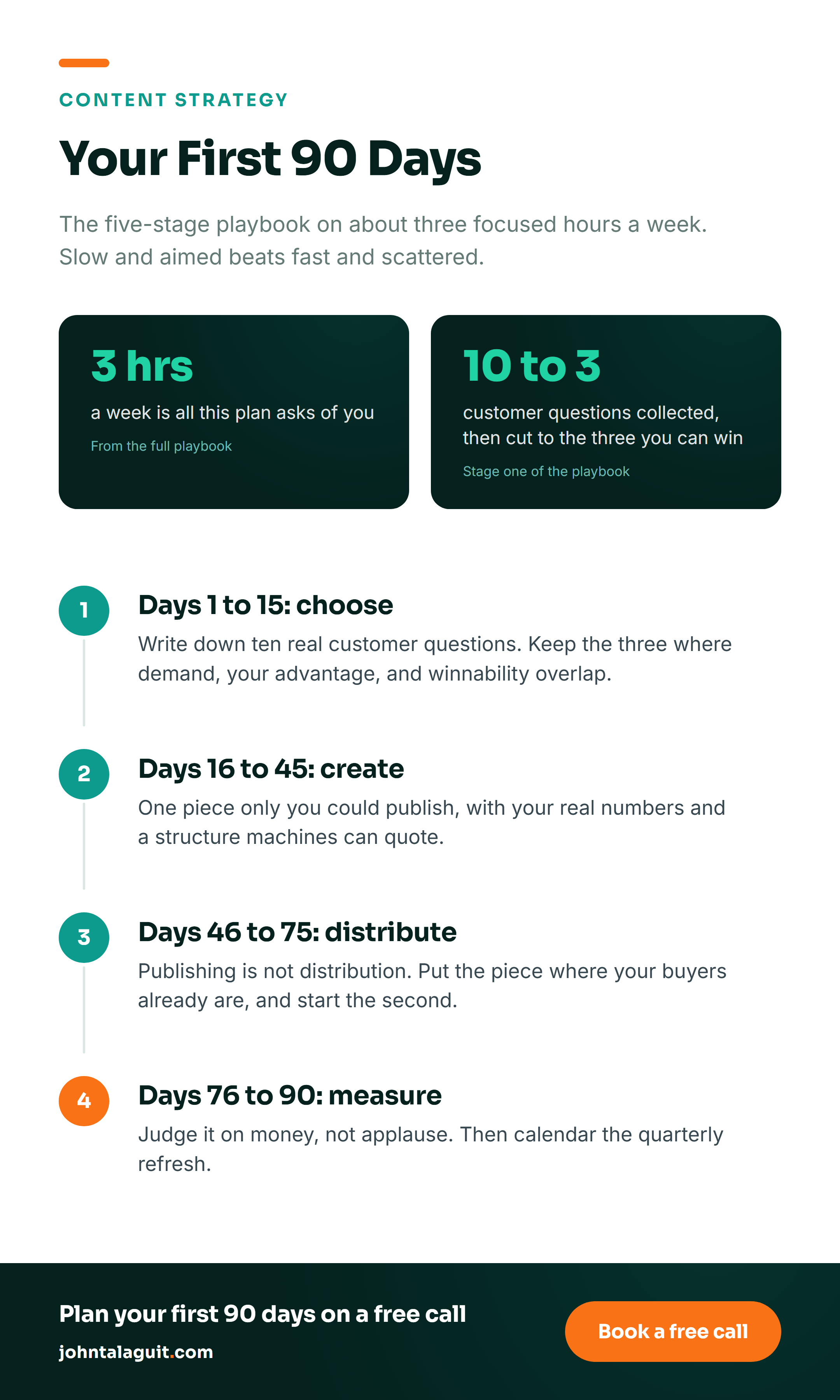
Days 1 to 15: write down the ten questions customers actually ask you, in their words. Pick the three where demand, your unfair advantage, and winnability overlap. Days 16 to 45: produce the first piece properly, with your real numbers and a structure machines can quote. Name the five places it will travel before you draft it. Days 46 to 75: publish and distribute the first piece, start the second, and set up the money metrics so results have somewhere to show up. Days 76 to 90: review what the first piece earned, adjust, and put a quarterly refresh date on the calendar for everything you have published so far.
Free download
The 90-Day Content Strategy Checklist
Your first 90 days from this playbook as a printable plan, on about three focused hours a week.
- Four calendar windows from choose to measure
- Two actions per window you can schedule today
- The ten-questions-to-three selection filter
That pace feels slow until you compare it to the alternative: another year of weekly posts no customer asked for. Slow and aimed beats fast and scattered, every time I have measured it.
And if you want a partner on it instead of running it alone, that is literally the work I do with owners in my content strategy service. We go from picking the topics to proving the revenue.
Frequently Asked Questions
How many posts do I need before content starts bringing in customers?
Fewer than you think, if they are chosen well. I have watched a single well-aimed post outproduce a hundred generic ones, because it answered a question real buyers ask at the moment they are ready to spend. Plan on a small library of deep pieces, somewhere between 10 and 20, each mapped to a question that shows buying intent. Volume only helps after the aim is right, and it never fixes bad aim.
Can I run a real content strategy with only a few hours a week?
Yes, and most of my clients do. Three focused hours a week covers one deep piece a month, real distribution for it, and a quarterly refresh pass on your library. What you cannot do in three hours is publish weekly and promote everything everywhere. Do not try. Cut volume before you cut distribution or maintenance, because an unseen post is worthless and a decaying library leaks customers you already earned.
Is blogging still worth it now that AI answers most questions?
Blogging is worth more now, but the job changed. Generic explainer posts are dead, because AI answers those questions directly and nobody clicks through. What works now is content only you could publish: your data, your process, your proof. That is what AI systems cite when they recommend businesses, and it is what convinces the warmer, fewer visitors they send you. Write less, make it verifiable, and measure it in customers instead of clicks.
If you want an honest read on where your content actually stands, book a free AI visibility call and I will walk you through what I would fix first, in plain English, no pitch. Worst case, you leave with a shorter to-do list than the one you have now.